


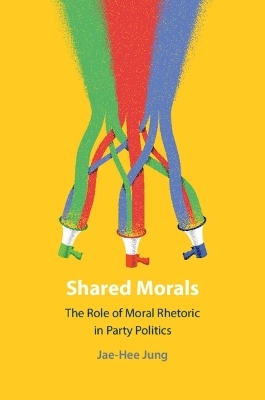
Shared Morals
The Role of Moral Rhetoric in Party Politics
Seiten
2026
Cambridge University Press (Verlag)
978-1-009-66792-0 (ISBN)
Cambridge University Press (Verlag)
978-1-009-66792-0 (ISBN)
- Noch nicht erschienen (ca. Februar 2026)
- Versandkostenfrei
- Auch auf Rechnung
- Artikel merken
People often use moral judgements about right and wrong when thinking about politics. Political parties appeal to those moral considerations when talking to voters. This book provides academics, journalists, strategists, and general readers with a comprehensive analysis of moral rhetoric, its uses, and the goals it serves in democratic politics.
Political parties often use moral arguments—judgements about fundamental notions of right and wrong—to frame and explain their political views. Morality is an aspect of politics that people are regularly exposed to in real life. But what role does moral rhetoric play in party politics? And how does it shape our views? Focusing on Western democracies, Shared Morals examines what moral rhetoric looks like, how it affects voters, and how it is relevant for democratic representation. Drawing from studies on party competition, political behavior, and moral and political psychology, the book illustrates that moral rhetoric is an integral aspect of party communication. Yet, unlike many current narratives in the scholarly and policymaking worlds, Shared Morals draws attention to the potential for moral rhetoric to highlight common grounds, bridge differences, and bring people together.
Political parties often use moral arguments—judgements about fundamental notions of right and wrong—to frame and explain their political views. Morality is an aspect of politics that people are regularly exposed to in real life. But what role does moral rhetoric play in party politics? And how does it shape our views? Focusing on Western democracies, Shared Morals examines what moral rhetoric looks like, how it affects voters, and how it is relevant for democratic representation. Drawing from studies on party competition, political behavior, and moral and political psychology, the book illustrates that moral rhetoric is an integral aspect of party communication. Yet, unlike many current narratives in the scholarly and policymaking worlds, Shared Morals draws attention to the potential for moral rhetoric to highlight common grounds, bridge differences, and bring people together.
Jae-Hee Jung is an Assistant Professor in the Department of Political Science at Rice University. Her research focuses on party politics, political behavior, and political psychology in the context of democracies. She is the co-author (with Margit Tavits) of Counter-Stereotypes and Attitudes Toward Gender and LGBTQ Equality (2023).
1. Introduction; 2. Moral rhetoric in party communication; 3. Does moral rhetoric mobilize the party base?; 4. Does moral rhetoric persuade non-supporters?; 5. Moral rhetoric as moral representation; 6. Conclusion; References; Index.
| Erscheint lt. Verlag | 28.2.2026 |
|---|---|
| Zusatzinfo | Worked examples or Exercises |
| Verlagsort | Cambridge |
| Sprache | englisch |
| Gewicht | 250 g |
| Themenwelt | Geisteswissenschaften ► Psychologie ► Sozialpsychologie |
| Sozialwissenschaften ► Politik / Verwaltung ► Vergleichende Politikwissenschaften | |
| ISBN-10 | 1-009-66792-0 / 1009667920 |
| ISBN-13 | 978-1-009-66792-0 / 9781009667920 |
| Zustand | Neuware |
| Informationen gemäß Produktsicherheitsverordnung (GPSR) | |
| Haben Sie eine Frage zum Produkt? |
Mehr entdecken
aus dem Bereich



aus dem Bereich
ein Praxismanual zur Unterstützung von Menschen in herausfordernden …
Buch | Hardcover (2023)
Springer Fachmedien Wiesbaden GmbH (Verlag)
CHF 69,95
Handbuch für Therapeuten und Coaches
Buch | Softcover (2025)
Karl F. Haug (Verlag)
CHF 89,95


