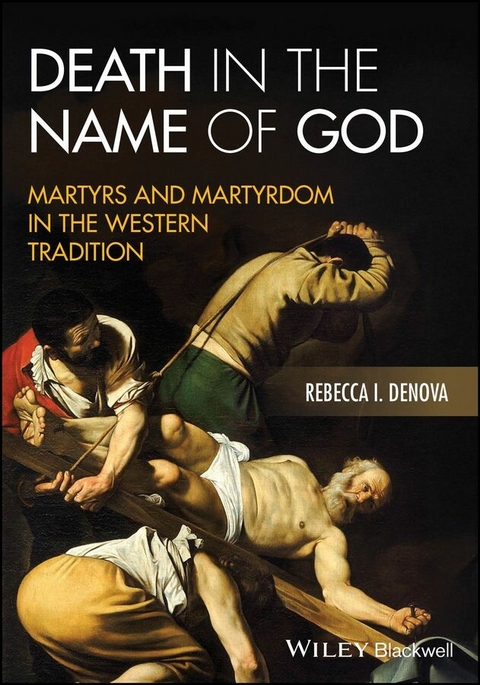
Death in the Name of God (eBook)
827 Seiten
Wiley-Blackwell (Verlag)
978-1-394-25293-0 (ISBN)
Explores the evolution of martyrdom across Judaism, Christianity, and Islam
Martyrdom has long been a defining concept in religious traditions, shaping the identities of faith communities and influencing theological thought across centuries. Death in the Name of God: Martyrs and Martyrdom traces the historical development of this powerful idea within Judaism, Christianity, and Islam, examining how cultural, social, and political contexts have influenced evolving interpretations of martyrdom. Through a multidisciplinary lens, noted scholar Rebecca I. Denova provides a comprehensive analysis of how each tradition adapted and redefined martyrdom in response to changing historical circumstances. By offering historical depth and critical examination, the author helps readers understand how martyrdom has been utilized to define faith, legitimacy, and religious authority in different eras.
An accessible yet rigorous study of the roots and transformations of martyrdom, Death in the Name of God features detailed historical context, primary source discussions, and thematic analyses. The book's three-tiered methodological framework-descriptive, comparative, and critical-guides readers through the role of martyrdom in shaping religious belief systems, including its origins in ancient traditions, its role in theological and political developments, and its continued significance in modern religious and social discourse.
An essential resource for understanding the enduring impact of martyrdom in Western religious thought, Death in the Name of God:
- Provides a multidisciplinary analysis of martyrdom through history, incorporating anthropology, sociology, philosophy, and religious studies
- Explores how martyrdom developed in response to shifting historical and cultural contexts
- Features sections that offer deeper insight into key topics such as the evolution of Satan and distinctions in martyrdom between Sunni and Shi'a Islam
- Examines how martyrdom transitioned from an act of deliberate sacrifice to a modern concept of victimhood and social struggle
- Includes timelines, figures, and archaeological findings to provide visual and historical context
Offering a non-theological, academic perspective that fosters objective discussion on a historically and politically charged topic, Death in the Name of God: Martyrs and Martyrdom is perfect for courses in Religious Studies, History, Theology, and Middle Eastern Studies. It is particularly well-suited for degree programs in the liberal arts and social sciences, offering foundational knowledge for courses on the history of Judaism, Christianity, and Islam, as well as broader discussions on religious violence and martyrdom in contemporary society.
REBECCA I. DENOVA is Emeritus Instructor in the Department of Religious Studies at the University of Pittsburgh, where she taught for over thirty years. Specializing in the religions of the ancient Mediterranean, she has published extensively on early Christianity, ancient Judaism, and Greco-Roman religious traditions. Her works include Greek and Roman Religions and The Origins of Christianity and the New Testament.
Explores the evolution of martyrdom across Judaism, Christianity, and Islam Martyrdom has long been a defining concept in religious traditions, shaping the identities of faith communities and influencing theological thought across centuries. Death in the Name of God: Martyrs and Martyrdom traces the historical development of this powerful idea within Judaism, Christianity, and Islam, examining how cultural, social, and political contexts have influenced evolving interpretations of martyrdom. Through a multidisciplinary lens, noted scholar Rebecca I. Denova provides a comprehensive analysis of how each tradition adapted and redefined martyrdom in response to changing historical circumstances. By offering historical depth and critical examination, the author helps readers understand how martyrdom has been utilized to define faith, legitimacy, and religious authority in different eras. An accessible yet rigorous study of the roots and transformations of martyrdom, Death in the Name of God features detailed historical context, primary source discussions, and thematic analyses. The book's three-tiered methodological framework descriptive, comparative, and critical guides readers through the role of martyrdom in shaping religious belief systems, including its origins in ancient traditions, its role in theological and political developments, and its continued significance in modern religious and social discourse. An essential resource for understanding the enduring impact of martyrdom in Western religious thought, Death in the Name of God: Provides a multidisciplinary analysis of martyrdom through history, incorporating anthropology, sociology, philosophy, and religious studies Explores how martyrdom developed in response to shifting historical and cultural contexts Features sections that offer deeper insight into key topics such as the evolution of Satan and distinctions in martyrdom between Sunni and Shi a Islam Examines how martyrdom transitioned from an act of deliberate sacrifice to a modern concept of victimhood and social struggle Includes timelines, figures, and archaeological findings to provide visual and historical context Offering a non-theological, academic perspective that fosters objective discussion on a historically and politically charged topic, Death in the Name of God: Martyrs and Martyrdom is perfect for courses in Religious Studies, History, Theology, and Middle Eastern Studies. It is particularly well-suited for degree programs in the liberal arts and social sciences, offering foundational knowledge for courses on the history of Judaism, Christianity, and Islam, as well as broader discussions on religious violence and martyrdom in contemporary society.
PREFACE
Most often associated with being an element of the ancient and medieval worlds, the concept of martyrdom became shockingly present in the modern world on September 11, 2001 with the bombing of the World Trade Center in New York and the Pentagon in Washington, DC. The members of the Islamist al Qaeda group who hijacked the planes were labeled terrorists by outsiders since they acted on their concepts of martyrdom.
The Merriam‐Webster Dictionary defines a martyr as (1) “a person who voluntarily suffers death as the penalty of witnessing to and refusing to renounce his/her religion”; (2) “a person who sacrifices something of great value and especially life itself for the sake of principle (a cause)”; (3) “a victim of great or constant suffering.”
Those who suffer “for the sake of a principle or cause” has become the modern concept of what we deem secular martyrs, most often associated with assassinated political leaders and those who die or who are killed for a social cause. Great or constant suffering now includes victims of domestic violence, sexual assault and abuse, social activists, and cancer sufferers. Secular, while distinct from religion, nevertheless incorporates social values that arose from religious traditions. These people's deaths are memorialized as a “sacrifice.”
The title of this book, Death in the Name of God: Martyrs and Martyrdom in the Western Tradition, reflects the emergence of concurrent elements that promoted martyrdom. Dying to defend the dictates of the God of Israel resulted in the reward of being transferred to Heaven in the afterlife. But killing the perceived enemies of God resulted in the same reward. This dual concept of death in the name of God continues to provide validation for violence by some participants in the Western traditions.
In the modern world, many people are convinced that religion breeds fanatics and absolutism, hence modern attempts to separate religion (private) from the state (public). Theorists have labeled violence and violent attacks motivated by religious views as arising from a human proclivity for what is described as “ultimate concerns.” Such ultimate concerns have very high stakes. There is a conviction that individuals and the world will not be saved, variously defined, unless there is obedience and conformity to a determined set of divine beliefs and behavior.
A second element of the dual nature of martyrdom is the word itself. From the Greek for “witness,” the original context was as a witness testifying in a court of law, testifying to the “truth.” The members of the martyr's community also serve as “witnesses” to the martyr's death and his/her claims concerning God.
The Purpose of This Textbook
Death in the Name of God: Martyrs and Martyrdom explores the origins and history of the concept of martyrs and martyrdom in the Western traditions of Judaism, Christianity, and Islam. It is designed for syllabi in courses on the history of these traditions in their historical contexts. Context determines content. In an evolutionary process, each of the Western traditions utilized and built on ancient roots but with updated variations as their historical circumstances and culture changed in various places over time. Many courses on the history of religion often require an extensive amount of reading in the various traditions. Having the basic materials in one book will help with the organization of educational resources. A second purpose is an introduction for participants of non‐Western traditions and lay readers.
Theistic and Nontheistic Religions
The emergence of the social sciences of anthropology, sociology, archaeology, and psychology in the nineteenth century led to the academic categorization of world religions. The Western traditions are described as theistic, systems that are revealed by a creator god or gods, and nontheistic, systems that promote ethnic and moral codes of conduct.
We also use the descriptors of linear for theistic systems and cyclical for nontheistic systems. Theistic, revealed systems begin with creation myths (a beginning of time) and subsequently progress to concepts of an end, the final days of the universe and life on earth. The Western religions share a concept that God will intervene in human history one last time and then manifest his kingdom on earth, his original plan in Eden. Nontheistic systems utilize cycles of birth, life, death, and rebirth, determined by the concept of karma, one's actions, and reincarnation, recurring cycles of rebirth. The measure of one's life ultimately leads to release from the cycle and the attainment of enlightenment. Nontheistic systems include concepts of martyrdom, but in this book we focus on the Western traditions.
Methodology: The Academic Discipline of Religious Studies
Religious Studies is a more recent discipline in the academy in the last century. It is important to recognize the differences between theology (the study of God) and religious studies. Western theology involves the study of the nature of the God of Israel and the way in which God and humans interact. Theologians address such issues from preconceived faith convictions. There are thousands of books and articles on the theological development of Judaism, Christianity, and Islam.
Religious Studies (often referred to as “the academic study of religion”) focuses on the origins of religious authority (institutions), beliefs, rituals, sacred texts, and ethics. Absent value judgments on which religions are right or wrong, religious studies examines the people and societies who created religious traditions and the way in which such traditions functioned in daily life.
Religious Studies utilizes a multidisciplinary approach and methodology that incorporate all the liberal arts and social sciences: classics, history, literature, anthropology, archaeology, sociology, philosophy, and psychology. In addition, the study of religion analyzes economics, politics, ethnic studies, ritual studies, gender studies, the arts, global studies, and cross‐cultural approaches. Religious Studies explores the human experience of religion in specific cultures over time, as a “system of meaning.” This is the approach utilized in this book. Working in tandem, a Religious Studies approach also sheds light on the origin and evolution of theological concepts.
Each of the Western traditions is analyzed here through three methods of analysis:
- The descriptive dimension. This includes the historical, cultural, social, and religious context of each tradition and its concepts of martyrdom.
- The comparative dimension. In relation to a variety of religious options, which elements of the original were retained? Which elements were rejected and why?
- The critical dimension. In what way was the development or reinterpretation of traditions deemed necessary? In other words, what was happening in these ancient cultures that necessitated a new or adjusted understanding?
The Revealed Traditions of Judaism, Christianity, and Islam
The foundation story for what became Judaism, Christianity, and Islam began with “the call of Abraham,” when a deity subsequently identified as the God of Israel ordered Abraham to create a separate nation (Genesis 12). Described as a “revelation,” God's intentions were consistently repeated and added to over the course of Jewish history.
But religious systems do not arise in a vacuum. All religions are social constructions that provide meaning to daily life. Ancient cultures had “covenants,” contracts from the gods, that dictated religious rituals, social behavior, and gender roles. The divine source provided validity as to why these covenants should be obeyed. Obedience to the contracts was rewarded with prosperity and procreation, while disobedience was punished. A dominant theme in ancient cultures was survival: survival of people, crops, and herds. The survival of people was assured through the social unit of the family, which extended to the clan and the tribe. Thus, we describe these societies as communal.
Martyrs also do not arise in a vacuum. A martyr cannot declare himself/herself as such. The recognition must come from a community. Communal recognition includes anniversaries of the martyr's death, community reenactments of his/her life and suffering, pilgrimages to the tombs of the martyr, and public memorials. Martyrologies, biographies of the martyr, remain popular literature.
The communal element is expressed in concepts of collective reward and punishment. The actions and speeches of martyrs address contemporary sins or social crises. This serves as anticipatory ways in which to avoid the wrath of the God when he eventually institutes his kingdom on earth. At the same time, the experience of martyrdom, that of suffering, persecution, and ultimate death, is offered as a reversal to the continuing problem of the existence of evil in daily life.
The Chapters
Chapter I: Shared Concepts of Culture and Religion
The opening chapter includes a survey of cultures in the areas of the ancient Mediterranean and Middle East and their shared elements of religious concepts and practices. For our purposes, we consider here those areas bordering the Mediterranean Sea that facilitated trade and cultural interaction.
We define the basic terminology and concepts (sacrifices, rituals,...
| Erscheint lt. Verlag | 1.7.2025 |
|---|---|
| Sprache | englisch |
| Themenwelt | Geisteswissenschaften ► Geschichte |
| Geisteswissenschaften ► Religion / Theologie | |
| Schlagworte | history of martyrdom • martyr contexts • martyrdom • martyrdom Christianity • martyrdom comparative religion • martyrdom history • martyrdom Islam • martyrdom Judaism • martyrdom religious studies • martyrdom textbook • Martyrdom theology • religious martyrs |
| ISBN-10 | 1-394-25293-5 / 1394252935 |
| ISBN-13 | 978-1-394-25293-0 / 9781394252930 |
| Informationen gemäß Produktsicherheitsverordnung (GPSR) | |
| Haben Sie eine Frage zum Produkt? |
 EPUB (Adobe DRM)
Kopierschutz: Adobe-DRM
Adobe-DRM ist ein Kopierschutz, der das eBook vor Mißbrauch schützen soll. Dabei wird das eBook bereits beim Download auf Ihre persönliche Adobe-ID autorisiert. Lesen können Sie das eBook dann nur auf den Geräten, welche ebenfalls auf Ihre Adobe-ID registriert sind.
Details zum Adobe-DRM
Dateiformat: EPUB (Electronic Publication)
EPUB ist ein offener Standard für eBooks und eignet sich besonders zur Darstellung von Belletristik und Sachbüchern. Der Fließtext wird dynamisch an die Display- und Schriftgröße angepasst. Auch für mobile Lesegeräte ist EPUB daher gut geeignet.
Systemvoraussetzungen:
PC/Mac: Mit einem PC oder Mac können Sie dieses eBook lesen. Sie benötigen eine
eReader: Dieses eBook kann mit (fast) allen eBook-Readern gelesen werden. Mit dem amazon-Kindle ist es aber nicht kompatibel.
Smartphone/Tablet: Egal ob Apple oder Android, dieses eBook können Sie lesen. Sie benötigen eine
Geräteliste und zusätzliche Hinweise
Buying eBooks from abroad
For tax law reasons we can sell eBooks just within Germany and Switzerland. Regrettably we cannot fulfill eBook-orders from other countries.
aus dem Bereich