


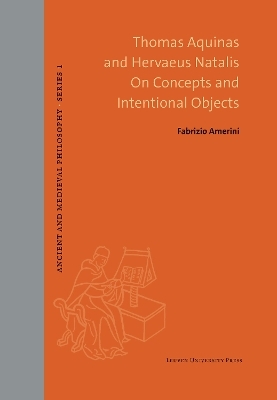
Thomas Aquinas and Hervaeus Natalis On Concepts and Intentional Objects
Seiten
2026
Leuven University Press (Verlag)
978-94-6270-501-2 (ISBN)
Leuven University Press (Verlag)
978-94-6270-501-2 (ISBN)
- Titel nicht im Sortiment
- Artikel merken
Analysis of two key medieval reflections at the intersection of our mental representations and external reality
Thought, in a sense, transforms the world. When we think of a particular thing - Charlie the dog, for example - we always think of it in a universal way: as a dog. Through this act of thinking, Charlie comes to exist in our mind and becomes the dog that is the object of our thought. Explaining how our act of thinking relates to and transforms the reality around us is often considered the hallmark of the modern age. Yet the Middle Ages offer illuminating examples of speculation on the human mind and how it functions. This book explores the views on mental acts, concepts and objects of the mind of two of the most eminent Dominican authors of the late Middle Ages: Thomas Aquinas and Hervaeus Natalis, one of his closest followers. By putting Aquinas and Hervaeus Natalis directly in conversation with each other Amerini proposes a new interpretative framework for understanding their philosophy of mind and traces the origins of modern accounts of the intentionality of the mind.
Thought, in a sense, transforms the world. When we think of a particular thing - Charlie the dog, for example - we always think of it in a universal way: as a dog. Through this act of thinking, Charlie comes to exist in our mind and becomes the dog that is the object of our thought. Explaining how our act of thinking relates to and transforms the reality around us is often considered the hallmark of the modern age. Yet the Middle Ages offer illuminating examples of speculation on the human mind and how it functions. This book explores the views on mental acts, concepts and objects of the mind of two of the most eminent Dominican authors of the late Middle Ages: Thomas Aquinas and Hervaeus Natalis, one of his closest followers. By putting Aquinas and Hervaeus Natalis directly in conversation with each other Amerini proposes a new interpretative framework for understanding their philosophy of mind and traces the origins of modern accounts of the intentionality of the mind.
Fabrizio Amerini is Professor of History of Medieval Philosophy at the University of Parma. He has conducted extensive research on late medieval logic, metaphysics, and philosophy of mind.
| Erscheint lt. Verlag | 16.2.2026 |
|---|---|
| Reihe/Serie | Ancient and Medieval Philosophy–Series 1 |
| Zusatzinfo | Not illustrated |
| Verlagsort | Leuven |
| Sprache | englisch |
| Maße | 155 x 233 mm |
| Themenwelt | Geisteswissenschaften ► Philosophie ► Philosophie des Mittelalters |
| ISBN-10 | 94-6270-501-1 / 9462705011 |
| ISBN-13 | 978-94-6270-501-2 / 9789462705012 |
| Zustand | Neuware |
| Informationen gemäß Produktsicherheitsverordnung (GPSR) | |
| Haben Sie eine Frage zum Produkt? |
Mehr entdecken
aus dem Bereich

aus dem Bereich
Buch | Softcover (2024)
Reclam (Verlag)
CHF 11,90
von der menschlichen Wahl
Buch | Softcover (2024)
Phillip Reclam (Verlag)
CHF 10,35


