


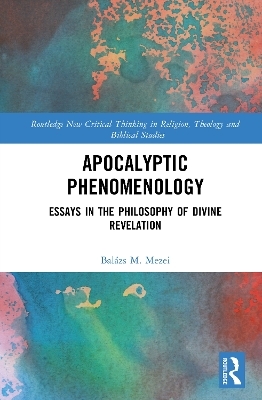
Apocalyptic Phenomenology
Essays in the Philosophy of Divine Revelation
Seiten
2025
Routledge (Verlag)
978-1-041-07711-4 (ISBN)
Routledge (Verlag)
978-1-041-07711-4 (ISBN)
This book provides a detailed view of the author’s conception of ‘apocalyptic phenomenology’, referring to the revelatory and self-disclosing nature of phenomenological thinking, a thinking that is central to our philosophical traditions today.
The concept of ‘apocalyptic phenomenology’, i.e., a phenomenological theology that discloses the ultimate ground of being, God in the form of divine revelation, is original. At the same time, it is rooted in the phenomenological tradition of Offenbarung (revelation, revealing) as the basic feature of phenomena. In the author’s view, reality is self-disclosing, ‘apocalyptic’, and thus he explains the connections between the original, biblical notion of apocalupsis and the important developments of our philosophical traditions leading up to the ‘theological turn of phenomenology’. The chapters are framed around a focus on newness and engage with the work of key thinkers such as Edmund Husserl, Martin Heidegger, Paul Ricœur, Hans Urs von Balthasar, and Anton Günther.
Apocalyptic Phenomenology will be of interest to scholars of both theology and philosophy.
The concept of ‘apocalyptic phenomenology’, i.e., a phenomenological theology that discloses the ultimate ground of being, God in the form of divine revelation, is original. At the same time, it is rooted in the phenomenological tradition of Offenbarung (revelation, revealing) as the basic feature of phenomena. In the author’s view, reality is self-disclosing, ‘apocalyptic’, and thus he explains the connections between the original, biblical notion of apocalupsis and the important developments of our philosophical traditions leading up to the ‘theological turn of phenomenology’. The chapters are framed around a focus on newness and engage with the work of key thinkers such as Edmund Husserl, Martin Heidegger, Paul Ricœur, Hans Urs von Balthasar, and Anton Günther.
Apocalyptic Phenomenology will be of interest to scholars of both theology and philosophy.
Balázs M. Mezei is Full Professor of Philosophy at Corvinus University of Budapest, Hungary. His publications include Radical Revelation: A Philosophical Approach (2017) and Divine Revelation and the Sciences (2024).
1. Foreword 2. The Newness of Revelation 3. The Rise of Revelation in Phenomenology 4. Method and Revelation 5. The Hard Problem of Revelation 6. Apocalyptic Phenomenology 7. Phenomenology of the Supernatural 8. Reason, Faith, and Revelation 9. Organic Revelation 10. The Scientific Impact of Revelation 11. A Radical Philosophical Theology of Revelation 12. Revelation as the Source of Dialogue 13. Revelation as Newness
| Erscheinungsdatum | 31.10.2025 |
|---|---|
| Reihe/Serie | Routledge New Critical Thinking in Religion, Theology and Biblical Studies |
| Zusatzinfo | 1 Tables, black and white; 1 Line drawings, black and white; 1 Illustrations, black and white |
| Verlagsort | London |
| Sprache | englisch |
| Maße | 156 x 234 mm |
| Gewicht | 760 g |
| Themenwelt | Geisteswissenschaften ► Philosophie ► Philosophie der Neuzeit |
| Religion / Theologie ► Christentum ► Kirchengeschichte | |
| ISBN-10 | 1-041-07711-4 / 1041077114 |
| ISBN-13 | 978-1-041-07711-4 / 9781041077114 |
| Zustand | Neuware |
| Informationen gemäß Produktsicherheitsverordnung (GPSR) | |
| Haben Sie eine Frage zum Produkt? |
Mehr entdecken
aus dem Bereich



aus dem Bereich
eine andere Geschichte der Papststadt
Buch | Softcover (2024)
C.H.Beck (Verlag)
CHF 25,20
die Macht des Dunklen in unserer Zeit und wie wir ihr entgegentreten
Buch | Hardcover (2025)
Verlag Herder
CHF 27,90


