


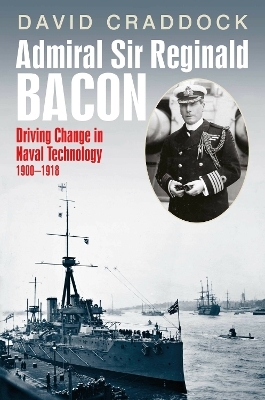
Admiral Sir Reginald Bacon
Driving Change in Naval Technology 1900–1918
Seiten
2026
Pen & Sword Books Ltd (Verlag)
978-1-0361-4589-7 (ISBN)
Pen & Sword Books Ltd (Verlag)
978-1-0361-4589-7 (ISBN)
- Noch nicht erschienen (ca. Februar 2026)
- Versandkostenfrei
- Auch auf Rechnung
- Artikel merken
Reginald Bacon was no Drake, Hawke or Nelson, yet in a naval career that spanned four decades of critical change for the Royal Navy, he was a pivotal figure among Admiral ‘Jacky’ Fisher’s ‘five best brains in the navy’ who revolutionised Britain’s naval warfighting capability between 1900 and the end of the First World War.
This new biography traces Bacon’s remarkable career from his service as a fifteen-year-old Midshipman aboard Sir Geoffrey Hornby’s Mediterranean flagship to his three years in command of the Dover Patrol. A mine and torpedo specialist, he was by turns the father of the Submarine Service, the first captain of HMS Dreadnought and Director of Naval Ordnance at the Admiralty before leaving the Royal Navy for five years to run Coventry Ordnance Works whose fortunes he transformed.
Having ended the war as Controller of Munition Inventions with the rank of Admiral, over the next twenty-five years he re-invented himself as a writer, dividing his time between homes in Hampshire and Italy. No stranger to controversy, having been unwittingly caught in the bitter Beresford/Fisher feud of 1909, he robustly defended Sir John Jellicoe as C-in-C Grand Fleet against accusations of weak and defensive tactics that deprived the nation of a resounding victory at Jutland. He went on to write acclaimed biographies of both Jacky Fisher and Earl Jellicoe besides two novels and two layman’s guides to new technologies, the motor car and the wireless, the latter in his A Simple Guide to Wireless for All Whose Knowledge of Electricity is Childlike. His account of his service in Command of the Dover Patrol is considered a classic of naval reminiscence and reveals undercurrants of contested naval doctrine that resonate today. As war threatened again in the 1930s, he wrote two more books championing the role of the Royal Navy in wartime.
This highly readable biography does justice to both the man – ‘the ablest and cleverest officer I have ever known,’ wrote Admiral of the Fleet Sir Henry Oliver – and his remarkable input into so many aspects of the development of the Navy at a time of exponential change.
This new biography traces Bacon’s remarkable career from his service as a fifteen-year-old Midshipman aboard Sir Geoffrey Hornby’s Mediterranean flagship to his three years in command of the Dover Patrol. A mine and torpedo specialist, he was by turns the father of the Submarine Service, the first captain of HMS Dreadnought and Director of Naval Ordnance at the Admiralty before leaving the Royal Navy for five years to run Coventry Ordnance Works whose fortunes he transformed.
Having ended the war as Controller of Munition Inventions with the rank of Admiral, over the next twenty-five years he re-invented himself as a writer, dividing his time between homes in Hampshire and Italy. No stranger to controversy, having been unwittingly caught in the bitter Beresford/Fisher feud of 1909, he robustly defended Sir John Jellicoe as C-in-C Grand Fleet against accusations of weak and defensive tactics that deprived the nation of a resounding victory at Jutland. He went on to write acclaimed biographies of both Jacky Fisher and Earl Jellicoe besides two novels and two layman’s guides to new technologies, the motor car and the wireless, the latter in his A Simple Guide to Wireless for All Whose Knowledge of Electricity is Childlike. His account of his service in Command of the Dover Patrol is considered a classic of naval reminiscence and reveals undercurrants of contested naval doctrine that resonate today. As war threatened again in the 1930s, he wrote two more books championing the role of the Royal Navy in wartime.
This highly readable biography does justice to both the man – ‘the ablest and cleverest officer I have ever known,’ wrote Admiral of the Fleet Sir Henry Oliver – and his remarkable input into so many aspects of the development of the Navy at a time of exponential change.
DAVID CRADDOCK began his working life in the Merchant Navy as a cadet with P&O. He came ashore to study graphic design and later a BA in History through the Open University. Over five decades he has combined both interests with a career in exhibition and graphic design specialising in historic interpretation. He is a Trustee of the Britannia Museum at the Royal Naval College Dartmouth and now devotes most of his time to writing. His first book What Ship Where Bound? A History of Visual Communication at Sea was published by Seaforth in February 2021 and was well received on both sides of the Atlantic.
| Erscheint lt. Verlag | 28.2.2026 |
|---|---|
| Zusatzinfo | 40 mono illustrations |
| Verlagsort | Barnsley |
| Sprache | englisch |
| Maße | 156 x 234 mm |
| Themenwelt | Geisteswissenschaften ► Geschichte ► Teilgebiete der Geschichte |
| ISBN-10 | 1-0361-4589-1 / 1036145891 |
| ISBN-13 | 978-1-0361-4589-7 / 9781036145897 |
| Zustand | Neuware |
| Informationen gemäß Produktsicherheitsverordnung (GPSR) | |
| Haben Sie eine Frage zum Produkt? |
Mehr entdecken
aus dem Bereich


aus dem Bereich
Mythen und Legenden aus der Seefahrt
Buch | Hardcover (2025)
Regionalia Verlag
CHF 13,90
the world's 300 greatest maps explained
Buch | Hardcover (2025)
DK (Verlag)
CHF 78,90


