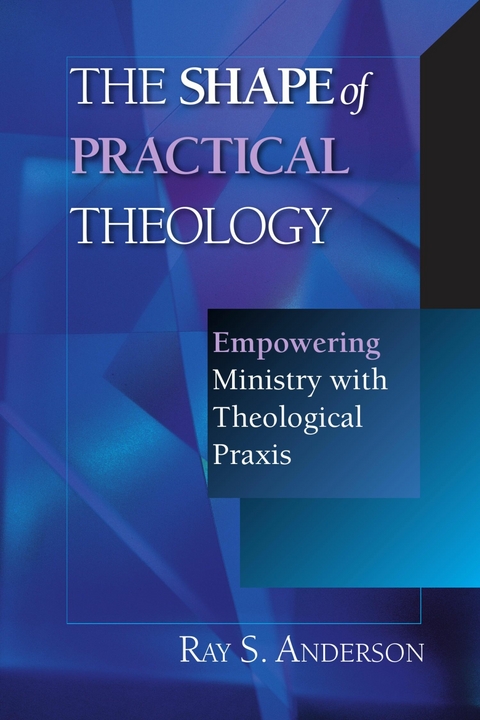
The Shape of Practical Theology (eBook)
Ray S. Anderson (Ph.D., University of Edinburgh) is senior professor of theology and ministry at Fuller Theological Seminary in Pasadena, California. He has written many books, including Judas and Jesus: Amazing Grace for the Wounded Soul, The Soul of God: A Theological Memoir and The Shape of Practical Theology: Empowering Ministry with Theological Praxis.
Too often in the life of the church, theological reflection and the practical matters of leading and serving have been considered independently. The result has been the impoverishment of both Christian faith and Christian practice. In this groundbreaking book Ray Anderson reflects theologically and practically on preaching, worship, ethics, social justice, therapy, family, homosexuality, burnout in ministry, reconciliation in relationships and theological education itself. The result is The Shape of Practical Theology, a new and renewing foundation for engaging in Christian ministry. Anderson lays out his threefold goal as follows:- to define more clearly the shape of practical theology as truly a theological enterprise rather than mere mastery of skills and methods- to demonstrate the praxis of practical theology as critical engagement with the interface between the word of God as revealed through Scripture and the work of God taking place in and through the church in the world- to deal with practical pastoral theology from the perspective of those who are on the "e;field of play"e; of life and ministry, where preaching, counseling and teaching does affect for many persons the outcome of the gameIlluminated by stimulating discussion and helpful case studies, The Shape of Practical Theology is aimed at seminary students, at Christian educators, and at working pastors and counselors. Anderson's work, fascinating and fruitful, brings together the Word of God with the Spirit of God in the ever-changing context of real-life ministry.
1
Introduction to Practical Theology
Before the theologian there was the storyteller. To say “Abraham, Isaac and Jacob” is not the recitation of a genealogical litany but the recapitulation of a theological legacy. To say “Abraham” calls to mind a personal encounter that demanded a walk of faith and a witness to divine promise. To say “Isaac” reiterates the gracious intervention of the God who brings forth the promised seed from Sara’s barren womb. To say “Jacob” distinguishes Rebekah’s revelation as divine Word from Isaac’s natural inclination to honor a cultural custom.
These were all storytellers; it remained for Moses to become the first theologian. Following the encounter with God at the burning bush, and the revelation of the new name—Yahweh—Moses outlined the contours of the divine covenant of grace and mercy as revealed through the liberation of his people from Egypt and the journey toward the Promised Land. The inner logic of God’s saving grace became the “spine” to which the stories lodged as fragments in the oral tradition could be attached as a coherent pattern of inspired and written Word of God. God’s act of reconciliation is simultaneously God’s Word of revelation. The God who accompanied the people on their journey through the wilderness walked with Adam and Eve in the Garden of Eden (Gen 3:8). To walk with God, from “bedlam to shalom,” as John Swinton artfully put it, is to discover and know the Word of God.1
What makes theology practical is not the fitting of orthopedic devices to theoretical concepts in order to make them walk. Rather, theology occurs as a divine partner joins us on our walk, stimulating our reflection and inspiring us to recognize the living Word, as happened to the two walking on the road to Emmaus on the first Easter (Lk 24).2
I write this book as one who entered into pastoral ministry directly out of seminary with a major in systematic theology but, as I soon discovered, afflicted with PTDS—practical theology deficiency syndrome. I had a theology that could talk but that would not walk. What passed for practical theology in the seminary curriculum was a survey of the various forms of church polity unique to each tradition and some practical advice on how to make hospital calls—don’t sit on the bed—and how to prepare sermons—spend at least one hour a week of preparation for each minute of the sermon! My sermons were strong on the attributes of God but weak on their application to the daily life of faith.
Finally a member of the congregation found the courage to tell me that it was easy to agree to the omnipotence of God—that he could do everything—but what was of more immediate concern was whether God could do anything in particular. If it is important to know and believe that God is omnipresent—that he is everywhere present—one could readily assent, but what one really longed for was to discover God present in the small space of one’s personal life.
At that time I found no problem with those who had red letter editions of the New Testament, where every word that Jesus spoke was highlighted in color. I was taught that propositional truth in the form of that which was thought, spoken and communicated was “real truth,” while the actions of Jesus were only descriptions and accounts of his ministry—as though ministry was only something Jesus did to prove that he was truly of God. One of my most revered seminary professors pointed me in this direction when he made the observation in a theology class one day that it was curious that the liturgical churches stood for the reading of the Gospels and sat for the reading of the Epistles. It should be the other way around, he opined. The letters of Paul constitute the truth of doctrine as the ground of our faith, while the Gospels are but anecdotes that provide the context for the teaching of Jesus. We should stand for the reading of the Epistles, he concluded. It never occurred to me that we had it upside down! Jesus himself had said, “Even though you do not believe me, believe the works, so that you may know and understand that the Father is in me and I am in the Father” (Jn 10:38). Only later did I come to understand that what Jesus did was as authoritative and as much revelation of God as what he said and taught. I now hold that if one wishes to highlight what is revealed truth in the life and ministry of Jesus, one should better print his works in red! When Jesus healed on the sabbath, the act of healing became a criterion (text) by which a true theology of the sabbath was revealed.
My conversion to practical theology began early in my ministry. A woman member of the church had been divorced several years before joining. During her participation in our church fellowship she fell in love with a man who had also been divorced. Both of them were faithful and regular participants in the life of the church. One day she came to my office and said, “Pastor, I know what the Bible says concerning divorce and remarriage. According to the Bible I can never remarry. I am not the innocent party to my previous divorce. I contributed as much as my husband to the tragic failure of our marriage. I have sought and received God’s forgiveness for the sin of divorce. Now I have met a man with whom I not only have a bond of love, but we share a strong bond of life in Jesus Christ.”
She paused for a long time and then asked, “Where is God in our lives? Is God on the side of a law of marriage and divorce, or is he on our side as we experience forgiveness and renewal as his children seeking his blessing on our lives through marriage?”
She asked the right question. It was the question asked of Jesus by those who sought healing on the sabbath, who reached out to him from the ranks of those marginalized and scorned by the self-righteous religious authorities. It was not a question that sought to evade a biblical principle by finding a loophole through which one could drive a bargain with God. It was not a question of human pragmatism but of divine praxis. I was being asked to interpret the Word of God by the work of God in their lives. To use the Word against the work of God seemed dangerously close to the practice of those who crucified Jesus because he was judged to have violated the law of the sabbath by healing on the sabbath (Jn 9:16).
My response to this couple after meeting with them paraphrased the statement of Jesus concerning the sabbath: “Marriage is made for the benefit of humankind; humans are not made merely to uphold marriage as a law” (Mk 2:27-28). At their marriage, before the entire congregation, I said, “Bill and Sue [not their real names] want you to know that they have no right to be married today. But you are witnesses of the saving and healing work of Christ in their midst, and it is on that basis, as recipients of God’s grace, that they stand before you as a testimony to the power of God to redeem and bless what is redeemed.”
At that crucial point in my own ministry, I had a good deal of systematic theology but no preparation in practical theology. Since then I have come to understand that the core theology of the Bible, both Old and New Testament, is practical theology before it becomes systematic theology. This book attempts to define the contours of a biblical and practical theology as foundation for the theological task itself. I want to make clear the distinction between a theology grounded primarily in theory as compared to a theory of theology grounded in praxis. I also want to distinguish a theology made practical through a pragmatic approach—not everything that works is God’s work—from a practical theology that reads Scripture in the context of ministry—what God does (works) honors and illuminates the purpose of God’s Word.
This requires at the outset an analysis of the relation of theory to practice, including a brief survey of the factors that led to the splitting apart of theory and practice in the so-called modern period of theology following the Enlightenment in Europe. I confess that my own approach is from within a Western tradition and culture. I am a child of that culture. At the same time, I seek to lay bare the inner logic of God’s self-revelation as directed to all of humanity, in every culture and across all ethnic and geographical boundaries. The first part of this book attempts to do this through an exploration of God’s self-revelation in Christ as a form of Christopraxis, leading to a practical theology of ministry. The remainder of the book then takes up issues and questions that confront those who are on the frontlines of Christ’s ministry through the church and in the world.
The Relation of Theory to Practice
At the center of the discussion of the nature of practical theology is the issue of the relation of theory to praxis. If theory precedes and determines practice, then practice tends to be concerned primarily with methods, techniques and strategies for ministry, lacking theological substance. If practice takes priority over theory, ministry tends to be based on pragmatic results rather than prophetic revelation. All good practice includes theory, some will say. Others will claim that theory without good practice is invalid theory.
Behind the massive work of Karl Barth lies the dynamic interrelation between theory and praxis. The task of theology as Barth construed it is to clarify the presuppositions of church praxis. Praxis comes first precisely because God is “no fifth wheel on the wagon, but the wheel that drives all wheels.”3 In his furious response to the...
| Erscheint lt. Verlag | 28.10.2025 |
|---|---|
| Sprache | englisch |
| Themenwelt | Religion / Theologie ► Christentum ► Kirchengeschichte |
| Schlagworte | Church • Counseling • Cross • Educators • ethics • Family • Forgiveness • gay • God • Healing • Holy Spirit • Homosexuality • Jesus • Karl Barth • Kids • Neighbor • Paraclesis • Parents • Pastoral Care • postmodern • Reconciliation • Sociocultural • Suffering • therapy • Trinitarian • Trinity • Urban |
| ISBN-10 | 1-5140-1515-3 / 1514015153 |
| ISBN-13 | 978-1-5140-1515-5 / 9781514015155 |
| Informationen gemäß Produktsicherheitsverordnung (GPSR) | |
| Haben Sie eine Frage zum Produkt? |
 EPUB (Wasserzeichen)
DRM: Digitales Wasserzeichen
Dieses eBook enthält ein digitales Wasserzeichen und ist damit für Sie personalisiert. Bei einer missbräuchlichen Weitergabe des eBooks an Dritte ist eine Rückverfolgung an die Quelle möglich.
Dateiformat: EPUB (Electronic Publication)
EPUB ist ein offener Standard für eBooks und eignet sich besonders zur Darstellung von Belletristik und Sachbüchern. Der Fließtext wird dynamisch an die Display- und Schriftgröße angepasst. Auch für mobile Lesegeräte ist EPUB daher gut geeignet.
Systemvoraussetzungen:
PC/Mac: Mit einem PC oder Mac können Sie dieses eBook lesen. Sie benötigen dafür die kostenlose Software Adobe Digital Editions.
eReader: Dieses eBook kann mit (fast) allen eBook-Readern gelesen werden. Mit dem amazon-Kindle ist es aber nicht kompatibel.
Smartphone/Tablet: Egal ob Apple oder Android, dieses eBook können Sie lesen. Sie benötigen dafür eine kostenlose App.
Geräteliste und zusätzliche Hinweise
Buying eBooks from abroad
For tax law reasons we can sell eBooks just within Germany and Switzerland. Regrettably we cannot fulfill eBook-orders from other countries.
aus dem Bereich