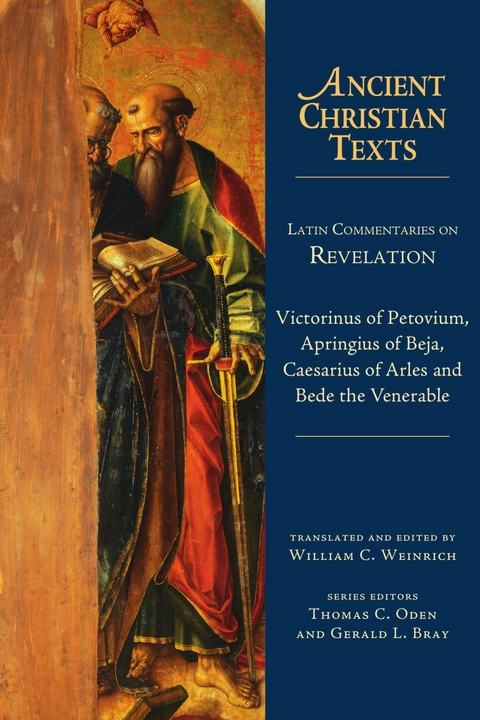
Latin Commentaries on Revelation (eBook)
201 Seiten
IVP Academic (Verlag)
978-1-5140-1521-6 (ISBN)
Gerald L. Bray (PhD, La Sorbonne) is a professor at Beeson Divinity School of Samford University in Birmingham, Alabama, and director of research for the Latimer Trust. He has written and edited a number of books on different theological subjects, including Galatians, Ephesians in the Reformation Commentary on Scripture series, Biblical Interpretation: Past and Present, The Doctrine of God, and Romans in the Ancient Christian Commentary on Scripture series. A priest of the Church of England, Bray has also edited the post-Reformation Anglican canons. Thomas C. Oden (1931-2016), was the general editor of the Ancient Christian Commentary on Scripture and the Ancient Christian Doctrine series as well as the author of Classic Christianity, a revision of his three-volume systematic theology. His books also include The African Memory of Mark, Early Libyan Christianity, and How Africa Shaped the Christian Mind. He was the director of the Center for Early African Christianity at Eastern University in Pennsylvania and he also served as the Henry Anson Buttz Professor of Theology at the Graduate School and The Theological School of Drew University in Madison, New Jersey. William C. Weinrich (DTheol, Basel) is rector of the Luther Academy, theological seminary of the Evangelical Lutheran Church of Latvia. Additionally, he is a professor of early church history and patristic studies at Concordia Theological Seminary in Fort Wayne, Indiana. He is the author of Spirit and Martyrdom: A Study of the Work of the Holy Spirit in Contexts of Persecution and Martyrdom in the New Testament and Early Christian Literature and editor of The New Testament Age: Essays in Honor of Bo Reicke.
Interest in the book of Revelation in the Western tradition is stronger and earlier than that in the East. The earliest full commentary on the Apocalypse is that of Victorinus of Petovium written in the mid to late third century by the earliest exegete to write in Latin. Victorinus interpreted Revelation in millennialist terms, a mode of interpretation already evident in works by Irenaeus, as well as in modest allegorical terms. Caesarius of Arles wrote in the early sixth century and offered a thoroughgoing allegorical-ecclesial interpretation of the Apocalypse. Apringius of Beja in Portugal, writing in the mid sixth century, drew on Jerome's edition of Victorinus's commentary yet understood the seven seals christologically as the incarnation, birth, passion, death, resurrection, glory and kingdom. Bede the Venerable, who died in 735, is the last commentator to be included in this collection. Characteristically, he passes on commentary from earlier exegetes, here including that of Augustine, Gregory the Great, Victorinus, Tyconius and Primasius. William Weinrich renders a particular service to readers interested in ancient commentary on the Apocalypse by drawing together these significant Latin commentaries. The work of translating these texts was begun in preparing the volume on Revelation in the Ancient Christian Commentary on Scripture. We are indebted to William Weinrich for completing this work with his able and fresh translation and notes on these texts. Ancient Christian Texts are new English translations of full-length commentaries or sermon series from ancient Christian authors that allow you to study key writings of the early church fathers in a fresh way.
General Introduction
Ancient Christian Texts (hereafter ACT) presents the full text of ancient Christian commentaries on Scripture that have remained so unnoticed that they have not yet been translated into English.
The patristic period (a.d. 95–750) is the time of the fathers of the church, when the exegesis of Scripture texts was in its primitive formation. This period spans from Clement of Rome to John of Damascus, embracing seven centuries of biblical interpretation, from the end of the New Testament to the mid-eighth century, including the Venerable Bede.
This series extends but does not reduplicate texts of the Ancient Christian Commentary on Scripture (ACCS). It presents full-length translations of texts that appear only as brief extracts in the ACCS. The ACCS began years ago authorizing full-length translations of key patristic texts on Scripture in order to provide fresh sources of valuable commentary that previously were not available in English. It is from these translations that the ACT series has emerged.
A multiyear project such as this requires a well-defined objective. The task is straight-forward: to introduce full-length translations of key texts of early Christian teaching, homilies and commentaries on a particular book of Scripture. These are seminal documents that have decisively shaped the entire subsequent history of biblical exegesis, but in our time have been largely ignored.
To carry out this mission each volume of the Ancient Christian Texts series has four aspirations:
-
1. To show the approach of one of the early Christian writers in dealing with the problems of understanding, reading and conveying the meaning of a particular book of Scripture.
-
2. To make more fully available the whole argument of the ancient Christian interpreter of Scripture to all who wish to think with the early church about a particular canonical text.
-
3. To broaden the base of the biblical studies, Christian teaching and preaching to include classical Christian exegesis.
-
4. To stimulate Christian historical, biblical, theological and pastoral scholarship toward deeper inquiry into early classic practitioners of scriptural interpretation.
For Whom Is This Series Designed?
We have selected and translated these texts primarily for general and nonprofessional use by an audience of persons who study the Bible regularly.
In varied cultural settings around the world, contemporary readers are asking how they might grasp the meaning of sacred texts under the instruction of the great minds of the ancient church. They often study books of the Bible verse by verse, book by book, in groups and workshops, sometimes with a modern commentary in hand. But many who study the Bible intensively hunger to have available as well the thoughts of a reliable classic Christian commentator on this same text. This series will give the modern commentators a classical text for comparison and amplification. Readers will judge for themselves as to how valuable or complementary are their insights and guidance.
The classic texts we are translating were originally written for anyone (lay or clergy, believers or seekers) who wished to reflect and meditate with the great minds of the early church. They sought to illuminate the plain sense, theological wisdom, and moral and spiritual meaning of an individual book of Scripture. They were not written for an academic audience, but for a community of faith shaped by the sacred text.
Yet in serving this general audience, the editors remain determined not to neglect the rigorous requirements and needs of academic readers who until recently have had few full translations available to them in the history of exegesis. So this series is designed also to serve public libraries, universities, academic classes, homiletic preparation and historical interests worldwide in Christian scholarship and interpretation.
Hence our expected audience is not limited to the highly technical and specialized scholarly field of patristic studies, with its strong bent toward detailed word studies and explorations of cultural contexts. Though all of our editors and translators are patristic and linguistic scholars, they also are scholars who search for the meanings and implications of the texts. The audience is not primarily the university scholar concentrating on the study of the history of the transmission of the text or those with highly focused interests in textual morphology or historical-critical issues. If we succeed in serving our wider readers practically and well, we hope to serve as well college and seminary courses in Bible, church history, historical theology, hermeneutics and homiletics. These texts have not until now been available to these classes.
Readiness for Classic Spiritual Formation
Today global Christians are being steadily drawn toward these biblical and patristic sources for daily meditation and spiritual formation. They are on the outlook for primary classic sources of spiritual formation and biblical interpretation, presented in accessible form and grounded in reliable scholarship.
These crucial texts have had an extended epoch of sustained influence on Scripture interpretation, but virtually no influence in the modern period. They also deserve a hearing among modern readers and scholars. There is a growing awareness of the speculative excesses and spiritual and homiletic limitations of much post-Enlightenment criticism. Meanwhile the motifs, methods and approaches of ancient exegetes have remained unfamiliar not only to historians but to otherwise highly literate biblical scholars, trained exhaustively in the methods of historical and scientific criticism.
It is ironic that our times, which claim to be so fully furnished with historical insight and research methods, have neglected these texts more than scholars in previous centuries who could read them in their original languages.
This series provides indisputable evidence of the modern neglect of classic Christian exegesis: it remains a fact that extensive and once authoritative classic commentaries on Scripture still remain untranslated into any modern language. Even in China such a high level of neglect has not befallen classic Buddhist, Taoist and Confucian commentaries.
Ecumenical Scholarship
This series, like its two companion series, the ACCS and Ancient Christian Doctrine (ACD), are expressions of unceasing ecumenical efforts that have enjoyed the wide cooperation of distinguished scholars of many differing academic communities. Under this classic textual umbrella, it has brought together in common spirit Christians who have long distanced themselves from each other by competing church memories. But all of these traditions have an equal right to appeal to the early history of Christian exegesis. All of these traditions can, without a sacrifice of principle or intellect, come together to study texts common to them all. This is its ecumenical significance.
This series of translations is respectful of a distinctively theological reading of Scripture that cannot be reduced to historical, philosophical, scientific, or sociological insights or methods alone. It takes seriously the venerable tradition of ecumenical reflection concerning the premises of revelation, providence, apostolicity, canon and consensuality. A high respect is here granted, despite modern assumptions, to uniquely Christian theological forms of reasoning, such as classical consensual christological and triune reasoning, as distinguishing premises of classic Christian textual interpretation. These cannot be acquired by empirical methods alone. This approach does not pit theology against critical theory; instead, it incorporates critical historical methods and brings them into coordinate accountability within its larger purpose of listening to Scripture.
The internationally diverse character of our editors and translators corresponds with the global range of our audience, which bridges many major communions of Christianity. We have sought to bring together a distinguished international network of Protestant, Catholic and Orthodox scholars, editors and translators of the highest quality and reputation to accomplish this design.
But why just now at this historical moment is this need for patristic wisdom felt particularly by so many readers of Scripture? Part of the reason is that these readers have been longer deprived of significant contact with many of these vital sources of classic Christian exegesis.
The Ancient Commentary Tradition
This series focuses on texts that comment on Scripture and teach its meaning. We define a commentary in its plain-sense definition as a series of illustrative or explanatory notes on any work of enduring significance. The word commentary is an Anglicized form of the Latin commentarius (or “annotation” or “memoranda” on a subject, text or series of events). In its theological meaning it is a work that explains, analyzes or expounds a biblical book or portion of Scripture. Tertullian, Origen, John Chrysostom, Jerome, Augustine and Clement of Alexandria all revealed their familiarity with both the secular and religious commentators available to them as they unpacked the meanings of the sacred text at hand.
The commentary in ancient times typically began with a general introduction covering such questions as authorship, date, purpose and audience. It commented as needed on grammatical or lexical problems in the text and provided explanations of difficulties in the text. It typically moved...
| Erscheint lt. Verlag | 4.11.2025 |
|---|---|
| Mitarbeit |
Herausgeber (Serie): Gerald Bray, Thomas C. Oden |
| Übersetzer | William C. Weinrich |
| Sprache | englisch |
| Themenwelt | Geisteswissenschaften ► Religion / Theologie ► Christentum |
| Schlagworte | Act • Ancient • Apocalypse • Apringius • Background • Biblical • caesarius • Christian • Church • Early • End times • exegetical • Father • judgement • New • Pastor • Patristic • preach • Scripture • second coming • Sermon • Student • Teach • Testament • Text • Theologian • Translation • Victorinus |
| ISBN-10 | 1-5140-1521-8 / 1514015218 |
| ISBN-13 | 978-1-5140-1521-6 / 9781514015216 |
| Informationen gemäß Produktsicherheitsverordnung (GPSR) | |
| Haben Sie eine Frage zum Produkt? |
 EPUB (Wasserzeichen)
DRM: Digitales Wasserzeichen
Dieses eBook enthält ein digitales Wasserzeichen und ist damit für Sie personalisiert. Bei einer missbräuchlichen Weitergabe des eBooks an Dritte ist eine Rückverfolgung an die Quelle möglich.
Dateiformat: EPUB (Electronic Publication)
EPUB ist ein offener Standard für eBooks und eignet sich besonders zur Darstellung von Belletristik und Sachbüchern. Der Fließtext wird dynamisch an die Display- und Schriftgröße angepasst. Auch für mobile Lesegeräte ist EPUB daher gut geeignet.
Systemvoraussetzungen:
PC/Mac: Mit einem PC oder Mac können Sie dieses eBook lesen. Sie benötigen dafür die kostenlose Software Adobe Digital Editions.
eReader: Dieses eBook kann mit (fast) allen eBook-Readern gelesen werden. Mit dem amazon-Kindle ist es aber nicht kompatibel.
Smartphone/Tablet: Egal ob Apple oder Android, dieses eBook können Sie lesen. Sie benötigen dafür eine kostenlose App.
Geräteliste und zusätzliche Hinweise
Buying eBooks from abroad
For tax law reasons we can sell eBooks just within Germany and Switzerland. Regrettably we cannot fulfill eBook-orders from other countries.
aus dem Bereich