


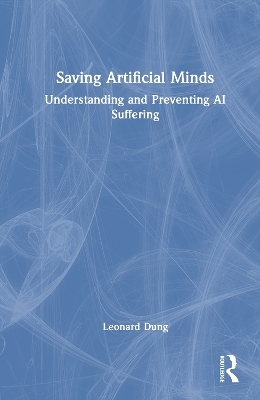
Saving Artificial Minds
Understanding and Preventing AI Suffering
Seiten
2025
Routledge (Verlag)
9781041144670 (ISBN)
Routledge (Verlag)
9781041144670 (ISBN)
This is the first book to investigate the nature and extent of artificial intelligence (AI) suffering risks. It argues that AI suffering risk is a serious near-term concern and analyses approaches for addressing it.
This is the first book to investigate the nature and extent of artificial intelligence (AI) suffering risks. It argues that AI suffering risk is a serious near-term concern and analyzes approaches for addressing it.
AI systems are currently treated as mere objects, not as bearers of moral standing whose wellbeing may matter in its own right. However, we may soon create AI systems which are capable of suffering and thus have moral standing. This book examines the philosophy and science of AI suffering risks. Its investigation is deeply grounded in philosophy of mind, comparative psychology, the science of consciousness, AI research, and applied AI ethics. The book has three primary goals:
It argues that there is a significant probability that we will soon create AI systems capable of suffering
It presents the first systematic assessment of approaches for reducing AI suffering risks
It provides a rigorous overview and discussion of the most important research and ideas on AI sentience, AI agency, and the grounds of moral status
Saving Artificial Minds is essential reading for researchers and graduate students working on the philosophy or ethics of AI.
This is the first book to investigate the nature and extent of artificial intelligence (AI) suffering risks. It argues that AI suffering risk is a serious near-term concern and analyzes approaches for addressing it.
AI systems are currently treated as mere objects, not as bearers of moral standing whose wellbeing may matter in its own right. However, we may soon create AI systems which are capable of suffering and thus have moral standing. This book examines the philosophy and science of AI suffering risks. Its investigation is deeply grounded in philosophy of mind, comparative psychology, the science of consciousness, AI research, and applied AI ethics. The book has three primary goals:
It argues that there is a significant probability that we will soon create AI systems capable of suffering
It presents the first systematic assessment of approaches for reducing AI suffering risks
It provides a rigorous overview and discussion of the most important research and ideas on AI sentience, AI agency, and the grounds of moral status
Saving Artificial Minds is essential reading for researchers and graduate students working on the philosophy or ethics of AI.
Leonard Dung is a philosopher at the Ruhr-University Bochum. His research especially focuses on AI sentience, AI moral status, and risks, including existential risks, from advanced AI systems. Moreover, he investigates topics related to animal consciousness and welfare, which were also the focus of his PhD.
1. Introduction 2. Sentience and Suffering 3. Indicators of AI Sentience 4. Are Near-future AI Systems Sentient? 5. Non-conscious Suffering and AI 6. Approaches for Reducing AI Suffering Risk 7. AI Suffering, Ethics, and Safety 8. Conclusion and Outlook
| Erscheinungsdatum | 12.09.2025 |
|---|---|
| Zusatzinfo | 5 Tables, black and white |
| Verlagsort | London |
| Sprache | englisch |
| Maße | 152 x 229 mm |
| Gewicht | 650 g |
| Themenwelt | Geisteswissenschaften ► Philosophie ► Ethik |
| Informatik ► Theorie / Studium ► Künstliche Intelligenz / Robotik | |
| ISBN-13 | 9781041144670 / 9781041144670 |
| Zustand | Neuware |
| Informationen gemäß Produktsicherheitsverordnung (GPSR) | |
| Haben Sie eine Frage zum Produkt? |
Mehr entdecken
aus dem Bereich


aus dem Bereich
Eine praxisorientierte Einführung
Buch | Softcover (2025)
Springer Vieweg (Verlag)
CHF 53,15
Künstliche Intelligenz, Macht und das größte Dilemma des 21. …
Buch | Softcover (2025)
C.H.Beck (Verlag)
CHF 25,20
Buch | Softcover (2025)
Reclam, Philipp (Verlag)
CHF 11,20


