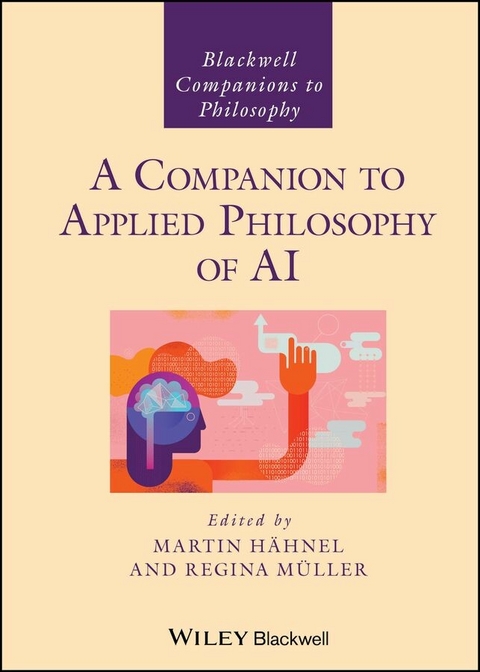
A Companion to Applied Philosophy of AI (eBook)
975 Seiten
Wiley-Blackwell (Verlag)
978-1-394-23863-7 (ISBN)
A comprehensive guide to AI's ethical, epistemological, and legal impacts through applied philosophy
Inartificial intelligence (AI) influences nearly every aspect of society. A Companion to Applied Philosophy of AI provides a critical philosophical framework for understanding and addressing its complexities. Edited by Martin Hähnel and Regina Müller, this volume explores AI's practical implications in epistemology, ethics, politics, and law. Moving beyond a narrow ethical perspective, the authors advocate for a multi-faceted approach that synthesizes diverse disciplines and perspectives, offering readers a nuanced and integrative understanding of AI's transformative role.
The Companion explores a broad range of topics, from issues of transparency and expertise in AI-driven systems to discussions of ethical theories and their relevance to AI, such as consequentialism, deontology, and virtue ethics. Filling a significant gap in the current academic literature, this groundbreaking volume also addresses AI's broader social, political, and legal dimensions, equipping readers with practical frameworks to navigate this rapidly evolving field.
Offering fresh and invaluable insights into the interplay between philosophical thought and technological innovation, A Companion to Applied Philosophy of AI:
- Features contributions from leading philosophers and interdisciplinary experts
- Offers a unique applied philosophy perspective on artificial intelligence
- Covers diverse topics including ethics, epistemology, politics, and law
- Encourages interdisciplinary dialogue to better understand AI's profound implications for humanity
A Companion to Applied Philosophy of AI is ideal for undergraduate and graduate courses in applied philosophy, AI ethics, political theory, and legal philosophy. It is also a vital reference for those working in areas including AI policy, governance, and interdisciplinary research.
MARTIN HÄHNEL is a Lecturer at the University of Bremen with a particular focus on applied philosophy and normative ethics (especially virtue ethics). In his current research, he advocates a neo-Aristotelian approach to ethics, which he attempts to apply to contemporary problems and challenges in bioethics, research ethics and AI ethics.
REGINA MÜLLER is a postdoctoral researcher at the Department of Philosophy at the University of Bremen. Her work addresses the ethical dimensions of technology, especially in health care and medicine. She focuses on the intersections of digital ethics, medical ethics and structural injustice, with a strong emphasis on feminist perspectives.
A comprehensive guide to AI's ethical, epistemological, and legal impacts through applied philosophy Inartificial intelligence (AI) influences nearly every aspect of society. A Companion to Applied Philosophy of AI provides a critical philosophical framework for understanding and addressing its complexities. Edited by Martin H hnel and Regina M ller, this volume explores AI's practical implications in epistemology, ethics, politics, and law. Moving beyond a narrow ethical perspective, the authors advocate for a multi-faceted approach that synthesizes diverse disciplines and perspectives, offering readers a nuanced and integrative understanding of AI's transformative role. The Companion explores a broad range of topics, from issues of transparency and expertise in AI-driven systems to discussions of ethical theories and their relevance to AI, such as consequentialism, deontology, and virtue ethics. Filling a significant gap in the current academic literature, this groundbreaking volume also addresses AI's broader social, political, and legal dimensions, equipping readers with practical frameworks to navigate this rapidly evolving field. Offering fresh and invaluable insights into the interplay between philosophical thought and technological innovation, A Companion to Applied Philosophy of AI: Features contributions from leading philosophers and interdisciplinary experts Offers a unique applied philosophy perspective on artificial intelligence Covers diverse topics including ethics, epistemology, politics, and law Encourages interdisciplinary dialogue to better understand AI's profound implications for humanity A Companion to Applied Philosophy of AI is ideal for undergraduate and graduate courses in applied philosophy, AI ethics, political theory, and legal philosophy. It is also a vital reference for those working in areas including AI policy, governance, and interdisciplinary research.
Notes on Contributors
John Basl is an Associate Professor of Philosophy at Northeastern University. He works primarily in moral philosophy and applied ethics with a focus on the ethics of emerging technologies. He leads AI and data ethics initiatives at the Northeastern Ethics Institute.
Kathi Beier is a Postdoctoral Research Fellow at the Department of Philosophy at the University of Bremen, Germany, where she is part of two research projects on AI in medicine and healthcare. She is Co‐editor‐in‐Chief of Zeitschrift für Ethik und Moralphilosophie/Journal for Ethics and Moral Philosophy. Her main research focus is virtue ethics, both old and new. Besides virtue ethics, her publications include books and papers on theories of practical rationality and irrationality, moral psychology and the philosophy of love.
Andrea Berber is a Research Associate at the Institute of Philosophy of the Faculty of Philosophy at the University of Belgrade. Her research interests are the philosophy of artificial intelligence, applied ethics, and applied epistemology. Specifically, she is working on ethical and epistemological issues surrounding the usage of opaque machine learning algorithms in various fields of human practice.
Paula Boddington has held academic posts at the University of Bristol, at the Australian National University, at Cardiff University, and at Oxford University. Much of her work has concerned the application of philosophy to ethical and policy issues. She is the author of AI Ethics: A Textbook (2023), Towards a Code of Ethics for Artificial Intelligence (2017), Ethical Challenges in Genomics Research (2012) and Reading for Study and Research (1999).
Larissa Bolte is a Research Associate and PhD candidate at the Bonn Sustainable AI Lab of the Institute for Science and Ethics at the University of Bonn. She currently works on the intersection of sustainability and technology from a critical theory perspective. Her research interests are in philosophy of technology, critical theory, and AI ethics, here especially sustainable AI.
Oliver Buchholz is a Postdoctoral Research Fellow at the Chair of Bioethics at ETH Zurich and an associate member of the Interchange Forum for Reflecting on Intelligent Systems (IRIS) at University of Stuttgart. He works mainly in epistemology and the philosophy of science, focusing on methodological issues of machine learning systems as well as potential remedies.
Mark Coeckelbergh is Professor of Philosophy of Media and Technology at the Philosophy Department of the University of Vienna. He is also ERA Chair at the Institute of Philosophy of the Czech Academy of Sciences in Prague and Guest Professor at WASP‐HS and the University of Uppsala. Previously he was President of the Society for Philosophy and Technology. His expertise focuses on ethics and technology, in particular robotics and artificial intelligence.
Hugo Cossette‐Lefebvre is a Postdoctoral Researcher at McGill University and the Institute for Data Valorization (IVADO). He completed his PhD at McGill in 2022 and was a visiting researcher at Aarhus University from 2022 to 2024. His research explores three questions: (1) What does it mean to treat and regard others as equals? (2) Why value egalitarian relationships? (3) How do emerging technologies affect socio‐political relations from an ethical standpoint? His work has been published in the Journal of Social Philosophy, Bioethics, Journal of Medical Ethics, AI & Ethics, Public Affairs Quarterly, French Politics, and Options Politiques, among others.
Michael T. Dale is an Assistant Professor of Philosophy at Hampden‐Sydney College. His research explores to what extent empirical findings can have implications for ethics and metaethics. He has written on topics in normative ethics, metaethics, moral psychology, ethics of artificial intelligence, technology ethics, the evolution of morality, neuroscience of ethics, and virtue ethics.
Mirjam Faissner is a Research Associate at the Institute of the History of Medicine and Ethics in Medicine at Charité‐Universitätsklinikum Berlin, Germany. Trained in philosophy and medicine, she works on questions of structural and epistemic injustice in the context of health and healthcare, with a special focus on the situation of marginalized social groups. Her research areas include feminist bioethics, ethics in psychiatry, and social epistemology.
Luciano Floridi is the Founding Director of the Digital Ethics Center at Yale University, where he is also a Professor in the Cognitive Science Program. Outside Yale, he is a part‐time Professor of Sociology of Culture and Communication at the University of Bologna. His research concerns primarily digital ethics, the ethics of AI, the philosophy of information, and the philosophy of technology. Further research interests include epistemology, philosophy of logic, and the history and philosophy of skepticism.
Markus Furendal is a Researcher and Teacher at the Department of Political Science at Stockholm University and the Institute for Futures Studies. His research interests lie in the intersection between politics, economics, and philosophy, and focuses on the global governance of artificial intelligence, automated decision making in the public sector, and the future of work.
John‐Stewart Gordon is Chief researcher (full professor equivalent) at Kaunas University of Technology, an Associated Member of the IZEW at the University of Tübingen, Associate Fellow at the Academy of International Affairs NRW, and Permanent Visiting Professor at Vytautas Magnus University. John is a member of several editorial boards, including Bioethics and AI & Society, and acts as the general editor for the Philosophy and Human Rights book series at de Gruyter Brill. He has published over 100 works on practical philosophy through esteemed international publishers and leading journals.
David G. Grant is Assistant Professor in the Department of Philosophy at the University of Florida. He works mainly in applied ethics (especially ethics of AI) and philosophy of science (especially philosophy of AI). His research focuses on concerns about fairness and transparency that arise when institutions use artificial intelligence to make high‐stakes decisions.
David J. Gunkel is a Presidential Research, Scholarship and Artistry Professor in the Department of Communication at Northern Illinois University and Associate Professor of Applied Ethics at Łazarski University in Warsaw. He has been teaching and writing on several concepts in philosophy of technology with a focus on the moral and legal challenges of artificial intelligence and robots. His books include Handbook on the Ethics of AI (2024), Person, Thing, Robot (2023), An Introduction to Communication and Artificial Intelligence (2020), Robot Rights (2018), and The Machine Question (2012).
Martin Hähnel is Lecturer and Postdoctoral Researcher at the Universities of Bremen and Augsburg with expertise in applied philosophy, normative ethics, and the history of philosophy. He is currently coordinating the interdisciplinary research project "Dealing responsibly with AI‐assisted systems in medicine," funded by the German Federal Ministry of Education and Research. At the Augsburg Institute of Ethics and History of Health in Society, Hähnel is investigating the ethical implications of the development and use of digital tools in psychiatric healthcare. For years, he has been trying to introduce the approach of Neo‐Aristotelian ethical naturalism (Aristotelian Naturalism – A Research Companion [2020]) to various fields of applied ethics, especially bioethics.
Rico Hauswald is a Privatdozent at the Institute of Philosophy at TU Dresden and a co‐project leader in the interdisciplinary research project "Dealing responsibly with AI‐assisted systems in medicine," funded by the German Federal Ministry of Education and Research. His research focuses on the philosophy of science, epistemology, and medical theory, among other areas.
Marten H.L. Kaas is a Postdoctoral Researcher at the Charité‐Universitätsmedizin Berlin working as a member of the Science of Intelligence Excellence Research Cluster. He is interested in the effect of technology and science on society, with a particular focus on the ethics of artificial intelligence. His areas of expertise are philosophy of mind, philosophy of artificial intelligence, ethics, metaphysics, and philosophy of science.
Antonia Kempkens is a PhD candidate in the Department of Philosophy at the University of Bremen. Her research interests include digital ethics and philosophy of AI, focusing on the ethical issues of privacy and transparency. In her dissertation, she discusses how the digitalisation of public administration in Germany can be designed ethically.
Janne Lenk is a Student Assistant for the book project A Companion of Applied Philosophy of AI at the Institute for Philosophy at the University of Bremen and is studying for a Master's degree in philosophy at Carl von Ossietzky University, Oldenburg. Their areas of interest are feminist and queer theories and (in)justices.
Lukas J. Meier is a Fellow at the Harvard Center for Ethics, with main interests in neurophilosophy, artificial intelligence, medical ethics, and philosophy of mind. Previously, he was a Junior Research Fellow at...
| Erscheint lt. Verlag | 24.6.2025 |
|---|---|
| Reihe/Serie | Blackwell Companions to Philosophy |
| Sprache | englisch |
| Themenwelt | Geisteswissenschaften ► Philosophie |
| Schlagworte | AI ethics • AI governance • AI interdisciplinary research • AI legal philosophy • AI political philosophy • artificial intelligence applied philosophy • artificial intelligence epistemology • Artificial Intelligence Ethics • Ethics of Technology |
| ISBN-10 | 1-394-23863-0 / 1394238630 |
| ISBN-13 | 978-1-394-23863-7 / 9781394238637 |
| Informationen gemäß Produktsicherheitsverordnung (GPSR) | |
| Haben Sie eine Frage zum Produkt? |
 EPUB (Adobe DRM)
Kopierschutz: Adobe-DRM
Adobe-DRM ist ein Kopierschutz, der das eBook vor Mißbrauch schützen soll. Dabei wird das eBook bereits beim Download auf Ihre persönliche Adobe-ID autorisiert. Lesen können Sie das eBook dann nur auf den Geräten, welche ebenfalls auf Ihre Adobe-ID registriert sind.
Details zum Adobe-DRM
Dateiformat: EPUB (Electronic Publication)
EPUB ist ein offener Standard für eBooks und eignet sich besonders zur Darstellung von Belletristik und Sachbüchern. Der Fließtext wird dynamisch an die Display- und Schriftgröße angepasst. Auch für mobile Lesegeräte ist EPUB daher gut geeignet.
Systemvoraussetzungen:
PC/Mac: Mit einem PC oder Mac können Sie dieses eBook lesen. Sie benötigen eine
eReader: Dieses eBook kann mit (fast) allen eBook-Readern gelesen werden. Mit dem amazon-Kindle ist es aber nicht kompatibel.
Smartphone/Tablet: Egal ob Apple oder Android, dieses eBook können Sie lesen. Sie benötigen eine
Geräteliste und zusätzliche Hinweise
Buying eBooks from abroad
For tax law reasons we can sell eBooks just within Germany and Switzerland. Regrettably we cannot fulfill eBook-orders from other countries.
aus dem Bereich