


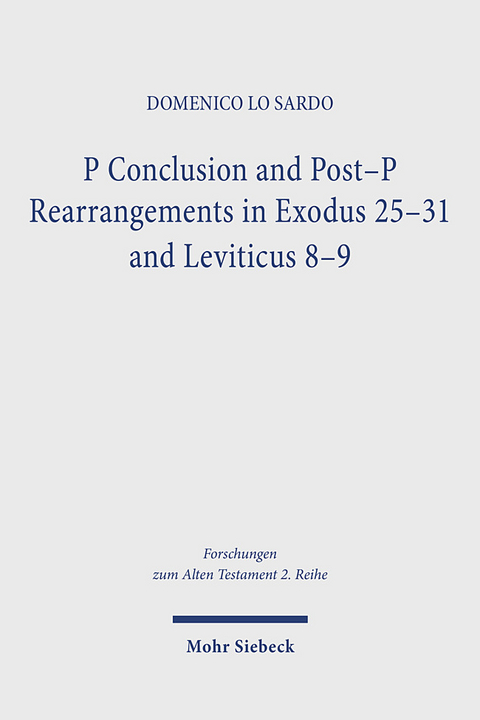
P Conclusion and Post-P Rearrangements in Exodus 25-31 and Leviticus 8-9
A Textual and Literary Criticism Study on the Pentateuch Formation
Seiten
2025
Mohr Siebeck (Verlag)
978-3-16-164684-3 (ISBN)
Mohr Siebeck (Verlag)
978-3-16-164684-3 (ISBN)
Mit der vorliegenden Studie zu Exodus 25-31 und Levitikus 8-9 baut Domenico Lo Sardo auf früheren Untersuchungen zu Exodus 3-40 auf und analysiert die literarische Entwicklung der Priesterschrift. Dabei legt es sich nahe, den Bau der Stiftshütte als Teil eines sich entwickelnden Projekts zu verstehen, das sich auf Raum, Zeit und göttliche Gegenwart konzentrierte und darauf abzielte, den Gottesdienst und die jüdische Identität nach dem Exil wiederherzustellen.
In this study, Domenico Lo Sardo examines the textual and literary development of Exodus 25-31 and Leviticus 8-9, expanding on prior research on the Tabernacle's second account (Exodus 35-40). He argues that Exodus 25-31 was later composed to legitimize the Temple's construction and was shaped alongside Leviticus 8. Challenging the idea of an early, fully developed Priestly Writing (Pg), his analysis of the texts studied in terms of textual and literary criticism presents it as an evolving tradition with a multistage production history. He further demonstrates that Priestly Writing (P) concludes at Leviticus 8 and does not extend beyond this point. Highlighting themes of divine presence, worship, and sacred space, the author ultimately situates the Temple-cult project within the broader theological framework of creation and covenant fulfillment.
In this study, Domenico Lo Sardo examines the textual and literary development of Exodus 25-31 and Leviticus 8-9, expanding on prior research on the Tabernacle's second account (Exodus 35-40). He argues that Exodus 25-31 was later composed to legitimize the Temple's construction and was shaped alongside Leviticus 8. Challenging the idea of an early, fully developed Priestly Writing (Pg), his analysis of the texts studied in terms of textual and literary criticism presents it as an evolving tradition with a multistage production history. He further demonstrates that Priestly Writing (P) concludes at Leviticus 8 and does not extend beyond this point. Highlighting themes of divine presence, worship, and sacred space, the author ultimately situates the Temple-cult project within the broader theological framework of creation and covenant fulfillment.
Born 1978; 2009 B.S. from the Theology Faculty of Sicily (Palermo); 2013 S.S.L. from the Pontifical Biblical Institute (Rome); 2018 S.S.D. from the Pontifical Biblical Institute; since 2018 Visiting Professor at the Franciscan Institute of Spirituality of the Pontifical University of Antonianum (Rome).
| Erscheinungsdatum | 30.09.2025 |
|---|---|
| Reihe/Serie | Forschungen zum Alten Testament 2. Reihe |
| Verlagsort | Tübingen |
| Sprache | englisch |
| Maße | 155 x 232 mm |
| Gewicht | 564 g |
| Themenwelt | Religion / Theologie ► Christentum ► Bibelausgaben / Bibelkommentare |
| Schlagworte | Cultic • Divine presence • Editorial Revision • Priestly Writing • Tabernacle |
| ISBN-10 | 3-16-164684-3 / 3161646843 |
| ISBN-13 | 978-3-16-164684-3 / 9783161646843 |
| Zustand | Neuware |
| Informationen gemäß Produktsicherheitsverordnung (GPSR) | |
| Haben Sie eine Frage zum Produkt? |
Mehr entdecken
aus dem Bereich

aus dem Bereich
Buch | Softcover (2021)
De Gruyter (Verlag)
CHF 44,90
warum ich der Bibel trotzdem vertraue
Buch | Hardcover (2024)
Gütersloher Verlagshaus
CHF 29,90


