


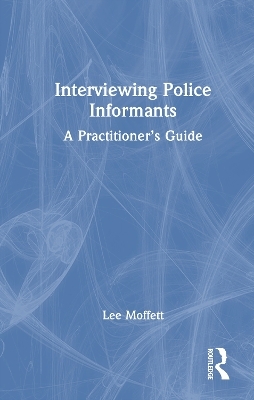
Interviewing Police Informants
A Practitioner’s Guide
Seiten
2025
Routledge (Verlag)
978-1-041-11292-1 (ISBN)
Routledge (Verlag)
978-1-041-11292-1 (ISBN)
This book provides students and practitioners alike with a comprehensive discussion of the latest psychological research relevant to interviewing informants. In particular, the book contains a detailed outline of the R-WITS-US interview model.
This book provides students and practitioners alike with a comprehensive discussion of the latest psychological research relevant to interviewing informants.
In particular, the book contains a detailed outline of the R-WITS-US (Review and Research; Welfare; Information; Tasking; Security; Understanding context; Sharing) interview model. This is a bespoke informant interview model that can be remembered by the axiom: Keeping our wits about us. The current book examines the development of this model, bringing a clear focus on the specific definition of an informant and how this definition differentiates informants from other individuals who are likely to be interviewed by police – such as victims, witnesses, or suspects. A variety of relational and organisational objectives are identified and explored with the R-WITS-US model proposed as an ethical interview model capable of addressing these interconnected objectives. The aims of each individual phase are carefully explained, and practical examples of psychological techniques that can be used are provided throughout. The book concludes with a detailed example of the R-WITS-US model, highlighting how it could be employed in practice.
This book provides invaluable evidence-based guidance to practitioners, making it essential reading for police professionals who are required to understand and interview informants. It will also be useful secondary reading for professional policing students engaged in police practice, criminal investigation, and investigative interviewing.
This book provides students and practitioners alike with a comprehensive discussion of the latest psychological research relevant to interviewing informants.
In particular, the book contains a detailed outline of the R-WITS-US (Review and Research; Welfare; Information; Tasking; Security; Understanding context; Sharing) interview model. This is a bespoke informant interview model that can be remembered by the axiom: Keeping our wits about us. The current book examines the development of this model, bringing a clear focus on the specific definition of an informant and how this definition differentiates informants from other individuals who are likely to be interviewed by police – such as victims, witnesses, or suspects. A variety of relational and organisational objectives are identified and explored with the R-WITS-US model proposed as an ethical interview model capable of addressing these interconnected objectives. The aims of each individual phase are carefully explained, and practical examples of psychological techniques that can be used are provided throughout. The book concludes with a detailed example of the R-WITS-US model, highlighting how it could be employed in practice.
This book provides invaluable evidence-based guidance to practitioners, making it essential reading for police professionals who are required to understand and interview informants. It will also be useful secondary reading for professional policing students engaged in police practice, criminal investigation, and investigative interviewing.
Lee Moffett has over 25 years of law enforcement experience as well as an MSc and PhD in investigative psychology. His research examines police informant interactions and includes Keeping our wits about us: Introducing a bespoke informant interview model for covert human intelligence source (CHIS) interactions.
Introduction 1. What is an Informant? 2. Understanding Informants 3. Relationship Building 4. Organisational Objectives 5. The Practitioner’s Perspective 6. Alternate Interview Models 7. Keeping It Ethical 8. Review and Research 9. Welfare 10. Information 11. Tasking 12. Security 13. Understanding Context 14. Sharing 15. An Example of R-WITS-US 16. Conclusion
| Erscheinungsdatum | 11.11.2025 |
|---|---|
| Zusatzinfo | 15 Tables, black and white; 4 Line drawings, black and white; 4 Illustrations, black and white |
| Verlagsort | London |
| Sprache | englisch |
| Maße | 129 x 198 mm |
| Gewicht | 530 g |
| Themenwelt | Geisteswissenschaften ► Psychologie ► Sozialpsychologie |
| Recht / Steuern ► Strafrecht ► Kriminologie | |
| Sozialwissenschaften ► Soziologie | |
| ISBN-10 | 1-041-11292-0 / 1041112920 |
| ISBN-13 | 978-1-041-11292-1 / 9781041112921 |
| Zustand | Neuware |
| Informationen gemäß Produktsicherheitsverordnung (GPSR) | |
| Haben Sie eine Frage zum Produkt? |
Mehr entdecken
aus dem Bereich


aus dem Bereich
Handbuch für Therapeuten und Coaches
Buch | Softcover (2025)
Karl F. Haug (Verlag)
CHF 89,95
Buch | Softcover (2024)
Heyne (Verlag)
CHF 16,80


