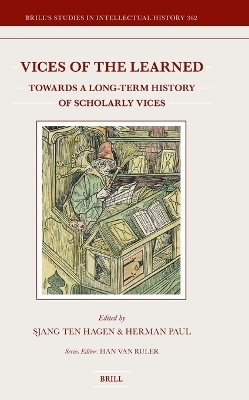
Vices of the Learned
Brill (Verlag)
9789004725041 (ISBN)
Why are professors still warning their students against dogmatism, prejudice, pedantry, and other centuries-old vices? What explains the persistence of these scholarly vices across the ages?
With case studies from medieval Europe to twenty-first century America, Vices of the Learned offers a panoramic overview of qualities, habits, and inclinations that scholars at various times and places saw as detrimental to their work.
Innovative is the volume’s longue durée approach. The volume breaks new ground in highlighting the importance of “low” genres (aphorisms, proverbs, anecdotes) and stereotypical figures (the pedant, the charlatan, the mammon) in transmitting vices over time.
Sjang ten Hagen is Assistant Professor in Liberal Arts and Sciences at Utrecht University. He worked as a postdoctoral researcher in the project Scholarly Vices: A Longue Durée History at Leiden University. Herman Paul is Professor of the History of the Humanities at Leiden University. From 2019 to 2025, he led the project Scholarly Vices: A Longue Durée History, out of which this volume has emerged.
Acknowledgements
Introduction
1 The Euthalian Tradition and Its Features
2 Additional Items Not Catalogued
3 The Corpus
4 Using the Catalogue
5 Using the Feature Inventory
6 The Euthalian Tradition and Catenae: A Test Case
Catalogue
A Substantial Witnesses (22)
B Intermediate Witnesses (245)
C Chapter Lists and/or Hypotheses Only (264)
D In-Text Annotations Only (19)
E Miscellaneous Witnesses (40)
F Fragmentary Witnesses (37)
G Manuscripts with No Euthalian Material (162)
H Manuscripts Not Marked in the Catalogue (106)
Features Inventory
Catena Cross-Reference List
Bibliography
Gregory-Aland and Ditykon Number Index
Acknowledgments
Notes on Contributors
1 Introduction: towards a Long-Term History of Scholarly Vices
Herman Paul
Part 1 Vice Terms
2 Tracing the Development of curiositas in Early Condemnations of the University
From Academics’ Useless Curiosity to Education for Productive Action
Richard Newhauser
3 Notes towards a History of “Prejudice,” Early to Late Modern
Sorana Corneanu
4 Dogmatism: the Persistence of an Umbrella Term
Alexander Stoeger
5 Scholasticism as a Scholarly Vice Term: from the Middle Ages to the Twenty-First Century
Sjang ten Hagen
Part 2 Figurations of Vice
6 The Persistence of the Pedant
Arnoud Visser
7 The Many Lives of the Charlatan: on the Persistence of an Embodiment of Scholarly Vices
Marian Füssel
8 From the Novum Organum to the Forensic Crime Lab: the Modern Afterlives of Francis Bacon’s Idols of the Mind
Edurne De Wilde
9 The Mammon Metaphor in American Science: Continuities and Discontinuities, 1890–2010
Pieter Huistra and Herman Paul
Part 3 Media of Circulation
10 Medical Vices and Proverbial Expressions in Eighteenth-Century Medical Dissertations on Moderation, Patience, and Trust
Sari Kivistö
11 Mocking Medieval Minds: How Modern Histories of Science Transmitted Scholarly Vices
Sjang ten Hagen
12 Student Advice Literature and the Vice of Uninformed Studying: from Hodegetik to Study Vlogs
Anne Por
13 Conclusion: How and Why Scholarly Vices Persisted over Time
Sjang ten Hagen and Herman Paul
Index
| Erscheinungsdatum | 21.10.2025 |
|---|---|
| Reihe/Serie | Brill's Studies in Intellectual History ; 362 |
| Verlagsort | Leiden |
| Sprache | englisch |
| Maße | 155 x 235 mm |
| Gewicht | 716 g |
| Themenwelt | Geisteswissenschaften ► Geschichte |
| Geisteswissenschaften ► Philosophie ► Geschichte der Philosophie | |
| Geisteswissenschaften ► Philosophie ► Philosophie der Neuzeit | |
| Naturwissenschaften | |
| ISBN-13 | 9789004725041 / 9789004725041 |
| Zustand | Neuware |
| Informationen gemäß Produktsicherheitsverordnung (GPSR) | |
| Haben Sie eine Frage zum Produkt? |
aus dem Bereich