


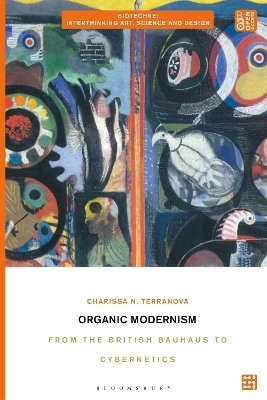
Organic Modernism
From the British Bauhaus to Cybernetics
Seiten
2026
Bloomsbury Visual Arts (Verlag)
978-1-350-22757-6 (ISBN)
Bloomsbury Visual Arts (Verlag)
978-1-350-22757-6 (ISBN)
- Noch nicht erschienen (ca. Mai 2026)
- Versandkostenfrei
- Auch auf Rechnung
- Artikel merken
When artists, scientists, and designers unite they create new ways of thinking and alternative paths to problem solving.
The first book to trace the story of British "organic modernism", this ground-breaking open access study tells the story of a collective culture of artists, scientists, and designers in 20th century united by a holistic understanding of the organic world and devoted to collaboration, cooperation, and cross-pollination of the arts and biological sciences.
Tracing how artists, scientists, and designers cooperated in various capacities from the Great Depression to postwar cybernetics, this book follows the evolution of philosophical organicism from the British Bauhaus, modern architecture, and surrealism; through to post-war socialism, the welfare state, epigenetics, biology-based art exhibitions; robotic art and design, cybernetics and ecology in art. Reacting against blunt reductionism, organic modernists implemented organicist and emergentist philosophies in scientific labs, design studios, and art ateliers, embracing complexity to solve problems in various scales and arenas, from cells to socialism. Their actions offer a template for finding meaningful agency and problem solving in today's world fraught by global climate disaster, ever-expanding economic inequalities, and backsliding democracy
A sequel to Terranova's Art as Organism: Biology and the Evolution of the Digital Image (2016), Organic Modernism reveals the biological roots of cybernetics in the British context.
The ebook editions of this book are available open access under a CC BY-NC-ND 4.0 licence on bloomsburycollections.com. Open access was funded by the Edith O'Donnell Institute of Art History.
The first book to trace the story of British "organic modernism", this ground-breaking open access study tells the story of a collective culture of artists, scientists, and designers in 20th century united by a holistic understanding of the organic world and devoted to collaboration, cooperation, and cross-pollination of the arts and biological sciences.
Tracing how artists, scientists, and designers cooperated in various capacities from the Great Depression to postwar cybernetics, this book follows the evolution of philosophical organicism from the British Bauhaus, modern architecture, and surrealism; through to post-war socialism, the welfare state, epigenetics, biology-based art exhibitions; robotic art and design, cybernetics and ecology in art. Reacting against blunt reductionism, organic modernists implemented organicist and emergentist philosophies in scientific labs, design studios, and art ateliers, embracing complexity to solve problems in various scales and arenas, from cells to socialism. Their actions offer a template for finding meaningful agency and problem solving in today's world fraught by global climate disaster, ever-expanding economic inequalities, and backsliding democracy
A sequel to Terranova's Art as Organism: Biology and the Evolution of the Digital Image (2016), Organic Modernism reveals the biological roots of cybernetics in the British context.
The ebook editions of this book are available open access under a CC BY-NC-ND 4.0 licence on bloomsburycollections.com. Open access was funded by the Edith O'Donnell Institute of Art History.
Charissa N. Terranova is Margaret M. McDermott Distinguished Chair in Art and Aesthetic Studies and Professor of Art and Architectural History at the University of Texas at Dallas, USA
List of Illustrations
Preface
Chapter 1 Organicism Abounds: British Intellectual Culture in the 1930s
Chapter 2 Biology and the British Bauhaus: From the Laboratory to Modern Design
Chapter 3 Romantic Genetics: Landscape Lived, Rendered, and Epigenetic
Chapter 4 Exhibition as Extended Organism: Three Shows in 1951
Chapter 5 The Eccentric Cybernetics of György Kepes and Organic Modernism
Conclusion Teachback and the Heuristics of Organic Modernism
Bibliography
Index
| Erscheint lt. Verlag | 28.5.2026 |
|---|---|
| Reihe/Serie | Biotechne: Interthinking Art, Science and Design |
| Zusatzinfo | 16 colour & 71 bw illus |
| Verlagsort | London |
| Sprache | englisch |
| Maße | 156 x 234 mm |
| Themenwelt | Kunst / Musik / Theater ► Allgemeines / Lexika |
| Kunst / Musik / Theater ► Kunstgeschichte / Kunststile | |
| Geisteswissenschaften ► Geschichte ► Regional- / Ländergeschichte | |
| ISBN-10 | 1-350-22757-9 / 1350227579 |
| ISBN-13 | 978-1-350-22757-6 / 9781350227576 |
| Zustand | Neuware |
| Informationen gemäß Produktsicherheitsverordnung (GPSR) | |
| Haben Sie eine Frage zum Produkt? |
Mehr entdecken
aus dem Bereich


aus dem Bereich
die Geschichte meiner Urgroßmutter
Buch | Hardcover (2025)
C.H.Beck (Verlag)
CHF 32,15
Träume und Macht : eine Biografie
Buch | Hardcover (2025)
C.H.Beck (Verlag)
CHF 61,60


