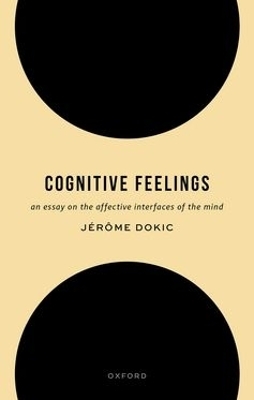
Cognitive Feelings
Oxford University Press (Verlag)
978-0-19-288218-9 (ISBN)
This book proposes a comprehensive theory of cognitive feelings, also referred to as 'noetic', 'epistemic', or 'metacognitive' feelings. There are pivotal moments in our mental lives when, even before we have explicitly thought or reflected on the matter, we become aware of our own epistemic relationship with the world and the extent to which we can exert control over it. The book analyses these moments and the subjective experiences involved, which can be fleeting or more lasting. These experiences are cognitive feelings, such as feelings of familiarity, knowing, confidence, rightness, understanding, certainty, presence, and reality and, on the negative side, feelings of unfamiliarity or strangeness, not knowing, wrongness, perplexity, doubt, uncertainty, absence, and unreality. Some cognitive feelings have evocative names, such as the tip-of-the-tongue experience, the 'aha' moment, or the 'eureka' effect. The set of cognitive feelings has fuzzy boundaries, and shares similarities with other experiences, such as surprise, curiosity, and interest, but also with intuitions, hunches, or presentiments.
The book puts forward a unified account of cognitive feelings as genuine affective experiences that play a constitutive role in the geography and economy of the mind at the interfaces between perception, memory, imagination, belief, and action. Like ordinary emotions, cognitive feelings have both an evaluative and a motivational dimension. Specifically, they are based on monitoring features of our epistemic situation and generate action tendencies aimed at improving it. The book also presents detailed applications of this account to two main types of cognitive feelings, namely feelings of reality and familiarity. It examines the role of these feelings in various domains such as virtual reality, aesthetic experiences, and self-transcendent experiences (i.e., experiences in which the apparent boundaries between the self and the external world are altered). The methodology is philosophical analysis informed by empirical studies in cognitive science.
Jérôme Dokic is Professor of Cognitive Philosophy at the École des Hautes Études en Sciences Sociales (EHESS) and a member of Institut Jean-Nicod in Paris. He has written many essays on indexicality, perception, memory, and imagination and more recently aesthetic experience and cognitive feelings. His previous books include La philosophie du son with Roberto Casati (Philosophy of sound, Chambon, 1994), L'esprit en mouvement: Essai sur la dynamique cognitive (Mind in motion: Essay on cognitive dynamics, CSLI, 2001), Qu'est-ce que la perception? (What is perception?, Vrin, 2nd edition, 2009), and Ramsey: Truth and Success with Pascal Engel (Routledge, 2002).
1: Introduction: What Are Cognitive Feelings and Why Study Them?
Part I. Foundations
2: Cognitive Feelings and Emotions
3: Psychological Models of Cognitive Feelings
4: Epistemological Models of Cognitive Feelings
Part II. Applications
5: Reality I: Presence and Virtuality
6: Reality II: Monitoring and Cues
7: Familiarity
8: Reality, Familiarity, and Recognition
9: Memory Feelings
Part III. Transfigurations
10: Aesthetic Experiences
11: Self-Transcendent Experiences
12: General Conclusion: Results and Prospects
| Erscheinungsdatum | 11.11.2025 |
|---|---|
| Zusatzinfo | 3 Figures, 5 Tables |
| Verlagsort | Oxford |
| Sprache | englisch |
| Maße | 146 x 223 mm |
| Gewicht | 405 g |
| Themenwelt | Geisteswissenschaften ► Philosophie ► Erkenntnistheorie / Wissenschaftstheorie |
| Geisteswissenschaften ► Psychologie ► Verhaltenstherapie | |
| ISBN-10 | 0-19-288218-X / 019288218X |
| ISBN-13 | 978-0-19-288218-9 / 9780192882189 |
| Zustand | Neuware |
| Informationen gemäß Produktsicherheitsverordnung (GPSR) | |
| Haben Sie eine Frage zum Produkt? |
aus dem Bereich