


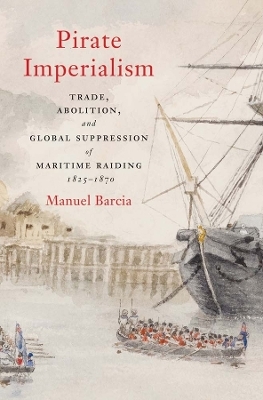
Pirate Imperialism
Trade, Abolition, and Global Suppression of Maritime Raiding, 1825–1870
Seiten
2026
Yale University Press (Verlag)
978-0-300-26945-1 (ISBN)
Yale University Press (Verlag)
978-0-300-26945-1 (ISBN)
- Lieferbar (Termin unbekannt)
- Versandkostenfrei
- Auch auf Rechnung
- Artikel merken
This first truly global history of the suppression of piracy links maritime raiding to empire building in the nineteenth century
In the middle decades of the nineteenth century, imperial powers around the world came into direct confrontation with local resistance in the form of maritime raiding. From the Atlantic basin to the western Mediterranean Sea, the Persian Gulf and the east coast of Africa, and Southeast Asia and China, imperial powers claimed that progress was being held back by the barbarity and greed of pirates, who repeatedly attacked imperial vessels. The suppression of piracy, justified under the banner of spreading civilization and free trade and abolishing slavery and the slave trade, provided both western and non-western powers with a back door for territorial expansion and the enforcement of imperialist agendas.
Historian Manuel Barcia tells the story of these conflicts, showing how imperialist powers frequently used anti–maritime raiding efforts as excuses to cement western supremacy in various parts of the world, while simultaneously resorting to violent means that were indistinguishable from the methods of those they accused of being pirates.
In the middle decades of the nineteenth century, imperial powers around the world came into direct confrontation with local resistance in the form of maritime raiding. From the Atlantic basin to the western Mediterranean Sea, the Persian Gulf and the east coast of Africa, and Southeast Asia and China, imperial powers claimed that progress was being held back by the barbarity and greed of pirates, who repeatedly attacked imperial vessels. The suppression of piracy, justified under the banner of spreading civilization and free trade and abolishing slavery and the slave trade, provided both western and non-western powers with a back door for territorial expansion and the enforcement of imperialist agendas.
Historian Manuel Barcia tells the story of these conflicts, showing how imperialist powers frequently used anti–maritime raiding efforts as excuses to cement western supremacy in various parts of the world, while simultaneously resorting to violent means that were indistinguishable from the methods of those they accused of being pirates.
Manuel Barcia is pro-vice-chancellor for global engagement at the University of Bath. He has published five books, the most recent of which, The Yellow Demon of Fever, won the Paul E. Lovejoy Prize.
| Erscheinungsdatum | 06.01.2026 |
|---|---|
| Zusatzinfo | 19 b-w illus. |
| Sprache | englisch |
| Maße | 156 x 235 mm |
| Themenwelt | Geschichte ► Allgemeine Geschichte ► Neuzeit (bis 1918) |
| Geisteswissenschaften ► Geschichte ► Teilgebiete der Geschichte | |
| ISBN-10 | 0-300-26945-5 / 0300269455 |
| ISBN-13 | 978-0-300-26945-1 / 9780300269451 |
| Zustand | Neuware |
| Informationen gemäß Produktsicherheitsverordnung (GPSR) | |
| Haben Sie eine Frage zum Produkt? |
Mehr entdecken
aus dem Bereich


aus dem Bereich
Geschichte einer wilden Handlung
Buch | Hardcover (2024)
C.H.Beck (Verlag)
CHF 47,60


