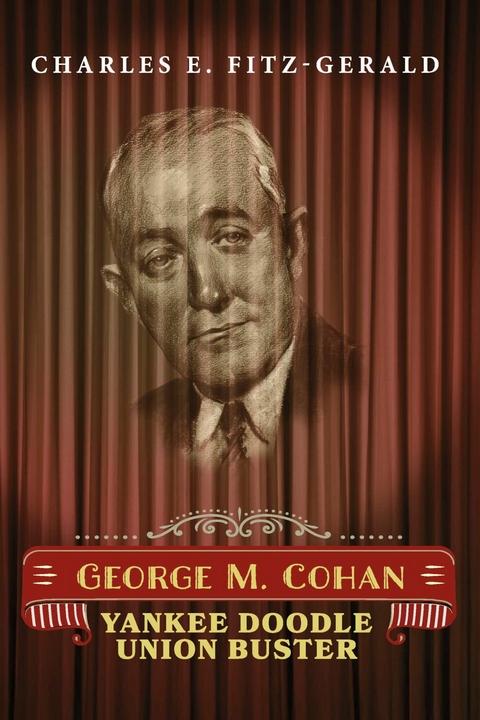
George M. Cohan (eBook)
368 Seiten
Bookbaby (Verlag)
979-8-3178-0199-1 (ISBN)
Charles E. Fitz-Gerald has published numerous articles in national and regional magazines, including Yankee, New York Alive, Georgia Backroads, and Columbia. His article, 'The Man Who Last Saw Lincoln,' was selected as one of thirty-six articles for the book, 'The Best of Yankee Magazine 1935-1985.' In addition, he has authored several one-act plays that have been produced by theaters in the Albany area, as well as other regions of New York State. Charles holds a bachelor's degree in theater from Syracuse University and a master's in theater from Regent University.
He was not the amiable, gracious guy portrayed by Jimmy Cagney in the movie. If you have ever watched "e;Yankee Doodle Dandy"e; based on the life of George M. Cohan, you probable came away feeling Cohan must have been a felicitous gentleman: who would not like him? That question was emphatically answered during the Actors' Strike of 1919 when bitter contempt was directed toward Cohan by the majority of those who shared his profession, his fellow actors. The strike was engendered by a long history of mistreatment of actors and the obstinate refusal of producers to recognize their union, the Actors Equity Association. Incredibly, the producer who was the most obdurate and vitriolic opponent of the actors' cause was George M. Cohan, a man who had spent his life on stage. Commenting on this paradox, Equity's first president, Francis Wilson, said, "e;It seems remarkable what with his theatrical lineage, he could have set his face against the fighting of long-standing abuses to the people of his profession. This attitude of his is still a matter of amazement."e;Within "e;George M. Cohan: Yankee Doodle Union buster"e; discover Cohan's primary role in hindering negotiations and extending the strike. It was a part he willingly played and would defend until his death.
Chapter One
The Life of an Actor in Colonial Times
The early colonists came to North America with the intent of building a new habitation filled with structures that would tame the inhospitable wilderness. First, houses were needed, followed by churches and schools and hospitals and stores, and so forth. There was no pressing need for theatres.
The heart of legitimate theatre in America today, New York City was anything but conducive to the performing arts when it was called New Amsterdam by the Dutch who settled in what is now Manhattan in 1624. The Dutch were not so much anti-theatrical based on religious objections as they were frugal. They were convinced that attending plays was a frivolous use of time and more importantly, a waste of money. When the Dutch were usurped by the British in 1664, New Amsterdam ceased to be and New York was born.
These were the people of England: the Country that 75 years earlier had witnessed the dawn of a golden age of theatre, with the emergence of William Shakespeare, the world’s greatest playwright. As a manager of the Kingsmen Acting Company, Shakespeare and his partners built the Globe Theatre in 1599. It is reasonable to assume that some of the colony’s new settlers must have seen the Globe and even attended plays there. They had a readymade template from which to avail themselves, but they did not. Though the nationality of the governing body may have changed, the cultural ethos did not--it was still anti-theatre, with a good portion of the population continuing to speak Dutch and holding fast to the manners and values of their forefathers. On May 6, 1709, the City Council passed an ordinance forbidding “play-acting and prize-fighting.” While there likely existed forms of informal entertainment and amateur presentations, it would be decades before New York would see its first professional stage production.
Beginning in 1749, a British troupe headed by actors-managers, Thomas Keane and Walter Murray, had begun performing in the colonies. In 1750, they retrofitted a warehouse on Nassau Street into a serviceable theatrical space; and on March 5th, they presented “Richard the III.”1 Despite some success for Keane and Murray, a more welcoming social climate in then New York was required for professional theatre to take root and germinate in the New World.
Virginia’s first settlers were Episcopalians, entrenched by law to the exclusion of other denominations. As a sect, the Episcopalians were then far more open-minded toward theatrical presentations than the settlers to the north in New England, New York, and Pennsylvania. The Presbyterians in New England were steadfast in opposing “those ‘profane stageplays’ which had been the delight of the Jacobite cavilers, the enemy of their forefathers.”2 The Puritans in Massachusetts charged that playhouses “were responsible for emptying the churches, aiding the Pope, inducing the Lord to visit the plague upon London, corrupting maidens and chaste wives, and providing a marketplace for harlots and their customers.”3 They were only outdone by the Quakers in Philadelphia who were scandalized by the wearing of colors other than black let alone the idea of stage presentations. In the colonies where religious zealots held sway, laws were enacted prohibiting theatrical presentations. The only colonies that never passed anti-theatre laws were Maryland and Virginia.4
Well aware of these forces at play, the manager of the London theatre where Garrick became famous, William Hallman instructed his brother, Lewis, to take his troupe of players to Virginia to establish a resident company in America. The group, composed of twelve adults and three children, is generally considered to be the first professional residential company in America. At that time, Williamsburg was the capital of Virginia, and it was there that the Hallman Company staged its first performance in 1752 after securing permission from Governor Dinwiddie.5 They had found an unoccupied building and converted it into a theatre.
After eleven months in Williamsburg, Lewis Hallman decided to go to New York, being persuaded that the company would find a warm reception there. On September 17, 1753, Hallman opened his theatre on Nassau Street. They billed themselves as a “Company of Comedians from London” knowing that gave them a special cache with the city’s population.
Throughout those early years, English plays, principally Shakespearean, dominated the dramaturgy offered. George Bromwell by George Lillo was also popular due mainly to its strong moral message of evil being punished. This made the tragedy a hard target for those critics hostile to stage plays.
As the next decades rolled past, the inveiglement of Englishness waned and in the late 1760s and early 1770s, an increase in presentations with political undertones took place.6 Addison’s Cato was one of the most popular presentations, combining neoclassical correctness with Whig politics. This was evidenced by Cato’s choice of death over submission to Caesar. Other plays were written simply as vehicles for the use of characters as mouthpieces of one political position or another: either Tory or Whig. Clearly, George M. Cohan was not the first flag-waving playwright in America.
With England’s final withdrawal from America in 1783, the need for jingoistic propaganda plays ended, and the ground for a new drama steeped in the fledgling country’s culture and mores emerged--one not beholding to European aesthetics.
Although it would be almost a century before American playwrights significantly contributed to a new drama, the process began with The Contrast by Royall Tyler which was presented in 1787 at the John Street Theatre in New York. It is with this play that the character of a rural American is first introduced: a country lad who is unsophisticated but noble of heart and possessed of good common sense. The character of Jonathan, a rustic servant, is brought to the city where he clashes with the Anglophile, Billy Dimple, who is intent on espousing the social attitudes of the departed British. The central conceit of the play indicates that Americans are virtuous, noble, unpretentious, and clear-thinking, and it is the effete fops who affect aristocratic airs in the seductive city who deserve ridicule. “The play reveals the contrast between Americans who are themselves and those who try to be something they are not, between dowdy virtue and supposedly fashionable deceit and selfishness, between independence and servility.”7
The colonies were driven fundamentally by a rural economy and agriculturally associated businesses. Consequently, the population was dispersed and urban areas sufficient in size to support a theatre were few. Even by 1800, there were only five cities in America with populations exceeding 8,000.
The theatre companies in those municipalities were compelled to follow the reparatory model. With such a limited scope of possible patrons, the same theatre-goers had to be enticed to attend over and over. To keep them coming back, the offerings needed to change almost nightly. Moreover, to draw the broadest audience, stage presentations had to appeal to a cross-section of the city’s population. In addition to a full-length play, the audience might see a musical drama, pantomime, or brief farce. If the play was a long one, variety performers were interjected between acts. These could include acrobats, dancers, animal acts, or freaks.8
For a theatre to change its bill nightly, it was necessary to have a large menu of offerings at its disposal. It was not unusual for a theatre in the late 1700s to have an active repertoire of as many as seventy-five plays.
These theatres were comprised of a group of actors who were hired for the season. At the company’s head was a manager, who usually owned or leased the theatre. Often, the manager was also the theatre’s leading actor and the company might include several of his family members. Actors were hired by type to fill rigidly defined roles or “lines of business.” They usually had trained to fit a specific mold and would follow it throughout their career. A typical stock company would consist of: first and second male and female leads, a first and second male and female ingénue, first and second old man and woman, first and second juveniles, a leading comedian and first comedian, a chambermaid, and servant plus utility actors and apprentices.9
To a certain degree, playing the same archetype over and over certainly facilitated actors appearing as a similar character in a different play almost every night. Actors were expected to know their line of business and required little supervision; therefore, directing was limited. With no time to develop a character, stock actors would draw on a storehouse of practiced mannerisms that could be used for a similar character in any play.
It was a hard life for the actors in a stock company. The manager’s word was law and the schedule was severe. In addition to nightly performances, as many as three plays might be rehearsed every day. Inordinate physical stamina was needed and the toll on mental resources could be even greater, which was often evidenced on stage in the evening...
| Erscheint lt. Verlag | 23.6.2025 |
|---|---|
| Sprache | englisch |
| Themenwelt | Geschichte ► Teilgebiete der Geschichte ► Kulturgeschichte |
| ISBN-13 | 979-8-3178-0199-1 / 9798317801991 |
| Informationen gemäß Produktsicherheitsverordnung (GPSR) | |
| Haben Sie eine Frage zum Produkt? |
 EPUB (Ohne DRM)
Größe: 2,4 MB
Digital Rights Management: ohne DRM
Dieses eBook enthält kein DRM oder Kopierschutz. Eine Weitergabe an Dritte ist jedoch rechtlich nicht zulässig, weil Sie beim Kauf nur die Rechte an der persönlichen Nutzung erwerben.
Dateiformat: EPUB (Electronic Publication)
EPUB ist ein offener Standard für eBooks und eignet sich besonders zur Darstellung von Belletristik und Sachbüchern. Der Fließtext wird dynamisch an die Display- und Schriftgröße angepasst. Auch für mobile Lesegeräte ist EPUB daher gut geeignet.
Systemvoraussetzungen:
PC/Mac: Mit einem PC oder Mac können Sie dieses eBook lesen. Sie benötigen dafür die kostenlose Software Adobe Digital Editions.
eReader: Dieses eBook kann mit (fast) allen eBook-Readern gelesen werden. Mit dem amazon-Kindle ist es aber nicht kompatibel.
Smartphone/Tablet: Egal ob Apple oder Android, dieses eBook können Sie lesen. Sie benötigen dafür eine kostenlose App.
Geräteliste und zusätzliche Hinweise
Buying eBooks from abroad
For tax law reasons we can sell eBooks just within Germany and Switzerland. Regrettably we cannot fulfill eBook-orders from other countries.
aus dem Bereich