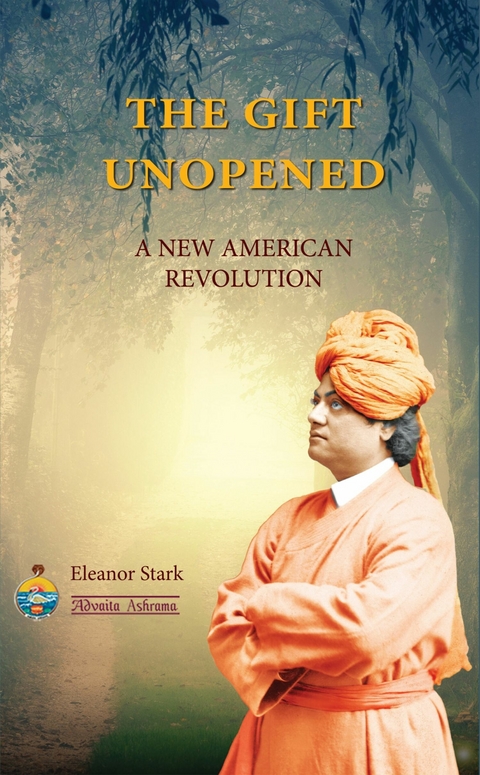
The Gift Unopened (eBook)
292 Seiten
Advaita Ashrama (Verlag)
978-0-00-072831-9 (ISBN)
The Gift Unopened-A New American Revolution explores Swami Vivekananda's spiritual gift to the modern world, which, as the title suggests, remains unopened till date.
By the late 19th and early 20th centuries, it was clear that political and economic solutions alone were insufficient to address the challenges and the widespread side-effects of industrial and technological growth in the 'industrialized world'. In this context, Swami Vivekananda's arrival in America in 1893 and his introduction of Vedanta marked a new era. His life-giving and soul-enriching message of Vedanta can instil hope and enlightenment. Though originally written for the American context, the book is relevant to all the people of the industrialized world.
CHAPTER ONE
EX ORIENTE LUX (*)
The millions are awake enough for physical labor; but only one in a million for effective intellectual exertion; only one in a hundred millions to a poetic or divine life. I have never yet met a man who was quite awake. How could I have looked him in the face?
—Henry David Thoreau
He spoke powerfully, he worked powerfully, and his body was built powerfully. A sickly saint everyone understands, but who ever heard of a powerful saint?
—Christine Greenstidel
ARRIVAL IN ANNISQUAM UNDER THE AEGIS OF PROFESSOR HENRY WRIGHT OF HARVARD
1. It was a chilly, blustery summer day in the little seacoast village of Annisquam on the Massachusetts coast, near Gloucester. Although the Cape Ann Breeze wrote in its columns of the unusual weather of that weekend of 1893, not many villagers were aware of an uncommon event about to take place in
Annisquam, filled for the summer months with the families of professors, artists, clergymen, and writers from Boston, Cambridge, and other Eastern cities as far as Chicago. The village in its sheltered cove was a peaceful and picturesque summer colony. Artists, including America’s famous Winslow Homer, found it a charming place to sketch and paint, with its lighthouse, granite hills and boulder-strewn pastures, its old wharves and dories.
Local residents had turned their homes into accommodations for the summer visitors and one of the largest, Miss Lane’s Boarding House, set just above Lobster Cove, had many spacious rooms and a dining room equipped with two long tables. On that chilly day of August 25, 1893, the boarders of “Aunt Tot”, as Charlotte Lane was affectionately called by the villagers, were all agog with anticipation and excitement. Professor John Henry Wright of Harvard University, who summered with his family at Miss Lane’s Annex, “The Lodge”, was due on that Friday with a foreign visitor, a young Hindu monk whom the professor had recently met. Impressed by the brilliant mind and the radiant personality of his new friend, Professor Wright had already made arrangements for him to attend and represent Hinduism at the Parliament of Religions in Chicago, soon to convene as part of the World’s Columbian Exposition of 1893. As the professor explained it, “This is the only way you can be introduced to the nation at large.”
Something about this appealing stranger had deeply impressed the learned and eminent professor of Greek Classics and had inspired him to write to the Chairman of the Delegate Committee in Chicago, “Here is a man who is more learned than all of our learned professors put together” and who, in answer to the monk’s remark that he had no credentials, had replied, “To ask you, Sir, for credentials is like asking the sun to state its right to shine!” Did the professor realize that by his help and encouragement he was preparing the way for an advent on the American scene that was so profound, so momentous, that it would be almost a hundred years before the impact was ready to be felt by a people increasingly burdened with material saturation and moral decay?
All Professor Wright knew, at that moment, was that he was in the presence of a force, the dimensions of which he could barely surmise but which had captivated him. The melodious voice, the leonine bearing, the spiritual glow in the great dark eyes of this young man of twenty-nine attracted all who approached him and when he spoke there was a strange and compelling reverberation felt within all who heard him.
Mrs. Wright, recording later this visit to Annisquam from notes taken at the time, wrote: “One day, at an unfashionable place by the sea, the professor was seen crossing the lawn between the boarding-house and his cottage accompanied by a man in a long red coat. The coat, which had something of a priestly cut, descended far below the man’s knees and was girded around the waist with a thick cord of the same reddish-orange tint. He walked with a strange, shambling gait, and yet there was a commanding dignity and impressiveness in the carriage of his neck and bare head that caused everyone in sight to stop and look at him; he moved slowly with the swinging tread of one who has never hastened, and in his great dark eyes was the beauty of an alien civilization...
“All the people of that little place were moved and excited by this young man, in a manner beyond what might be accounted for by his coming from a strange country and a different people. He had another power, an unusual ability to bring his hearers into vivid sympathy with his own point of view... People of all degrees were interested; women’s eyes blazed and their cheeks were red with excitement; even the children of the village talked of what he had said to them; all the idle summer boarders trooped to hear him, and all the artists observed him and wanted to paint him.”
That Sunday the Hindu monk was asked to speak at the Annisquam Universalist Church at the invitation of Rev. G.W. Penniman, its pastor. It was his first public discourse in America. In the words of Elva Nelson, who recently researched that visit to Annisquam, “It marked the beginning of his unprecedented work in the West. It was in this quiet village, Annisquam, from where ships had sailed to China and India before Revolutionary times, that another revolution was so quietly begun.”
The talk that was given that Sunday in the little church in Annisquam was the first gleam of lightning that heralded the approach of a spiritual storm that gathered force and power from the first rumblings of a triumphal recognition at the Parliament of Religions in Chicago to a full crescendo in an odyssey through cities and towns and homes across the land (the East Coast and the heartland of America from 1893 to 1896, and again the West Coast from 1899 to 1900) and then slowly died away after having watered and revivified the parched spiritual earth of America. Less than five years in all and yet history may some day record those years as the beginning of the regeneration of a great people who were given a mandate, in the words of mystical yet rational power, to find themselves, to shed the shackles of unexamined and futile attitudes and stances, to become aware that life itself is a religion that has no location in place and time, to awaken to new dimensions of existence to which science itself has already alerted us, and to realize the possibilities of becoming the vanguard of a new age of reconciliation among the peoples of the world.
Strong words, even greater assumptions, but as we follow this Vivekananda, or Swamiji as many came to call him (†), and record his message during those years of superhuman effort among us, we may come to the conclusion that, in the words of the Quakers, he “spoke to our condition”. As we examine our national heritage and speak of the troubles that beset us now, we shall see if he spoke the truth when he declared, “I have a message for the West as Buddha had a message for the East.”
With these words we are alerted that his challenge was no less than a call to the innate divinity of man, to the spirituality that is the core of every religion, to the possibility of breaking down the barriers that separate man from man; a call in words of incomparable power to a universal and practical spirituality. His most famous Western biographer, Romain Rolland, in his Life of Vivekananda speaks of the beauty and power of his speech: “His words are great music, phrases in the style of Beethoven, stirring rhythms like the march of Handel choruses. I cannot touch these sayings of his, scattered as they are through the pages of books at thirty years’ distance (1931) without receiving a thrill through my whole body like an electric shock. And what shocks... must have been produced when in burning words they issued from the lips of the hero!”
IMPACT ON THE PARLIAMENT OF RELIGIONS IN CHICAGO—TALKS AND NEWSPAPER ACCOUNTS
2. The Parliament of Religions convened in Chicago on the morning of September 11, 1893. Among the notables on that opening day at the Chicago Art Institute Vivekananda sat, appearing robust and serene in his brilliant orange-red turban. He later confessed in a letter that he felt far from calm within as he postponed from hour to hour his own opening address; he felt he was unprepared, he had no notes, no plan of action, his heart was fluttering, his mouth dry. The hall was filled to capacity with an estimated four thousand people. As the hours wore on and one speech followed another, a stir of restless fatigue began to permeate the crowd. Suddenly, late in the day, Vivekananda stood up. A hush fell as he slowly walked to the rostrum; then, as he spoke his opening words, “Sisters and brothers of America...” a thunderous roar of applause and acclaim resounded through the hall. People rose to their feet shouting and it was several minutes before he could continue. When he did, there was a profound quiet as the ringing, melodious voice sounded some deep chord in his audience as if they had awaited not only this direct and candid salutation as a brother but were hungry for a more profound message than formality had so far decreed. It was a short speech but it seemed to sound a keynote:
“Sisters and brothers of America, it fills my heart with joy unspeakable to rise in response to the warm and cordial welcome which you have given us. I thank you in the name of the most ancient order of monks in the world; I thank you in the name of the mother of religions; and I thank you in the name of millions and millions of Hindu people of all classes and all sects.
“My thanks also to some...
| Erscheint lt. Verlag | 19.2.2025 |
|---|---|
| Sprache | englisch |
| Themenwelt | Geisteswissenschaften ► Religion / Theologie ► Hinduismus |
| ISBN-10 | 0-00-072831-4 / 0000728314 |
| ISBN-13 | 978-0-00-072831-9 / 9780000728319 |
| Informationen gemäß Produktsicherheitsverordnung (GPSR) | |
| Haben Sie eine Frage zum Produkt? |
 EPUB (Adobe DRM)
Größe: 1,6 MB
Kopierschutz: Adobe-DRM
Adobe-DRM ist ein Kopierschutz, der das eBook vor Mißbrauch schützen soll. Dabei wird das eBook bereits beim Download auf Ihre persönliche Adobe-ID autorisiert. Lesen können Sie das eBook dann nur auf den Geräten, welche ebenfalls auf Ihre Adobe-ID registriert sind.
Details zum Adobe-DRM
Dateiformat: EPUB (Electronic Publication)
EPUB ist ein offener Standard für eBooks und eignet sich besonders zur Darstellung von Belletristik und Sachbüchern. Der Fließtext wird dynamisch an die Display- und Schriftgröße angepasst. Auch für mobile Lesegeräte ist EPUB daher gut geeignet.
Systemvoraussetzungen:
PC/Mac: Mit einem PC oder Mac können Sie dieses eBook lesen. Sie benötigen eine
eReader: Dieses eBook kann mit (fast) allen eBook-Readern gelesen werden. Mit dem amazon-Kindle ist es aber nicht kompatibel.
Smartphone/Tablet: Egal ob Apple oder Android, dieses eBook können Sie lesen. Sie benötigen eine
Geräteliste und zusätzliche Hinweise
Buying eBooks from abroad
For tax law reasons we can sell eBooks just within Germany and Switzerland. Regrettably we cannot fulfill eBook-orders from other countries.
aus dem Bereich