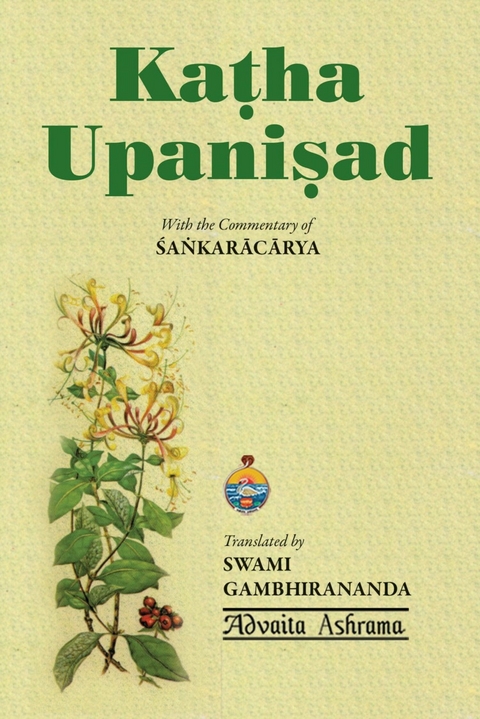
Katha Upanisad (eBook)
152 Seiten
Advaita Ashrama (Verlag)
9780000306791 (ISBN)
This Upanishad forms a part of the Brahmana belonging to the Katha Shakha of the Krishna Yajur Veda. It stands in a class by itself. It combines charming poetry, elevating mysticism, and profound philosophy. The subject of the mystery of death is introduced through the medium of an interesting anecdote; and the teaching of the Upanishad is presented in the form of a dialogue between a mere boy, Nachiketa, and Yama, the King of Death. With the text of the Upanishad in Devanagari, a lucid and faithful translation of the text and commentary, relevant notes, reference to quotations, and index to texts, this Upanishad is a must for all students of Vedanta.
Published by Advaita Ashrama, a publication house of Ramakrishna Math, Belur Math.
PART I
Canto II
Having tested the disciple and found his fitness for knowledge, he (Yama) said:
अन्यच्छ्रेयोऽन्यदुतैव प्रेय-
स्ते उभे नानार्थे पुरुषँ सिनीत: ।
तयो: श्रेय आददानस्य साधु
भवति हीयतेऽर्थाद्य उ प्रेयो वृणीते ।। १।।
1. The preferable is different indeed; and so, indeed, is the pleasurable different. These two, serving divergent purposes, (as they do), bind men. Good befalls him who accepts the preferable among these two. He who selects the pleasurable, falls from the true end.
Śreyaḥ, the preferable, the supreme goal (freedom); anyat eva, (is) certainly different. Similarly, uta, too; preyaḥ, the more pleasant; anyat eva, (is) different indeed. Te ubhe, both of them—the pleasurable and the preferable; nānā arthe, serving divergent purposes—as they do; sinītaḥ, bind; puruṣam, man—one who, as subject to caste, stage of life, etc., is competent (for either). All men are impelled by these two under an idea of personal duty; for according as one hankers after prosperity or immortality, one engages in the pleasurable or the preferable. Therefore, all men are said to be bound by these two through their sense of duty with regard to what leads to the pleasurable or the preferable. These two, though related severally to the (two) human goals (19), are opposed to each other, inasmuch as they are of the nature of knowledge and ignorance. Thus since these cannot be performed together by the same person, without discarding either of the two, therefore tayoḥ, of the two; ādadānasya, to one who accepts; only śreyaḥ, the preferable, by discarding the pleasurable, (the latter) being of the nature of ignorance; sādhu bhavati, well-being, good, comes (as a result). But he who is a short-sighted, the ignorant man, hīyate, gets alienated; arthāt, from this objective, from the human goal, i.e. he falls from the eternal supreme purpose. Who is that man? Yaḥ u, the one that; preyaḥ vṛṇīte, selects, i.e. takes hold of, the pleasurable.
If both can be done by a man at will, why do people cling mostly to the pleasurable only? This is being answered:
श्रेयश्च प्रेयश्च मनुष्यमेत:
तौ सम्परीत्य विविनक्ति धीर: ।
श्रेयो हि धीरोऽभि प्रेयसो वृणीते
प्रेयो मन्दो योगक्षेमाद्वृणीते ।। २।।
2. The preferable and the pleasurable approach man. The man of intelligence, having considered them, separates the two. The intelligent one selects the electable in preference to the delectable; the non-intelligent one selects the delectable for the sake of growth and protection (of the body etc.).
True it is that they are subject to (human) option ; still, since they are not easily distinguishable by men of poor intellect, either with regard to their means or with regard to their fruits, therefore, śreyaśca preyaśca, the preferable and the pleasurable; manuṣyam etaḥ (ā-itaḥ), approach this man, as though they are intermixed. Therefore, just as a swan separates milk from water, similarly dhīraḥ, a man of intelligence; samparītya, having surveyed fully, having considered mentally their importance and unimportance; vivinakti, separates; tau, those two, viz the preferable and the pleasurable things. And having distinguished, śreyaḥ hi, the electable indeed; abhivṛṇīte, (he) selects, because of its higher value; preyasaḥ, in comparison with the delectable. Who is he (that perfers)? Dhīraḥ, the intelligent man. As for the mandaḥ, the man of poor intelligence; he, because of a lack of discrimination, yogakṣemāt, for the sake of yoga and kṣema, i.e. for the growth and protection of the body etc.; vṛṇīte, selects; preyaḥ, the delectable, constituted by cattle, sons, etc.
स त्वं प्रियान्प्रियरूपांश्च कामान्
अभिध्यायन्नचिकेतोऽत्यस्त्राक्षी: ।
नैतां सृङ्कां वित्तमयीमवाप्तो
यस्यां मज्जन्ति बहवो मनुष्या: ।। ३।।
3. O Naciketā! you, such as you are, have discarded, after consideration, all the desirable things that are themselves delightful or are the producers of delight. You have not accepted this path of wealth in which many a man comes to grief.
Saḥ tvam, you, such as you are—though tempted by me again and again; abhidhyāyan, having considered—the defects such as impermanence and insubstantiality of; kāmān, desirable things; viz priyān, dear ones, such as children etc.; ca, and; priyarūpān, producers of delight, such as nymphs etc. (20); naciketāh, O Naciketā; atyasrākṣīḥ, you have discarded. What an intelligence you have! Na avāptaḥ, you have not accepted; etām, this; ugly sṛṇkām, course; vittamayīm, abounding in wealth, which is resorted to by ignorant people; yasyām, in which course; bahavaḥ, many; manuṣyāḥ, men; majjanti, sink, come to grief.
It has been said, ‘Good befalls him who accepts the preferable among these two. He who selects the pleasurable, falls from the true end.’ (I.ii.l) Why is that so? Because:
दूरमेते विपरीते विषूची
अविद्या या च विद्येति ज्ञाता ।
विद्याभीप्सिनं नचिकेतसं मन्ये
न त्वा कामा बहवोऽलोलुपन्त ।। ४।।
4. That which is known as knowledge and that which is known as ignorance are widely contradictory, and they follow divergent courses. I consider Naciketā to be an aspirant for knowledge, (because) the enjoyable things, multifarious though they be, did not tempt you.
Ete, these two; are dūram, widely, by a great distance; viparīte, contradictory, mutually exclusive, like light and darkness, they being of the nature of discrimination and non-discrimination; viṣūcī (i.e. viṣūcyau), have divergent courses, i.e. they produce different results, being the causes of worldly existence and emancipation. This is the idea. Which are they? The answer is: Yā ca, that which; jñātā, is fully ascertained, known by the learned; avidyā iti, as ignorance—which has for its object the pleasurable; yā ca, and that which; (is known) vidyā iti, as knowledge—which has for its object the preferable. Of these two, manye, I consider; you naciketasam, Naciketā; vidyābhīpsinam, as desirous of knowledge. Why? Because, kāmāḥ, the enjoyable things, such as nymphs etc.—which distract the intellect of the unenlightened; although they are bahavaḥ, many; they na alolupanta, did not tempt; tvā, you—tvā being the same as tvām; did not deflect you from the path of the preferable by arousing a desire for enjoying them. Therefore, I consider you to be craving for enlightenment, to be fit for the preferable—this is the idea.
अविद्यायामन्तरे वर्तमाना:
स्वयं धीरा: पण्डितंमन्यमाना: ।
दन्द्रम्यमाणा: परियन्ति मूढा
अन्धेनैव नीयमाना यथान्धा: ।। ५।।
5. Living in the midst of ignorance and considering themselves intelligent and enlightened, the senseless people go round and round, following crooked courses, just like the blind led by the blind.
But those who are fit for worldly existence, they, vartamānāḥ, living; avidyāyām antare, in the midst of ignorance—as though in the midst of thick darkness, being entangled in hundreds of fetters, forged by craving for sons, cattle, etc.; manyamānāḥ, considering—thinking of themselves; ‘svayam, we ourselves are; dhīrāḥ, intelligent; and paṇḍitāḥ, versed in the scriptures’; those mūḍhāḥ, senseless, non-discriminating people; pariyanti, go round and round; dandramyamāṇāḥ, by following (21) very much the various crooked courses, being afflicted by old age, death, disease, etc.; just as many andhāḥ, blind people; nīyamāṇāḥ, being led; andhena eva, by the blind indeed, on an uneven road, come to great calamity.
Because of this alone, because of ignorance, the means for the attainment of the...
| Erscheint lt. Verlag | 25.8.2021 |
|---|---|
| Übersetzer | Gambhirananda Swami |
| Sprache | englisch |
| Themenwelt | Geisteswissenschaften ► Religion / Theologie ► Hinduismus |
| ISBN-13 | 9780000306791 / 9780000306791 |
| Informationen gemäß Produktsicherheitsverordnung (GPSR) | |
| Haben Sie eine Frage zum Produkt? |
 EPUB (Adobe DRM)
Größe: 633 KB
Kopierschutz: Adobe-DRM
Adobe-DRM ist ein Kopierschutz, der das eBook vor Mißbrauch schützen soll. Dabei wird das eBook bereits beim Download auf Ihre persönliche Adobe-ID autorisiert. Lesen können Sie das eBook dann nur auf den Geräten, welche ebenfalls auf Ihre Adobe-ID registriert sind.
Details zum Adobe-DRM
Dateiformat: EPUB (Electronic Publication)
EPUB ist ein offener Standard für eBooks und eignet sich besonders zur Darstellung von Belletristik und Sachbüchern. Der Fließtext wird dynamisch an die Display- und Schriftgröße angepasst. Auch für mobile Lesegeräte ist EPUB daher gut geeignet.
Systemvoraussetzungen:
PC/Mac: Mit einem PC oder Mac können Sie dieses eBook lesen. Sie benötigen eine
eReader: Dieses eBook kann mit (fast) allen eBook-Readern gelesen werden. Mit dem amazon-Kindle ist es aber nicht kompatibel.
Smartphone/Tablet: Egal ob Apple oder Android, dieses eBook können Sie lesen. Sie benötigen eine
Geräteliste und zusätzliche Hinweise
Buying eBooks from abroad
For tax law reasons we can sell eBooks just within Germany and Switzerland. Regrettably we cannot fulfill eBook-orders from other countries.
aus dem Bereich