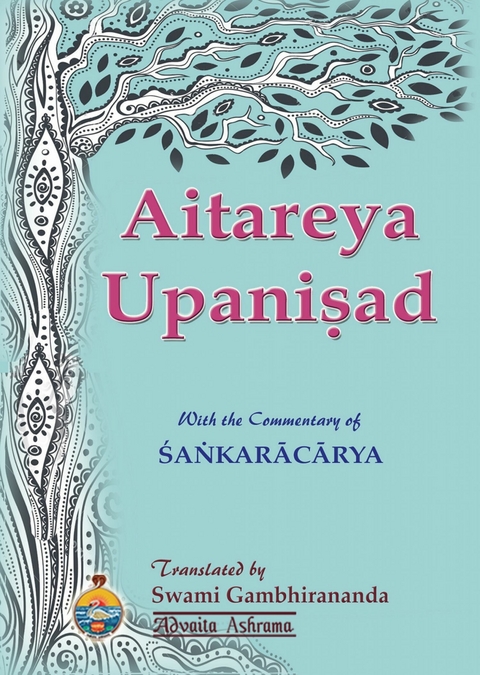
Aitareya Upanisad (eBook)
75 Seiten
Advaita Ashrama (Verlag)
978-0-00-030678-4 (ISBN)
This Upanishad is contained in the Rig Veda and forms a part of the Aitareya Aranyaka. With Sanskrit verses and its English rendering, followed by an authentic translation of Sri Shankaracharya's commentary, this Upanishad distinctly expounds the goal of human life to be the realization of the identity of the individual soul and the Supreme Soul. This it does by the method of adhyaropa and apavada, that is, assumption of names and forms and their negation.
Published by Advaita Ashrama, a publication house of Ramakrishna Math, Belur Math, India.
AITAREYA UPANISAD
PART I
CHAPTER I
Introduction: Earlier than this (1) was finished karma (2) along with the knowledge of (i.e. meditation on) the inferior Brahman (i.e. Hiraṇyagarbha). This highest result that is such and achievable through karma, associated with meditation, was concluded with the meditation on Uktha. (3) It was said, ‘This Brahman that is Truth is called Prāṇa; this is the only Deity’ (Kau. II. 2; Mai. VII. 7); ‘All the gods are but manifestations of this Prāṇa’; ‘Attaining identity with (the Deity, Brahmā, Immortality, that is) this Prāṇa, one becomes united with the gods.’ Some people believe that the highest human goal consists in this merger in the Deity, that this is emancipation, that this is attainable by the means of a combination of meditation and karma as described, and that there is nothing higher than this. With a view to refuting them and enjoining the knowledge of the absolute Self, the subsequent text says, ‘In the beginning this was but the absolute Self alone’, etc. (I. i. 1).
Objection: How is it, again, known that the subsequent text is meant for enjoining the knowledge of the absolute Self, unconnected with karma ?
Answer: Since no other meaning can be deduced. Moreover, through such texts as ‘He subjected Him (4) to hunger and thirst’ (I. ii. 1) etc., it will be shown that the gods such as Fire, mentioned earlier, are included in the phenomenal world because of the defects of their hunger etc. All that is subject to hunger etc. is surely within the phenomenal world, whereas the supreme Brahman is mentioned in the Vedas as transcendental to hunger and the rest.
Objection: Even if it be thus conceded that the knowledge of the absolute Self is the means for emancipation, it does not follow that a non-performer of karma alone is qualified for this, since no such specification is heard of, there being no mention in this Upaniṣad of any non-performer of karma (i.e. a sannyasi) belonging to a distinct order. Again, the knowledge of the Self is begun only after introducing the rite called Bṛhatī-sahasra. Therefore, it is the performer of karma who is in fact entitled to this. Nor is the knowledge of the Self incompatible with karma, for the summing up (here) at the end conforms to what went earlier. Just as it was stated by the (earlier) brāhmaṇa (portion) that the Puruṣa (5) associated with karma and identified with the Sun, is the Self of all beings, mobile and immobile, (6) and as it was confirmed by the mantra (portion) in such texts as, ‘The Sun is the Self (of the universe, moving and motionless)’ (Ṛ. I. cxv. 1), similarly (here), too, the start will be made with ‘This one is (the inferior) Brahman; this is Indra’ (III. i. 3), and the conclusion will be, ‘All the creatures that there are, which move or do not move, are impelled by Consciousness’ (III. i. 3). Similarly, too, in the Upaniṣad of the saṁhitā (portion), the Self will be spoken of as associated with karma, in the text, ‘The followers of the Ṛg-Veda deliberate on this very Entity in the hymn called Bṛhatī-sahasra’, etc. (Ai. Ā. III. ii. 3. 12), and the conclusion will be with, ‘They speak of it alone as the Self in all beings’, etc. Similarly, too, the identity of the One that is referred to in, ‘That which the bodiless conscious Self’, is spoken of in, ‘One should know That as identical with Him that is in the sun’. Here, again, commencing with, ‘Which is It that we worship as this Self?’ (III. i. 1), the identity with Consciousness Itself will be shown in ‘Consciousness is Brahman’ (III. i. 3). Therefore, the knowledge of the Self is not disconnected with karma.
Counter-objection: (On that supposition) the present text becomes useless because of tautology. How? The Self having been ascertained by the brāhmaṇa (portion) in, ‘O Ṛṣi, I am indeed Prāṇa’, and by the mantra (portion) in, ‘The Sun is the Self’ (Ṛ. I. cxv. 1), it is useless and tautological to ascertain It over again by the brāhmaṇa (i.e. the Upaniṣad portion) by raising the question, ‘Which is It that we worship as this Self.?’ (III. i. 1) and then answering that ‘all this is but the Self’, and so on.
Opponent: Not so, for no fault of tautology is involved, inasmuch as this is meant to determine some special qualities of that very Self. How? Of that very Self, as connected with karma, it is sought to determine some special attributes such as (the power of) creation, protection, and dissolution of the world, or to present It as an object of meditation in Its unconditioned state. To explain the second alternative: From the fact that meditation on the Self (as such) was not enjoined in the context of karma, it might be inferred that the Self, which is (found) associated with karma, is not to be meditated upon apart from karma; therefore the purport of the (following) text, beginning with ‘Ātmā’ etc., is that the unconditioned Self, too, is to be meditated on. Or since the Self is to be worshipped (both) as different and non-different (from oneself), the same Self that is subject to the idea of difference in a context of karma is again to be meditated on as non-different outside (that) karma. Thus there is no tautology. Moreover, according to the adherents of the Vājasaneya Section (of the Yajur-Veda) there are the statements, ‘He who knows these two, Vidyā (knowledge) and avidyā (rites etc.), together, attains immortality through vidyā by crossing over death through avidyā (Īś. 11) and ‘By doing karma indeed should one wish to live here for a hundred years’ (Īś. 2). Not that mortals can have more than a hundred years as the fullest span of life, so as to be able to meditate on the Self after renouncing karma (after a hundred years). And it has been shown in the Aitareya Āraṇyaka, ‘The span of a man's life comprises as many thousands of days.’ (7) Now, the hundred years of life are packed with karma; and the mantra, ‘By doing karma indeed...’ has just been quoted. Similar are the texts, ‘One should perform the Agnihotra sacrifices as long as one lives’, ‘One should perform the Darśa and Pūrṇamāsa (new moon and full moon) sacrifices as long as one lives’, and others, as well as, ‘Him they burn along with the sacrificial vessels.’ Besides, there is the Vedic text speaking of the three debts. (8) As for the scriptural text dealing with monasticism etc., to wit, ‘Knowing this very Self the Brāhmaṇas renounce, ... and lead a mendicant life’ (Bṛ. III. v. 1, IV. iv. 22), it is eulogistic, meant to praise the knowledge of the Self. Or it is meant for the disqualified ones (e.g. the blind, the lame, and others) (9).
Vedāntin: Not so, for when the supreme knowledge is achieved, there can be no idea of results, and so no action is possible. As for the statements that ‘the knowledge of the Self comes to the man engaged in karma’, that ‘it is associated with karma’, and so on, they are wrong. Action is inconceivable in one who has the knowledge of Brahman as his Self, comprised in the realization, ‘I am the supreme Brahman in which all desires are fulfilled and which is above all the worldly shortcomings’, and who has no idea of results because he feels no need for anything to be got for himself from actions done or to be done (by him).
Objection: Though he may not perceive any benefit therefrom, he still acts because of the (scriptural) injunction.
Answer: No, for he has realized the Self that is beyond the range of injunctions. It is seen in the world that one comes within the scope of injunction so long as one feels the need for acquiring some desirable thing or avoiding some undesirable thing for himself and seeks for a means thereof; but not is so the one who is of a contrary disposition and has realized the identity of the Self with Brahman that cannot be subjected to any injunction. If a man who has realized the identity of the Self and Brahman has still to bow down to injunctions, even though he is beyond all mandates, then there will remain none who is outside the pale of scriptural direction; and so all actions will become fit to be undertaken by all and sundry at all times. But that is undesirable. Nor can he be directed by anybody, for even the scriptures emanate from him. Not that anyone can himself be impelled by any sentence issuing out of his own wisdom. Nor is a well-informed master commanded by an ignorant servant.
Objection: The Vedas, being eternal, are independent, and hence have the mandatory power over all.
Answer: No, for the defect (of such an argument) has been already pointed out. Even on this assumption, the defect of every duty becoming fit to be indiscriminately undertaken at all times by all and sundry persists unavoidably.
Objection: That, too, is enjoined by the scriptures. (To explain:) As performance of duties is prescribed by scriptures, so is the knowledge of the Self prescribed for that man of karma by the scriptures themselves.
Answer: No, for it is...
| Erscheint lt. Verlag | 25.8.2021 |
|---|---|
| Übersetzer | Gambhirananda Swami |
| Sprache | englisch |
| Themenwelt | Geisteswissenschaften ► Religion / Theologie ► Hinduismus |
| ISBN-10 | 0-00-030678-9 / 0000306789 |
| ISBN-13 | 978-0-00-030678-4 / 9780000306784 |
| Informationen gemäß Produktsicherheitsverordnung (GPSR) | |
| Haben Sie eine Frage zum Produkt? |
 EPUB (Adobe DRM)
Größe: 872 KB
Kopierschutz: Adobe-DRM
Adobe-DRM ist ein Kopierschutz, der das eBook vor Mißbrauch schützen soll. Dabei wird das eBook bereits beim Download auf Ihre persönliche Adobe-ID autorisiert. Lesen können Sie das eBook dann nur auf den Geräten, welche ebenfalls auf Ihre Adobe-ID registriert sind.
Details zum Adobe-DRM
Dateiformat: EPUB (Electronic Publication)
EPUB ist ein offener Standard für eBooks und eignet sich besonders zur Darstellung von Belletristik und Sachbüchern. Der Fließtext wird dynamisch an die Display- und Schriftgröße angepasst. Auch für mobile Lesegeräte ist EPUB daher gut geeignet.
Systemvoraussetzungen:
PC/Mac: Mit einem PC oder Mac können Sie dieses eBook lesen. Sie benötigen eine
eReader: Dieses eBook kann mit (fast) allen eBook-Readern gelesen werden. Mit dem amazon-Kindle ist es aber nicht kompatibel.
Smartphone/Tablet: Egal ob Apple oder Android, dieses eBook können Sie lesen. Sie benötigen eine
Geräteliste und zusätzliche Hinweise
Buying eBooks from abroad
For tax law reasons we can sell eBooks just within Germany and Switzerland. Regrettably we cannot fulfill eBook-orders from other countries.
aus dem Bereich