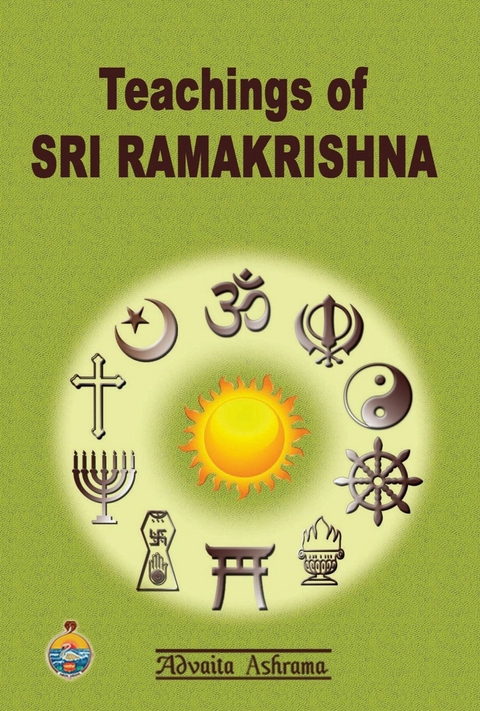
Teachings of Sri Ramakrishna (eBook)
352 Seiten
Advaita Ashrama (Verlag)
9780000306692 (ISBN)
The phenomenon called Sri Ramakrishna was the other name for God-consciousness. Like bread soaked in sugar syrup he was one who was permeated out-and-out with God-consciousness. Obviously, it's no wonder that his teachings should cover the entire gamut of spiritual and religious life. This book is a classified and comprehensive collection of his wonderful sayings and parables. Needless to say, this book will be vade mecum for all those who are religious minded and are engaged in spiritual practices eager to have communion with God.
Published by Advaita Ashrama, a publication house of Ramakrishna Math, Belur Math, India.
AVATĀRA, PERFECTED SOULS,
GURU, AND PREACHERS
AVATĀRA (DIVINE INCARNATION)
A FACT
118.* God is indeed Infinite. But He is Omnipotent. He may so ordain that His Divinity as Love may be manifest in the flesh and be among us as God incarnate. Divine Incarnation is a fact. Of course, one cannot make this perfectly clear by means of words. It is a fact to be seen and realised by the spiritual eyes. One must see God to be convinced of this. By analogy we can at best faintly apprehend the matter. Suppose one touches the horn of a cow, or her feet, or the tail, or the udder; would not this be the same as touching the cow herself? For us, human beings, the chief thing about the cow is the milk, which comes from the udder. Well! the milk of Divine Love streams to us from God incarnate.
119.* Who can know God? It is not given to us, nor is it required of us to know Him fully. It is enough if we can see Him—feel that He is the only Reality. A person, suppose, comes to the holy river Gangā and touches the water. He would say, “I have been blessed with the vision and touch of the holy river.” Surely he need not have to touch the whole river from Gomukhi to Gangāsāgar—from its source to the mouth!
120.* Seekest thou God? Then see Him in man! His Divinity is manifest more in man than in any other object. Look around for a man with a love of God that overflows—a man who lives, moves, and has his being in God—a man intoxicated with His Love. In such a man has God incarnated Himself.
121.* Fire is latent in all objects. In the constitution of wood it remains in a degree far greater than in other objects.
(To M.): God indeed is in all things; only His Power is more or less manifest in them. God incarnate is Divinity most manifest in the flesh.
122. Pandit Shiva Nāth Shāstri, the Minister of the Sādhāran Brāhmo Samāj, writes thus in The Modern Review, Nov., 1910, of a meeting with Sri Ramakrishna:
A Christian preacher of Bhowanipur, who was my personal friend, once accompanied me on my visit to Ramakrishna. When I introduced my friend to him, I said—“Today I bring a Christian preacher to you, who having heard of you from me, was very eager to see you.” Whereupon the Saint bowed his head to the ground and said, “I bow again and again at the feet of Jesus.” Then took place the following conversation:
My Christian friend: How is it, sir, that you bow at the feet of Christ? What do you think of Him?
Ramakrishna: Why, I look upon Him as an Incarnation of God.
My friend: Incarnation of God! Will you kindly explain what you mean by it?
Ramakrishna: An Incarnation like our Rāma or Krishna. Don't you know there is a passage in the Bhāgavata where it is said that the Incarnations of Vishnu or the Supreme Being are innumerable?
My friend: Please explain further; I do not quite understand it.
Ramakrishna: Just take the case of the ocean. It is a wide and almost infinite expanse of water. But owing to special causes, in special parts of this wide sea, the water becomes congealed into ice.
When reduced to ice it can be easily manipulated and applied to special uses. An Incarnation is something like that. Like that infinite expanse of water, there is the Infinite Power, immanent in matter and mind, but for some special purposes, in special regions, a portion of that Infinite Power, as it were, assumes a tangible shape in history, that is what you call a great man; but he is, properly speaking, a local manifestation of the all-pervading Divine Power; in other words, an Incarnation of God. The greatness of men is essentially the manifestation of Divine Energy.
My friend: I understand your position, though we do not quite agree with it. (Then turning to me)—I should like to know what my Brāhmo friends would say to this.
Ramakrishna: Don't talk of them, they do not see it in that light.
Myself (addressing Ramakrishna): Who told you, sir, that we do not believe that the greatness of the great teachers of humanity was a Divine communication, and in that sense they were Incarnations of a Divine Idea?
Ramakrishna: Do you really believe it to be so? I did not know that.
123. Think not that Rama and Sitā, Krishna and Rādhā, were mere allegories and not historical personages; or that the scriptures are true only in their inner or esoteric meaning. Nay, there must have been human beings of flesh and blood who personified the ideals of Rāma and Sitā, and because they were also divinities, their lives can be interpreted both historically and allegorically.
AVATĀRA — THEIR CHARACTERISTICS
124.* The Avatāras are born with Divine powers and Divine qualities. They can go into and stay in any state of realisation from the highest to the lowest. In a king's palace a stranger can go only to the outer quarters, but the king's own child, the prince of the house, is free to go to every corner.
125.* It is a thin ego that personages like the Incarnations possess. Through this ego God is always visible. For example, a man is standing on one side of a wall, on either side of which are boundless stretches of land. If there be an aperture in the wall, the whole of the other side is visible, and if this be big enough, one can pass through it as well. The ego of men like the Incarnations is that wall with the aperture. Even though they be on this side of the wall, they can see the boundless extent of land on the other. The meaning of this is that though they have taken up bodies, they are always in a state of Yoga, and, if they like, can enter into Samādhi on the other side of the big aperture. Again, if this be big enough, they can come and go through it, that is to say, can come down to a lower plane of consciousness even after their Samādhi.
126. The Avatāra is always one and the same. Plunging into the ocean of life, He rises up in one place and is known as Krishna; diving again and rising elsewhere, He is known as Christ.
127. On the tree of Sachchidānanda grow innumerable fruits such as Rāma, Krishna, Christ and others: one or two of them come down now and then to this world, and they work wonderful changes in society.
128. The Avatāras are to Brahman what the waves are to the ocean.
129. The Avatāra or Saviour is the messenger of God. He is like the viceroy of a mighty monarch. As when there is some disturbance in a far-off province the king sends his viceroy to quell it, so whenever there is prevalence of irreligion in any part of the world, God sends His Avatāra for its destruction.
REDEEMING POWER OF THE AVATĀRAS
130. When there is a flood — river, stream and land all alike present one watery surface. But the rain-water flows away through different channels. So when a Saviour becomes incarnate, all are saved through his grace. The perfected men who are called Siddhas only save themselves, by much pain and penance.
131. Water can be obtained from a great depth with much difficulty, but during the rains, when the whole country is flooded, it is everywhere easily obtainable. So God, who is generally reached only with great pain, through prayer and penance, makes Himself felt anywhere and everywhere when there is an Incarnation who floods the world with spirituality.
132 As a large and powerful steamer moves swiftly over the waters, towing rafts and barges in its wake, so when a Saviour comes, he carries thousands easily across the ocean of Māyā.
133. The locomotive engine, in reaching the destination itself, draws also and takes with it a long train of loaded wagons. In the same way, act the Saviours. They carry multitudes of men, burdened with the cares and sorrows of the world, to the feet of the Almighty.
OBJECT OF GOD'S INCARNATION
134.* Q. Why should God incarnate Himself in human form?
A. To make manifest to man the perfection of Divinity. Through these manifestations man can talk with God and see His play. In the Incarnation, God fully enjoys, as it were, His own transcendent sweetness.
In the saints, God manifests Himself only in part, like honey in a flower. You suck the flower and get a little honey. In the Incarnation, it is all "honey"—all sweetness and all blessedness.
135. The Lord takes the human body for the sake of those pure souls who love the Lord.
136. No one knows the immensity of the sacrifice which God makes when He incarnates Himself.
AVATĀRA — HARD TO COMPREHEND
137. A divine Incarnation is hard to comprehend. It is the play of the Infinite on the finite.
138. When Bhagavān Sri Rāmachandra came to this world, only twelve sages recognised Him as an Incarnation of God. So when God descends to this world, there are few who recognise His Divine nature.
139. As the elephant has two sets of teeth, the external tusks and the inner grinders, so the God-men, like Sri Krishna, act and behave to all appearance as common men, while their heart and soul are absorbed in the Highest, far beyond the region of Karma.
140. The Divine power must be understood to be in greater quantity in those who are honoured, respected, and obeyed by a large following than in those who have no such influence.
AVATĀRA, NOT HONOURED
IN HIS OWN LAND
141....
| Erscheint lt. Verlag | 24.8.2021 |
|---|---|
| Sprache | englisch |
| Themenwelt | Geisteswissenschaften ► Religion / Theologie ► Hinduismus |
| ISBN-13 | 9780000306692 / 9780000306692 |
| Informationen gemäß Produktsicherheitsverordnung (GPSR) | |
| Haben Sie eine Frage zum Produkt? |
 EPUB (Adobe DRM)
Größe: 3,1 MB
Kopierschutz: Adobe-DRM
Adobe-DRM ist ein Kopierschutz, der das eBook vor Mißbrauch schützen soll. Dabei wird das eBook bereits beim Download auf Ihre persönliche Adobe-ID autorisiert. Lesen können Sie das eBook dann nur auf den Geräten, welche ebenfalls auf Ihre Adobe-ID registriert sind.
Details zum Adobe-DRM
Dateiformat: EPUB (Electronic Publication)
EPUB ist ein offener Standard für eBooks und eignet sich besonders zur Darstellung von Belletristik und Sachbüchern. Der Fließtext wird dynamisch an die Display- und Schriftgröße angepasst. Auch für mobile Lesegeräte ist EPUB daher gut geeignet.
Systemvoraussetzungen:
PC/Mac: Mit einem PC oder Mac können Sie dieses eBook lesen. Sie benötigen eine
eReader: Dieses eBook kann mit (fast) allen eBook-Readern gelesen werden. Mit dem amazon-Kindle ist es aber nicht kompatibel.
Smartphone/Tablet: Egal ob Apple oder Android, dieses eBook können Sie lesen. Sie benötigen eine
Geräteliste und zusätzliche Hinweise
Buying eBooks from abroad
For tax law reasons we can sell eBooks just within Germany and Switzerland. Regrettably we cannot fulfill eBook-orders from other countries.
aus dem Bereich