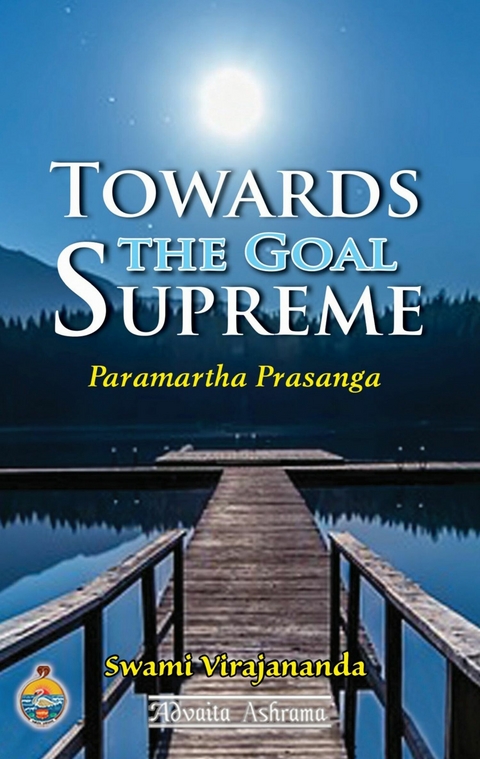
Towards The Goal Supreme (eBook)
328 Seiten
Advaita Ashrama (Verlag)
978-0-00-030667-8 (ISBN)
This compilation of spiritual teachings is full of useful information, penetrating insights, and profound counsels for all spiritual aspirants. It is something more than an ordinary book, it is a personal contact with a great man, a teacher who has actually experienced what he teaches. An invaluable work indeed for all the seekers of the Supreme Truth.
Published by Advaita Ashrama, a publication house of Ramakrishna Math, Belur Math, India.
PARAMARTHA PRASANGA
—TOWARDS THE GOAL SUPREME—
1. To realise God an aspirant must have: Patience, Perseverance, Purity of body and mind, Intense desire or yearnings the aggregate of the Six Attributes, namely, Shama (tranquillity of mind), Dama (restraint of the senses), Uparati (giving up of attachment to objects), Titikshâ (remaining unaffected amidst all kinds of afflictions), Shraddhâ (faith in the words of the spiritual teacher and the scriptures), and Samâdhâna (concentration of mind on the Chosen Ideal, or God).
* * *
2. Do not tell anybody else, except the Guru, the realisations, the visions, or similar experiences, that spiritual practices may bring to you. Always keep your spiritual treasure—your inmost thoughts—hidden within you. These are not for vulgar gaze. These are your sacred possessions to be shared only between you and the Lord in secret. Likewise, do not talk of your defects and blemishes to others. You lose thereby your self-respect and the respect of others for you. They are for you to confess to the Lord. Pray to Him for strength to overcome them.
* * *
3. When you begin meditation, first sit steadily for a while and watch the mind; let it wander wherever it pleases. Think that you are the witness, the seer. Sit watching how the mind floats and sinks, runs and skips. Keep thinking, “I am not the body, nor the senses, nor the mind; I am altogether separate from the mind. The mind, too, is material; it is only a finer form of matter. I am the Atman (Self), the master; the mind is my servant.” Whenever any idle thought arises in the mind, try at once to put it down forcibly.
* * *
4. Ordinarily one breathes through the left nostril at the time of rest, through the right at the time of work, and through both at the time of meditation. The state most favourable to meditation is when the body and mind have become calm and there is even flow of breath through both nostrils. But do not pay too much attention to watching your breath, nor make this a guide by which to regulate your activities.
* * *
5. When the mind is absolutely calm, breathing becomes steady and Kumbhaka (retention of breath) follows. When breathing is steady, the mind becomes one-pointed. Bhakti (love of God) also brings about Kumbhaka without effort, and breathing becomes steady. Even without practising Yoga, Prânâyâma (control of breath) is attained automatically if one remembers and thinks of the Lord and does Japa with a yearning heart.
* * *
6. There is no other easy or convenient method to achieve one-pointedness of mind except by Abhyâsa, or repeated and sustained efforts, and by Vairâgya, or non-attachment to worldly objects.
* * *
7. Whatever be the time you devote to Japa and meditation—even if it be only ten or fifteen minutes—do it with all your heart and soul. The Lord is the Indweller, the Inner Guide. He sees your heart; His measure is not how long you meditate on Him nor how many times you do Japa, but by your inner longing.
* * *
8. In the beginning, Japa and meditation taste rather dry. Yet you must go on practising them, even if it be like swallowing medicine. You will find joy after you have practised steadfastly for three or four years. Then, if you miss your meditation even for one day, you will feel miserable,—out of joint, as it were.
* * *
9. Self-effort (Purushakâra) is necessary for spiritual attainment. Resolve firmly, “I will realise God through my own efforts by doing spiritual practices,” and go on steadfastly practising Japa and meditation, seated in proper posture, for at least two hours every morning and evening, for three or four years—and see if you succeed or not.
* * *
10. It is not good for householders to do much Prânâyâma or Yoga. Those who are bent upon doing it, should strictly observe regularity and moderation in all walks of life. They should have nutritious and Sâttvic (pure) food at the proper time, well-ordered activities, a life without worry, a healthy and secluded spot with pure air and temperate climate, clean bowels, moderation in speech. Above all, it is imperative to observe Brahmacharya, or perfect continence. Violation of these restrictions is liable to cause heart or brain disease.
* * *
11. When by continued practice of Japa and meditation, the mind will have become calm and purified, then mind itself will be your Guru, or guide, and you will have proper understanding of everything, and find the solutions of your spiritual doubts and questions within yourself. The mind will tell you what you should do, one thing after another, and how you should conduct yourself.
* * *
12. When doing Japa, meditate on the form of your Chosen Ideal also; otherwise Japa never becomes deep. Even if the whole form of the Deity does not appear in meditation, begin with whatever part of the form comes. Try again and again, even if you fail. Why should you give up, if you do not succeed? You have got to carry on with tenacity. Does meditation come easily by the mere wish? Repeated efforts should be made to collect the mind from other objects and fix it upon the object of meditation. Success in this will come as one goes on practising.
* * *
13. Japa, or mental repetition of the Mantra, counting it on the fingers, using a rosary, or keeping the number of the repetitions—all these are only preliminary means to help withdraw the mind from other objects and fix it on the object of worship. Otherwise, you will not know when the mind may have run away in another direction; or you may even have dozed off. So, though these processes may appear to some to cause a little distraction at the outset, they will enable one to keep watch over the mind’s vagaries, detect them easily, and draw the mind back and keep it fixed on the object of meditation.
* * *
14. Never think yourself to be weak. Have firm faith in yourself. Think, “There is nothing that I cannot do; I can do everything if I will.” Why should you acknowledge defeat to your mind? Know that if you can subdue it, the whole world will be under your feet. One who has no self-confidence does not have real faith in God. Swami Vivekananda has said that the real atheist is he who has no faith in himself. Nobody listens to the words of one who has no self-confidence; and God also does not listen to his prayers.
* * *
15. Asana is that posture in which one can sit for meditation steadily and with ease for a long time. But the spine has to be kept straight, and the chest, neck and head should be held erect, so that the entire weight of the upper part of the body may fall on the ribs and the chest may not sag. A stooping posture, in any case, is not healthy.
* * *
16. Your mind will inevitably be restless at the time of meditation so long as the idea has not taken firm root in you that the world is insubstantial and transitory, and that He alone is the only Reality. Love of God will grow and at the same time the mind will become calm to the extent that one is freed from the thirst for sense pleasures. All the pleasures of the world will become trivial and distasteful if even a particle of His Love is experienced.
* * *
17. Japa, meditation, ritualistic worship, prayer, remembrance, reading sacred books, association with holy men, godly conversation, retiring into solitude and thinking spiritual thoughts—whichever of these attracts you, according to mood and opportunity, and gives you joy, take advantage of that and do that. But meditation and Japa are the main things. Never miss them for a single day, however occupied you may be, or even in times of sickness or infirmity, in misfortune or calamity. In such circumstances, if you cannot or do not find it convenient to carry on your practice in full measure, make salutation, pray and do Japa for at least ten or fifteen minutes.
* * *
18. The sensible man does not try to diagnose his own disease and prescribe medicine for himself by reading medical books. In case of disease, a doctor’s advice should be sought. In the same way, if after reading many books and scriptures one proceeds to choose for himself a particular spiritual discipline, his mind may become confused and troubled by doubts and misgivings, progress may be interrupted, and waste of effort and even harm may result. The reason is, that the various scriptures contain divergent or even contradictory directions and methods, suited to aspirants of different temperaments and capacities, and different stages of life. It is, therefore, dangerous in many cases to decide for yourself what is exactly suitable for you. The Guru alone can direct you to the right path. That is why spiritual knowledge has to be acquired direct from the Guru. Know that the initiation and instructions given by him are the only path for you to follow. If you do the spiritual practices as enjoined by him unswervingly and with full faith in them and in him, you are sure to achieve success in course of time. In any event, never give up these practices and take to other methods under anybody else’s advice. If you jump from one thing to another, the only result will be that you will lose your way and drift about, without gaining anything.
* * *
19. Faith works wonders—makes the impossible possible. Faith plies its boat, setting sail over dry land. The doubting self is drowned even in ankle-deep water.
* * *
20. Hope is life. Hope is the source of all strength and effort. If hope is given up, one suffers agonies of death, becomes dead though living. Cling to hope till the last breath. Never, till...
| Erscheint lt. Verlag | 24.8.2021 |
|---|---|
| Sprache | englisch |
| Themenwelt | Geisteswissenschaften ► Religion / Theologie ► Hinduismus |
| ISBN-10 | 0-00-030667-3 / 0000306673 |
| ISBN-13 | 978-0-00-030667-8 / 9780000306678 |
| Informationen gemäß Produktsicherheitsverordnung (GPSR) | |
| Haben Sie eine Frage zum Produkt? |
 EPUB (Adobe DRM)
Größe: 617 KB
Kopierschutz: Adobe-DRM
Adobe-DRM ist ein Kopierschutz, der das eBook vor Mißbrauch schützen soll. Dabei wird das eBook bereits beim Download auf Ihre persönliche Adobe-ID autorisiert. Lesen können Sie das eBook dann nur auf den Geräten, welche ebenfalls auf Ihre Adobe-ID registriert sind.
Details zum Adobe-DRM
Dateiformat: EPUB (Electronic Publication)
EPUB ist ein offener Standard für eBooks und eignet sich besonders zur Darstellung von Belletristik und Sachbüchern. Der Fließtext wird dynamisch an die Display- und Schriftgröße angepasst. Auch für mobile Lesegeräte ist EPUB daher gut geeignet.
Systemvoraussetzungen:
PC/Mac: Mit einem PC oder Mac können Sie dieses eBook lesen. Sie benötigen eine
eReader: Dieses eBook kann mit (fast) allen eBook-Readern gelesen werden. Mit dem amazon-Kindle ist es aber nicht kompatibel.
Smartphone/Tablet: Egal ob Apple oder Android, dieses eBook können Sie lesen. Sie benötigen eine
Geräteliste und zusätzliche Hinweise
Buying eBooks from abroad
For tax law reasons we can sell eBooks just within Germany and Switzerland. Regrettably we cannot fulfill eBook-orders from other countries.
aus dem Bereich