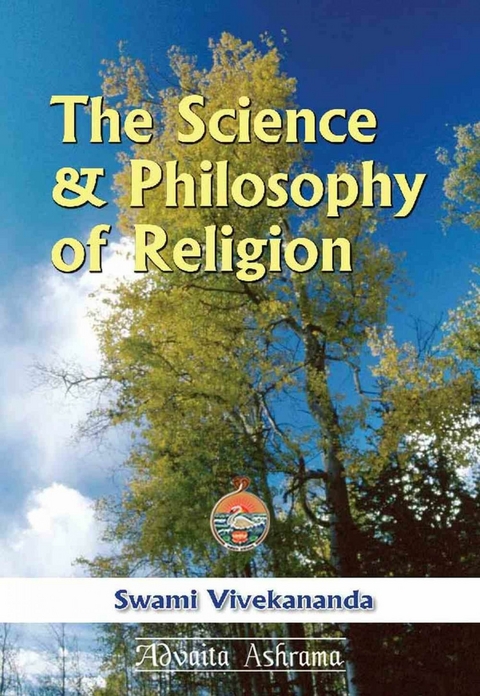
The Science and Philosophy of Religion (eBook)
128 Seiten
Advaita Ashrama (Verlag)
978-0-00-030511-4 (ISBN)
The ancient seers of India realized the highest non-dual Truth and thus attained to unity in the religious field; they succeeded in bringing religion to the rank of a perfect and complete science. The methods adopted by them to come to this result were the same as those followed by all the sciences of the present day. This book discusses how the philosophers of India applied these rational methods in coming to their respective discoveries, thus establishing the scientific character of Indian philosophy and religion. The book chiefly makes a comparative study of Samkhya, Vedanta and other systems of thought.
THE SAMKHYA COSMOLOGY
Here are two words, the microcosm and the macrocosm, the internal and the external. We get truths from both of these by means of experience; there is internal experience and external experience. The truths gathered from internal experience are psychology, metaphysics and religion; from external experience, the physical sciences. Now a perfect truth should be in harmony with experience in both these worlds. The microcosm must bear testimony to the macrocosm, and the macrocosm to the microcosm; physical truth must have its counterpart in the internal world, and the internal world must have its verification in the outside. Yet as a rule we find that many of these truths are constantly conflicting. At one period of the world’s history the ‘internals’ became supreme, and they began to fight the ‘externals’; at the present time the ‘externals,’ the physicists, have become supreme, and they have put down many claims of the psychologists and metaphysicians. So far as my little knowledge goes, I find that the really essential parts of psychology are in perfect accordance with the essential parts of modern physical knowledge.
It is not given to every individual to be great in every respect; it is not given to the same race or nation to be equally strong in the research of all the fields of knowledge. The modern European nations are very strong in their researches into the external physical knowledge, but the ancient Europeans were weak in their researches into the internal part of man. On the other hand, the Orientals have not been very strong in their researches in the external physical world, but have excelled in their researches into the internal, and therefore we find that some of the Oriental theories are not in accordance with Occidental physics, neither is Occidental psychology in harmony with Oriental teachings on this subject. The Oriental physicists have been criticized by Occidental scientists. At the same time each rests on truth, and, as we stated before, real truth in any field of knowledge will not contradict itself, the truths internal are in harmony with the truths external.
We know the present theories of the Cosmos according to the modern astronomers and physicists, and at the same time we know how woefully they hurt the old school of theologians, and how every new scientific discovery that is made, is as a bomb thrown into their houses, and how they have attempted in every age to put down all these researches. In the first place, let us go over the psychological and scientific ideas of the Orientals as to the Cosmology and all that pertains to it, and we shall find how wonderfully it is in accordance with all the latest discoveries of modern science; and when there is anything lacking, we shall find that it is on the side of modern science. We all use the word Nature, and the old Hindu philosophers called it by two different names, Prakriti, which is almost the same as the English word ‘Nature,’ and by the more scientific name, Avyaktam (undifferentiated), from which everything proceeds, out of which come atoms and molecules, matter and force, and mind and intellect. It is startling to find that the philosophers and metaphysicians of India ages ago stated that mind is but matter in a finer form; for, what are our present materialists striving to do but to show that mind is as much a product of Nature as the body? And so is thought; and we shall find by and by that the intellect also comes from the same Nature which is called Avyaktam, the undifferentiated.
The ancient teachers define Avyaktam, as the ‘equilibrium of the three forces,’ one of which is called sattva, the second rajas and the third tamas. Tamas, the lowest force, is that of attraction; a little higher is rajas, that of repulsion; and the highest is the control of these two, sattva: so that when the two forces, attraction and repulsion, are held in perfect control or balance, by the sattva, there is no creation, no modification; but as soon as this equilibrium is lost, the balance is disturbed and one of these forces gets stronger than the other. Then change and motion begin and evolution of all these goes on. This state of things is going on cyclically, periodically; that is to say, there is a period of disturbance of the balance, when all these forces begin to combine and recombine, and this universe is project-ed; and there is also a period when everything has a tendency to revert to the primal state of equilibrium, and the time comes when a total absence of all manifestations is reached. Again after a period, this state is disturbed, the forces tend to project outward and the universe slowly comes out in the form of waves; for all motions in this universe are in the form of waves, in successive rises and falls.
Some of the old philosophers taught that the whole universe quiets down for a period; others maintained that this quieting down applies only to systems. That is to say, while our system, here, this solar system, will quiet down and go back into the undifferentiated state, there will be millions of other systems going the other way. I should rather follow the second opinion, that is quieting down is not simultaneous over the whole universe, but that in different parts different things are going on. But the principle remains the same, that all that we see, that Prakriti herself is progressing in successive rises and falls. The stage of going back to the balance, to the perfect equilibrium, is called the end of a cycle. The whole kalpa, the evolution and the involution, has been compared by theistic writers in India to the outbreathing and inbreathing of God; God, as it were, breathes out the universe, and it returns into Him again. When it quiets down, what becomes of the universe? It still exists, only on finer form as it is called in Sanskrit, ‘Kārana,’ the causal state. Causation, time and space are still there, only they are potential. This return to an undifferentiated condition constitutes involution. Involution and evolution are eternally going on, so that when we speak of a beginning, we refer only to the beginning of a cycle.
The most extraneous part of the universe is what in modern times we call gross matter. The ancient Hindus called it the Bhutas, the external elements. One of these, according to them, is the cause of the rest, for every other element is produced out of this one, and this element has been called akasha. This is somewhat similar to the modern idea of ether, though not exactly the same. Akasha is the primal element out of which every gross thing proceeds, and along with it there is something else called prana; we shall see what it is as we go on. The prana and the akasha exist as long as creation lasts. They combine and recombine and form all gross manifestations until at the end of the cycle all these subside and go back to the unmanifested form of akasha and prana. There is in the Rig-Veda, the oldest scriptures in existence, a beautiful passage describing creation, which is most poetical: When there was neither aught nor naught, when darkness was rolling over darkness, what existed? And the answer is given: It (the Eternal One) then existed without motion. (1) Prana and akasha were latent in that Eternal One, but there was no phenomenal manifestation. This state is called Avyaktam which literally means ‘without vibration’, or unmanifested. At the beginning of a new cycle of evolution, this Avyaktam begins to vibrate, and blow after blow is given by prana to the akasha causing condensation and gradually through the forces of attraction and repulsion, atoms are formed. These in turn condense into molecules and finally into the different gross elements of which every object in nature is composed.
We generally find these things very curiously translated; people do not go to the ancient philosophers or to their commentators for their translations and have not learning enough to understand for themselves. They translate the elements as ‘air’, ‘fire’, and so on. If they would go to the commentators they would find that they do not mean anything of the sort. The akasha, by the repeated blows of prana produces vāyu or the vibratory state of the akasha, which in turn produces gaseous matter. The vibrations growing more and more rapid generate heat, which in Sanskrit is called tejas. Gradually it is cooled off and the gaseous substance becomes liquid āpa, and finally solid, prithivi. We have first akasha vibrating, then comes heat, then it becomes liquefied, and when still more condensed it appears as solid matter. It goes back to the unmanifested condition in exactly the reverse way. The solids will be converted into liquid and the liquid into a mass of heat, that will slowly go back into the gaseous state, then disintegration of atoms will begin and finally the equilibrium of all forces will be reached, when vibration will stop and thus the cycle of evolution, which in Sanskrit is called kalpa, will be at an end. We know from modern astronomy that this earth and sun of ours are undergoing the same transitions, this solid earth will melt down and become liquid once more, and will eventually go back to the gaseous state.
Prana cannot work alone without the help of akasha. All that we know of it is motion or vibration. Every movement that we see is a modification...
| Erscheint lt. Verlag | 17.8.2021 |
|---|---|
| Sprache | englisch |
| Themenwelt | Geisteswissenschaften ► Religion / Theologie ► Hinduismus |
| ISBN-10 | 0-00-030511-1 / 0000305111 |
| ISBN-13 | 978-0-00-030511-4 / 9780000305114 |
| Informationen gemäß Produktsicherheitsverordnung (GPSR) | |
| Haben Sie eine Frage zum Produkt? |
 EPUB (Adobe DRM)
Größe: 960 KB
Kopierschutz: Adobe-DRM
Adobe-DRM ist ein Kopierschutz, der das eBook vor Mißbrauch schützen soll. Dabei wird das eBook bereits beim Download auf Ihre persönliche Adobe-ID autorisiert. Lesen können Sie das eBook dann nur auf den Geräten, welche ebenfalls auf Ihre Adobe-ID registriert sind.
Details zum Adobe-DRM
Dateiformat: EPUB (Electronic Publication)
EPUB ist ein offener Standard für eBooks und eignet sich besonders zur Darstellung von Belletristik und Sachbüchern. Der Fließtext wird dynamisch an die Display- und Schriftgröße angepasst. Auch für mobile Lesegeräte ist EPUB daher gut geeignet.
Systemvoraussetzungen:
PC/Mac: Mit einem PC oder Mac können Sie dieses eBook lesen. Sie benötigen eine
eReader: Dieses eBook kann mit (fast) allen eBook-Readern gelesen werden. Mit dem amazon-Kindle ist es aber nicht kompatibel.
Smartphone/Tablet: Egal ob Apple oder Android, dieses eBook können Sie lesen. Sie benötigen eine
Geräteliste und zusätzliche Hinweise
Buying eBooks from abroad
For tax law reasons we can sell eBooks just within Germany and Switzerland. Regrettably we cannot fulfill eBook-orders from other countries.
aus dem Bereich