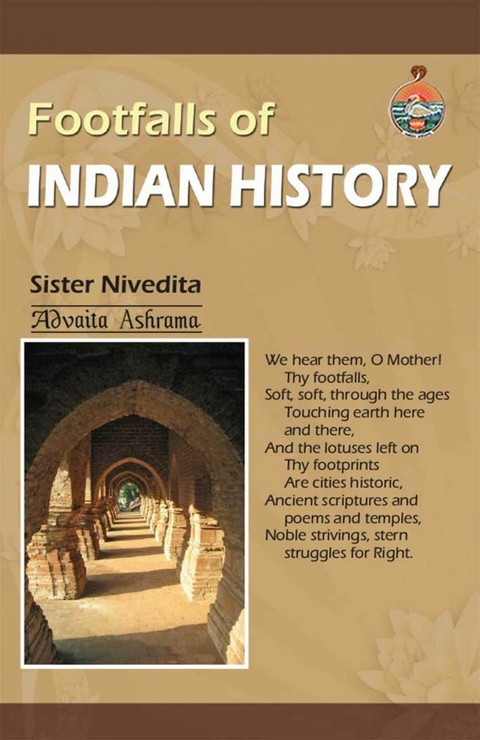
Footfalls of Indian History (eBook)
524 Seiten
Advaita Ashrama (Verlag)
9780000305107 (ISBN)
In this book the author Sister Nivedita, a disciple of Swami Vivekananda, in her inimitable style, gives a glimpse of the past glories and drawbacks of India in a nutshell. She has discussed the most important topics regarding Religion, Philosophy, Culture, Economics, Architecture, influence of the Gupta Dynasty, historical significance of the northern pilgrimage and some problems of Indian research. In the last chapter she has drawn a fine picture of Varanasi, the most ancient city of India. This is a book that will help all those who are eager to learn more about India.
Published by Advaita Ashrama, a publication house of Ramakrishna Math, Belur Math, India.
THE CITIES OF BUDDHISM
ACCEPTING the theory that Buddhism was developed in India, not as a sect or church, but only as a religious order, founded by one of the greatest of the World-Teachers, we find ourselves compelled to account for the relations that would arise between the king or the populace impressed by the memory of Buddha, and the order that followed in his succession and bore his name.
To do this, however, it is first necessary that we should have some determinate idea as to where, in the India of the Buddhist period, were the great centres of population. An Indian city, it has been well said, is a perishable thing, and it is easy to think of names which would justify the statement. No one who has seen the Dhauli Rock, for instance, seven miles away from Bhubaneshwar, can imagine that the edict it bears, fronted by the royal congnisance of the elephant head, was originally sculptured in the wild woods where it now stands. A glance is enough to tell us that the circular ditch which surrounds the fields below was once the moat of a city, backed and fortified by the Dhauli Hill itself, and that the edict-bearing rock stood at the south-eastern corner of this city, where the high-road from the coast must have reached and entered the gates. This city of Dhauli was the capital, doubtless, of Kalinga, when Asoka, in his military youth, conquered the province. In order to estimate its value and importance in the age to which it belonged, we must first restore to the mind’s eye the ports of Tamralipti and Puri, deciding which of these two was the Liverpool of the Asokan era. A theocratic institution such as pilgrimage is frequently a sort of precipitate from an old political condition, and almost always embodies elements of one sort or another which have grown up in a preceding age. Presumably, therefore, Puri was the great maritime centre of the pre-Christian centuries in Northern India; and if so, a road must have passed from it, through Dhauli, to Pataliputra in the north. By this road went and came the foreign trade between India and the East, and between the north and south. In the age of the Keshari kings of Orissa, not only had Dhauli itself given place to Bhubaneshwar, but Puri, perhaps by the same process, had been superseded by Tamralipti, the present Tamluk. It was at the second of these that Fa Hian in the fifth century embarked on his return voyage. Such a supersession of one port by another, however, would only be completed very gradually; and for it to happen at all, we should imagine that there must have been a road from one to the other along the coast. If only the covering sands could now be excavated along that line, there is no saying what discoveries might be made of buried temples and transitional cities. For a whole millennium in history would thus be brought to light.
On the great road from Dhauli to the north, again, there must have been some point at which a route branched off for Banaras, passing through Gaya, and crossing the Punpun River, following in great part the same line by which Sher Shah’s dak went later and the railway goes today.
Let us suppose, however, that two thousand and more years have rolled away, and that we are back once more in that era in which Dhauli was a fortified capital city. The elephant-heralded decree stands outside the gates, proclaiming in freshly-cut letters of the common tongue the name of that wise and just Emperor who binds himself and his people by a single body of law.
“I, King Piyadassi, in the twelfth year after my anointing, have obtained true enlightenment,” the august edict begins. It goes on to express the royal distress at the imperialistic conquest of the province, in Asoka’s youth, and assures his people of his desire to mitigate this fundamental injustice of his rule by a readiness to give audience to any one of them, high or low, at any hour of the day or night. It further enumerates certain of the departments of public works which have been established by the new government, such as those of wells, roads, trees, and medicine. And it notes the appointment of public censors or guardians of morality.
In his reference to the obtaining of “true enlightenment” Asoka records himself a non-monastic disciple of the great monastic order of the day. Nearly three hundred years have elapsed since the passing of the Blessed One, and in the history of the Begging Friars whom He inaugurated there has been heretofore no event like this, of the receiving of the imperial penitent into the lay-ranks served by them. Their task of nation-making is slowly but surely going forward nevertheless. In the light of the Gospel of Nirvana the Aryan Faith is steadily defining and consolidating itself. The Vedic gods have dropped out of common reference. The religious ideas of the Upanishads are being democratised by the very labours of the Begging Friars in spreading those of Buddha, and are coming to be regarded popularly as a recognised body of doctrine characteristic of the Aryan folk. Vague racial superstitions about snakes and trees and sacred springs are tending more and more to be intellectually organised and regimented round the central figure of Brahma, the creator and ordainer of Brahmanic thinkers.
Thus the higher philosophical conceptions of the higher race are being asserted as the outstanding peaks and summits of the Hinduistic faith, and the current notions of the populace are finding their place gradually in the body of that faith, coming by degrees into organic continuity with the lofty abstractions of the Upanishads. In other words, the making of Hinduism has begun.
The whole is fermented and energised by the memory of the Great Life, ended only three centuries agone, of which the yellow-clad brethren are earnest and token. Had Buddha founded a church, recognising social rites, receiving the newborn, solemnising marriage, and giving benediction to the passing soul, his personal teachings would have formed to this hour a distinguishable half-antagonistic strain in the organ-music of Hinduism. But he founded only an order. And its only function was to preach the Gospel and give individual souls the message of Nirvana. For marriage and blessing, men must go to the Brahmanas: the sons of Buddha could not be maintainers of the social polity, since in his eyes it had been the social nexus itself which had constituted that World, that Maya, (1) from which it was the mission of the Truth to set men free.
The work of the monk, then as a witness to the eternal verities, was in no rivalry to the more civic function of the Brahmanic priesthood. And this is the fact which finds expression in the relation of the monkhood to the Indian cities of the Asokan era. The Brahmana is a citizen-priest, living in a city. The Buddhist is a monk, living in an abbey. In all lands the monk has memorialised himself by buildings instead of by posterity. In India these have been largely carved, as at Mahablalipuram in the south, or excavated, as at Ellora and elsewhere, instead of built. But the sentiment is the same. In place of a single monastery with its chapel or cathedral, we find here a number of independent cells or groups of cells, and frequently a whole series of cathedral shrines. Apparently a given spot has remained a monastic centre during generation after generation. Dynasties and revolutions might come and go but this would remain, untouched by any circumstances save the inevitable shifting of population and the final decay of its own spiritual fire.
In its decoration the abbey would reflect the art of the current epoch. In culture it would act as a university. In ideals it represented the super-social, or extra-civic conception of the spiritual equality and fraternity of all men. Its inmates were vowed to religious celibacy. And we may take it that the place of the abbey would always be at a certain distance from a city whose government was in sympathy with it.
Thus the city of Dhauli, under the Emperor Asoka and succeeding worshippers of Buddha, had Khandagiri at seven miles’ distance as its royal abbey. The civic power was represented at Gaya: the monastic at Bodh-Gaya. Banaras was the seat of Erahmanas: Sarnath of monks. Elephanta was the cathedral-temple of a king’s capital, (2) but Kanheri, on another island a few miles away, offers to us the corresponding monastery.
From these examples and from what we can see to have been their inevitableness, we might expect that any important city of the Buddhistic period would be likely to occur in connection with a monastic centre some few miles distant. Now it is possible to determine the positions of a great many such cities on grounds entirely a priori. It is clear, for instance, that whatever geographical considerations might make Banaras great would also act at the same time to distinguish Allahabad. By a similar induction, Mathura on the Jamuna and Hardwar on the Ganges might also be expected to furnish proof of ancient greatness. Now outside Prayag we have to the present time, as a haunt of Sâdhus, (3) the spot known as Nirvanikal. And in the vicinity of Hardwar is there not Hrishikesh? The caves of Ellora have near them the town of Roza. But this we must regard as a sort of Mohammedan priory, inasmuch as its population consists mainly of religious beggars (of course not celibate) living about the tomb of Aurangzeb. The neighbouring capital that supported the youth of Ellora was probably at Deogiri, now called Daulatabad.
It is the broken links in the chain, however, that fascinate us most in the light of this historical generalisation. What was the city, and what the state, that made Ajanta possible? What was the city that corresponded to the Dharmashâlâ (4) at Sanchi?...
| Erscheint lt. Verlag | 17.8.2021 |
|---|---|
| Sprache | englisch |
| Themenwelt | Geisteswissenschaften ► Religion / Theologie ► Hinduismus |
| ISBN-13 | 9780000305107 / 9780000305107 |
| Informationen gemäß Produktsicherheitsverordnung (GPSR) | |
| Haben Sie eine Frage zum Produkt? |
 EPUB (Adobe DRM)
Größe: 739 KB
Kopierschutz: Adobe-DRM
Adobe-DRM ist ein Kopierschutz, der das eBook vor Mißbrauch schützen soll. Dabei wird das eBook bereits beim Download auf Ihre persönliche Adobe-ID autorisiert. Lesen können Sie das eBook dann nur auf den Geräten, welche ebenfalls auf Ihre Adobe-ID registriert sind.
Details zum Adobe-DRM
Dateiformat: EPUB (Electronic Publication)
EPUB ist ein offener Standard für eBooks und eignet sich besonders zur Darstellung von Belletristik und Sachbüchern. Der Fließtext wird dynamisch an die Display- und Schriftgröße angepasst. Auch für mobile Lesegeräte ist EPUB daher gut geeignet.
Systemvoraussetzungen:
PC/Mac: Mit einem PC oder Mac können Sie dieses eBook lesen. Sie benötigen eine
eReader: Dieses eBook kann mit (fast) allen eBook-Readern gelesen werden. Mit dem amazon-Kindle ist es aber nicht kompatibel.
Smartphone/Tablet: Egal ob Apple oder Android, dieses eBook können Sie lesen. Sie benötigen eine
Geräteliste und zusätzliche Hinweise
Buying eBooks from abroad
For tax law reasons we can sell eBooks just within Germany and Switzerland. Regrettably we cannot fulfill eBook-orders from other countries.
aus dem Bereich