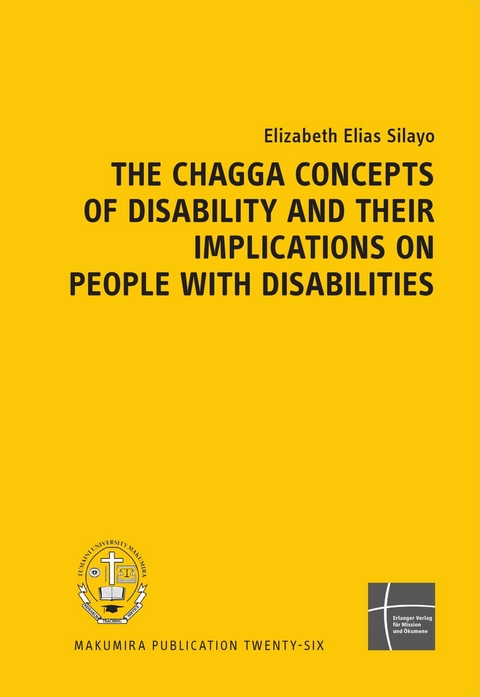
The Chagga Concepts of Disability and their Implications on People with Disabilities (eBook)
184 Seiten
Erlanger Verlag
978-3-87214-640-3 (ISBN)
After several years of pastoral service in the ELCT and her dissertation in Erlangen, for which she lived in Neuendettelsau for several years, she knows both Tanzania and Germany. She is therefore well prepared both theologically and culturally for her ministry. She wrote her dissertation on theology in the context of people with disabilities in her local Chagga community, where she believes there is much to be done: Although the church holds that all people are created in the image of God, a God with disabilities is still an unfamiliar idea for many. As a result, marginalized people receive less attention and consideration from the Chagga community. There is need for immediate and positive action to support people with disabilities.
After several years of pastoral service in the ELCT and her dissertation in Erlangen, for which she lived in Neuendettelsau for several years, she knows both Tanzania and Germany. She is therefore well prepared both theologically and culturally for her ministry. She wrote her dissertation on theology in the context of people with disabilities in her local Chagga community, where she believes there is much to be done: Although the church holds that all people are created in the image of God, a God with disabilities is still an unfamiliar idea for many. As a result, marginalized people receive less attention and consideration from the Chagga community. There is need for immediate and positive action to support people with disabilities.
CONTENTS
Acknowledgement - 9
Abbreviations - 11
Abstract - 12
1 INTRODUCTION TO THIS STUDY – 17
1.1 Introduction - 17
1.2 Statement of Interest on Disability Research - 17
1.3 Research Questions and Hypothesis - 20
1.4 The Objective of This Study - 21
1.5 Methodology and Theory - 21
1.6 The Importance of this Study - 25
1.7 Literature Reviews - 26
1.8 Research Organization - 32
2 BACKGROUND ON THE CHAGGA ETHNIC GROUP - 34
2.1 Introduction - 34
2.2 The United Republic of Tanzania - 34
2.3 Chiefdoms and Chiefs - 37
2.4 The Chagga People and the Kihamba - 44
2.5 Lore of the Chagga Culture on Human - 45
2.6 Community and Family Life - 45
2.7 The Chagga Indigenous Religion - 48
2.8 Early Christianity and Other Religion(s) among the Chagga - 51
2.9 Bruno Gutmann's Views on the Chagga Culture - 53
2.10 Rite Practices among the Chagga People - 57
2.11. Conclusion - 63
3 PRAGMATIC INFORMATION ABOUT THE CHAGGA CONCEPTS OF DISABILITY AND THEIR IMPACT ON PEOPLE WITH DISABILITIES - 65
3.1 Introduction - 65
3.2 Geographical Location and Visited Areas - 66
3.3 An Overview of the Findings of the Interviewees - 66
3.4 Ethnographical Relationship, its Importance and Challenges - 69
3.5 Research Ethics, Relationships and Respect - 71
3.6 The Interviewees: Selection and Methodology - 72
3.7 The Understanding of Humans According to the Chagga Community - 76
3.8 Rituals and Other Ways of Dealing with Disability- 85
3.9 People with Disabilities and their Families - 89
3.10 Witchcraft and Sorcerers, Witch Doctors and Prayers for Healing - 102
3.11 Vocabulary Used to Address People with Disabilities - 107
3.12 Encounters with the Homeless and Street People with Disabilities - 108
3.13 The Meaning of Disability According to the Chagga - 111
4 DISCOURSE THEORY AND ITS IMPORTANCE TO THIS WORK - 112
4.1 Introduction - 112
4.2 Comprehension of Discourse Theory - 112
4.3 Development of Discourse Theory - 115
4.4 Michel Foucault - 116
4.5 Foucault's Concepts of Discourse Theory - 117
4.6 Criticisms of Foucault's Discourse Theory - 128
4.7 The Relevance and Challenge of Discourse Theory to this Work - 129
4.8 Conclusion - 131
5 REFLECTING DISCOURSES AROUND DISABILITY AND HUMANISM PHILOSOPHY - 132
5.1 Introduction - 132
5.2. Humanism - 133
5.3 Reflecting Disability and Discourse - 142
5.4 Role of the Community to Individual Wellbeing - 154
5.5 Ambivalent Positions on Disability Concepts in Chagga - 158
5.6 Conclusion - 160
6 CONCLUDING REMARKS - 161
6.1 Conclusion and Recommendations - 161
6.2 Recommendations for Further Research - 163
References - 165
| Erscheint lt. Verlag | 5.6.2025 |
|---|---|
| Reihe/Serie | Makumira Publication |
| Verlagsort | Neuendettelsau |
| Sprache | englisch |
| Themenwelt | Geisteswissenschaften ► Religion / Theologie ► Christentum |
| Schlagworte | Ausgrenzung • Behinderung • Chagga • ELCT • Handikap • Inklusion • Integration • Interkulturelles Verstehen • Tansania |
| ISBN-10 | 3-87214-640-8 / 3872146408 |
| ISBN-13 | 978-3-87214-640-3 / 9783872146403 |
| Informationen gemäß Produktsicherheitsverordnung (GPSR) | |
| Haben Sie eine Frage zum Produkt? |
 PDF (Wasserzeichen)
DRM: Digitales Wasserzeichen
Dieses eBook enthält ein digitales Wasserzeichen und ist damit für Sie personalisiert. Bei einer missbräuchlichen Weitergabe des eBooks an Dritte ist eine Rückverfolgung an die Quelle möglich.
Dateiformat: PDF (Portable Document Format)
Mit einem festen Seitenlayout eignet sich die PDF besonders für Fachbücher mit Spalten, Tabellen und Abbildungen. Eine PDF kann auf fast allen Geräten angezeigt werden, ist aber für kleine Displays (Smartphone, eReader) nur eingeschränkt geeignet.
Systemvoraussetzungen:
PC/Mac: Mit einem PC oder Mac können Sie dieses eBook lesen. Sie benötigen dafür einen PDF-Viewer - z.B. den Adobe Reader oder Adobe Digital Editions.
eReader: Dieses eBook kann mit (fast) allen eBook-Readern gelesen werden. Mit dem amazon-Kindle ist es aber nicht kompatibel.
Smartphone/Tablet: Egal ob Apple oder Android, dieses eBook können Sie lesen. Sie benötigen dafür einen PDF-Viewer - z.B. die kostenlose Adobe Digital Editions-App.
Buying eBooks from abroad
For tax law reasons we can sell eBooks just within Germany and Switzerland. Regrettably we cannot fulfill eBook-orders from other countries.
aus dem Bereich