


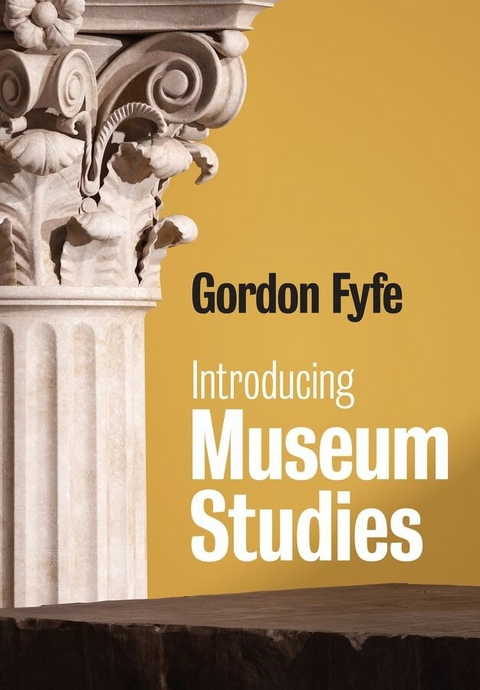
Introducing Museum Studies (eBook)
378 Seiten
Polity (Verlag)
978-0-7456-9481-8 (ISBN)
The book shows how museums, far from being neutral collections, exhibit objects which convey powerful symbolic meanings. This 'cultural turn' away from the object as a thing in itself has placed museums at the centre of debates about public culture, citizenship, inclusion and repatriation. Museums are becoming increasingly reflexive given the awareness of the social and political role they serve and their ability to reflect the problems of our time. Gordon Fyfe shows how and why this reflexivity creates a need for historical perspective on current practices: on the one hand museums are enmeshed in a changing world and on the other hand they exhibit change. At their best, museums help us to see that everything is on the move and that change is the natural order of things.
Accessibly written, this is the go-to introduction for scholars and students of museum studies, arts and cultural management, and heritage studies.
Gordon Fyfe was Senior Lecturer at Keele University and is a founding editor of the University of Leicester's museums journal, Museum and Society.
Introducing Museum Studies is the first introductory textbook for museum studies. Providing a wide-ranging and original overview of museums from a historical and contemporary perspective, it covers key topics such as the history of the museum, the museum as a public space, visitors, and communities. The book shows how museums, far from being neutral collections, exhibit objects which convey powerful symbolic meanings. This cultural turn away from the object as a thing in itself has placed museums at the centre of debates about public culture, citizenship, inclusion and repatriation. Museums are becoming increasingly reflexive given the awareness of the social and political role they serve and their ability to reflect the problems of our time. Gordon Fyfe shows how and why this reflexivity creates a need for historical perspective on current practices: on the one hand museums are enmeshed in a changing world and on the other hand they exhibit change. At their best, museums help us to see that everything is on the move and that change is the natural order of things.Accessibly written, this is the go-to introduction for scholars and students of museum studies, arts and cultural management, and heritage studies.
Introduction
By the late twentieth century, museums had gone through a major transformation. Nobody had planned it. But there were more and more museums. They had been sprouting up everywhere since the 1960s. As was the case with other professions such as medicine, school teaching, law and accountancy, clients were looking more and more like consumers. The scale and complexity of change was outrunning received definitions, modes of administration and ways of organizing things. Multiple challenges flowed from expansion. And this in a world where Western notions of civilization exhibited in museums were exposed as being just that, Western. Europeans were hatching something they called the New Museology. Beyond Europe there emerged different ideas about what museums might be and what studying them might entail. In a post-colonial world there were indigenous peoples whose material cultures had been appropriated by Western museums, and whose voices could now be better heard. The day of reckoning had arrived.
How to pay for it? There were matters of public subsidy: how to justify direct tax subsidies for cultural goods that were judged by some to be disproportionately of middle- and upper-class interest. Here we might note the competing claims of large state-registered museums against the smaller independent and more entrepreneurial museums whose expansion was reshaping the museum landscape. There were the transformative effects on the museum profession and most notably on the role of the curator in managing and interpreting collections. Somehow, to put it crudely, the museum had to become less object-oriented and more person- or visitor-oriented. In a pattern of change, by no means confined to museums, a marketization of culture had shifted the focus of attention towards the visitor’s experience. And, finally, there was citizenship. There was growing concern that museum visitors were unrepresentative of national populations. There was the matter of class, and other social divisions were coming into view. Feminists, civil rights activists, Black Lives Matter and LGBTQIA+ activists would come calling for new relationships of trust with and within museums. The contrast between a rhetorical universalism and the reality of visitor profiles required an answer to the question ‘What counts as a museum?’ And it was becoming evident that European museums were as ‘cultural’ as the world cultures they exhibited.
The museums of our time register the shifting balances of power associated with change, and it is this that has led to new visions of what a museum might be and should become. In the old industrial societies there emerged community and heritage museums which exhibited memories entangled with the exploitation of landscapes (e.g., mining, canal and railway construction). Elsewhere, new museum buildings would come to signify a different and indigenous relationship to the landscape. New Zealand’s Te Papa Tongarewa evokes the siting of traditional Māori buildings in the natural landscape, which is linked to a Māori stewardship that maintains a ‘balanced and pastoral relationship with their natural environment’ (Hourston 2004: 7). At the Museum of Sydney, the grand narrative of settler nationalism gives way to a more fractured less Europe-centred history of the world (Message 2006: 27–30).
So, to summarize. Over the past fifty years Western museums have been transformed. It has become a commonplace that the so-called universal survey museums of the nineteenth and early twentieth centuries have run out of steam. Their grand narratives of national progress can’t hack it in a world where there are so many other stories to tell. The museum’s universalism has been called out for what it always was – a particularism that registered patriarchal Western feelings of natural superiority over others. And the fixed co-ordinates of ‘family and faith, race and nation’ have lost salience in a world where identities are constantly under negotiation (Huyssen 1995: 34). These are some of the things that have come to preoccupy museum studies and have given it shape as an intellectual project.
Historical perspective
In the late twentieth century, some people began to wonder about the future of the museum. The challenge came from two directions, from philosophy and the social sciences. One challenge had roots that went back to the early nineteenth century. The charge was that museums are fundamentally alienating institutions because, in historicizing artefacts, in removing them from their original contexts, they cut them off from their true meaning (Maleuvre 1999). The second charge was that museums had betrayed the Enlightenment. Far from spreading knowledge and understanding of the world, art museums were failing to include all citizens within the public culture. However, that in itself was not the real news. What was news was that, in 1960s France, visitor research seemed to show that the function of museums, if not their purpose, was to reconcile subordinate social strata to their social exclusion, to a qualified citizenship. These developments did not take place in a social vacuum. On the one hand, Western museums were changing, commercializing and acquiring business acumen, so that visitors were increasingly addressed as consumers as well as citizens. And, on the other, there were the first intimations that a politics of inclusion might interrupt business as normal.
Critics turned their attention to the museum’s past only to take issue with the story as told. Douglas Crimp’s On the Museum’s Ruins was a critique of the so-called grand narratives of human progress in which the history of the museum was taken to be one of ‘continuous evolution, from ancient times’ (Crimp 1993: 18). The problem was an origin myth which anchored the museum in a universal impulse to collect and preserve humanity’s aesthetic heritage. This, Crimp thought, had the cart before the horse: aesthetics was a modern invention, and collections had ‘differed vastly in their objects and classificatory systems at different historical junctures’ (ibid.). Meanwhile Eilean Hooper-Greenhill was pointing out that the museum’s fixity was an illusion exposed as all the more illusory by the hard questions being asked about funding and maintenance (Hooper-Greenhill 1992: 1). Indeed, what exactly was it that was being funded? Did we know? That museum classifications might not be timeless was, she argued, important when it came to addressing the question ‘What are museums for and where are they going?’ The culture of the museum and what it demands of the spectator required study. In the 1980s and 1990s the history of museums began to attract two kinds of scholarly attention.
First, there were ethnographic descriptions of the collections and collecting practices of early modern Europeans. It was becoming clear that there was a history of objectivity to be addressed and that it began, not with the eighteenth-century Enlightenment, with the Age of Reason and its museums, but with an earlier phase in collecting. There was an age of curiosity, of the sixteenth- and seventeenth-century cabinets and Wunderkammer which had something to do with the history of objectivity. Peter Burke’s The Historical Anthropology of Early Modern Italy, Oliver Impey and Arthur MacGregor’s The Origins of Museums, Paula Findlen’s Possessing Nature and Krzysztof Pomian’s Collectors and Curiosities: Paris and Venice, 1500–1800 were especially significant. They rendered pre-modern collecting practices less opaque and more ‘readable’ as sites where the ingredients of modern science and the humanities were seen to be emerging. These scholars recovered the story of how collecting antiquities and natural objects was linked to the transformation of a medieval Christian scribal worldview. Here, with the gentlemanly and princely cabinets (the first museums) there was a shift of emphasis away from a scribal culture to an appreciation that collections of objects might be a source of intellectual authority (Findlen 1994).
Second, there was the idea that the history of the museum deserved a new kind of history – a history of its discourse or its way of knowing. Drawing on the work of the social theorist Michel Foucault ([1966] 1970), Tony Bennett, Eilean Hooper-Greenhill, Kevin Hetherington and others argued that the transparency of museum spaces is an illusion. Foucault had inspired a new perspective which located the museum within a history of cultural spaces and periods. At the heart of the argument was the idea that museums are realizations of cultural codes or epistemes which, in any given period, govern thought across a range of ‘disciplines’, setting the parameters of experience and of what human beings can think and know. Museums, in their manner of displaying objects, not only display order but emerged out of other spaces that displayed different ways of ordering things. It followed that there had been other kinds of museums in the past and perhaps they would be different in the future. Perhaps they were already in the making.
Defining the museum: social power and interdependence
So, what are museums? Definitions normally include some reference to publicness. However, when people say that museums are public institutions, they may have in mind one of several things or several things altogether. They may mean that a collection is publicly owned and managed in the public interest. Or that it is a publicly accessible place that...
| Erscheint lt. Verlag | 17.6.2025 |
|---|---|
| Sprache | englisch |
| Themenwelt | Kunst / Musik / Theater |
| Geisteswissenschaften ► Geschichte ► Hilfswissenschaften | |
| Sozialwissenschaften ► Politik / Verwaltung | |
| Schlagworte | artefacts • art gallery • Cultural Studies • empires and museums • Exhibitions • first introductory textbook for museum studies • Galleries • Gordon Fyfe • history of museums • museology • Museum Practice • Museums • museums and communities • museums and cultural capital • museums and modern society • museums as contested spaces • Museum Studies • Museum Visitors • objects • return of museum items taken from colonised countries • The New Museology • visitor studies |
| ISBN-10 | 0-7456-9481-0 / 0745694810 |
| ISBN-13 | 978-0-7456-9481-8 / 9780745694818 |
| Informationen gemäß Produktsicherheitsverordnung (GPSR) | |
| Haben Sie eine Frage zum Produkt? |
 EPUB (Adobe DRM)
Kopierschutz: Adobe-DRM
Adobe-DRM ist ein Kopierschutz, der das eBook vor Mißbrauch schützen soll. Dabei wird das eBook bereits beim Download auf Ihre persönliche Adobe-ID autorisiert. Lesen können Sie das eBook dann nur auf den Geräten, welche ebenfalls auf Ihre Adobe-ID registriert sind.
Details zum Adobe-DRM
Dateiformat: EPUB (Electronic Publication)
EPUB ist ein offener Standard für eBooks und eignet sich besonders zur Darstellung von Belletristik und Sachbüchern. Der Fließtext wird dynamisch an die Display- und Schriftgröße angepasst. Auch für mobile Lesegeräte ist EPUB daher gut geeignet.
Systemvoraussetzungen:
PC/Mac: Mit einem PC oder Mac können Sie dieses eBook lesen. Sie benötigen eine
eReader: Dieses eBook kann mit (fast) allen eBook-Readern gelesen werden. Mit dem amazon-Kindle ist es aber nicht kompatibel.
Smartphone/Tablet: Egal ob Apple oder Android, dieses eBook können Sie lesen. Sie benötigen eine
Geräteliste und zusätzliche Hinweise
Buying eBooks from abroad
For tax law reasons we can sell eBooks just within Germany and Switzerland. Regrettably we cannot fulfill eBook-orders from other countries.


