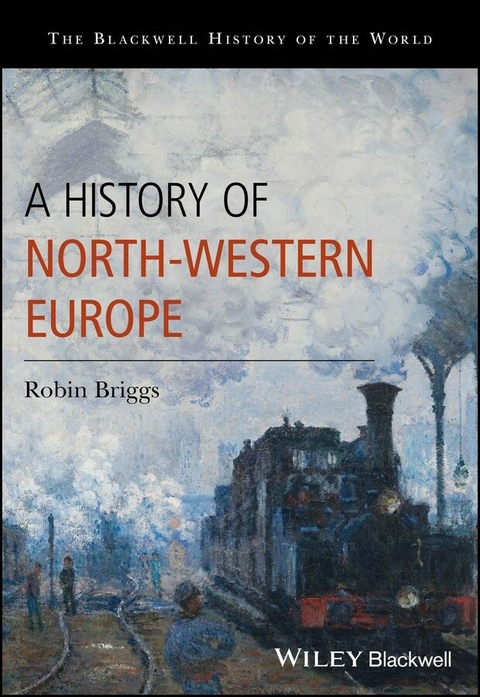
A History of North-Western Europe (eBook)
400 Seiten
Wiley-Blackwell (Verlag)
978-1-119-72116-1 (ISBN)
Concentrates solely on North-Western Europe, examines the crucial structural changes that shaped the modern world
The History of North-Western Europe provides a broad account of the regions included in the modern states of France, Germany, the Netherlands, Belgium, Austria, and Great Britain. Offering a rigorous yet accessible analytical narrative of the centuries between the fall of the Roman Empire and the First World War, noted historian Robin Briggs examines the many forms of structural change that helped to create a distinctive North-Western European society.
Organized chronologically into fourteen substantial chapters, the text covers major events and eras such as the Protestant Reformation, the rise of the fiscal-military state, and the scientific and industrial revolutions that combined to undermine traditional authority structures and generate new understandings of the world. The author also offers insights into the origins and development of the urban and industrial society that ultimately transformed the globe. Topics include the Carolingian dynasty, the rule of feudal lords and popes, the bubonic plague, the Renaissance, the Enlightenment, the Napoleonic wars, the Revolutions of 1848, the growth of nationalism and instability preceding the Great War, and much more.
- Stimulates readers to reflect in new ways on how the past is crucial to understanding the present
- Combines a coherent narrative with strong analyses of crucial developments at every stage of North-Western European history
- Explores the upheavals that shaped the social, religious, economic, and political landscape of the region
- Discusses how European naval, military, religious, and economic power was projected worldwide
The History of North-Western Europe: From Late Antiquity to the First World War is an excellent textbook for undergraduate students in European History courses, as well as a valuable resource for general readers looking for a wide-ranging historical account of the countries of the region.
ROBIN BRIGGS is Emeritus Senior Research Fellow at All Souls College, University of Oxford. He is a specialist in French and European history, with numerous publications in the fields of social and religious history. Briggs is a Fellow of the British Academy and the author of several books, including Communities of Belief: Cultural and Social Tension in Early Modern France and Witches and Neighbors: The Social and Cultural Context of European Witchcraft.
Preface
This is not a book I could ever have conceived of writing on my own initiative, and it took a great deal of persuasion before I agreed to make the attempt. No historian could possibly have a deep knowledge of the history of this crucial region over more than a millennium and a half, and the literature multiplies much faster than any feeble attempt to catch up with it, even over quite short periods of national history, let alone on all the nations involved. So this book is very largely the work of an amateur, whose professional qualifications extend only over a small part of the subject matter. If that has made the actual writing hard and rendered progress extremely slow at times, the compensation has been a licence to read many books and articles I would never have encountered otherwise, and to acquire a much fuller sense of the richness of the history under investigation. That has been fun, and usually thought‐provoking, however much it has prolonged the actual production. What I have tried to provide is an analytical narrative, switching between general aspects of the scene and national history in what seemed to be a set of reasonable compromises, while often moving at a breakneck pace and offering hazardous generalisations. If the result is sometimes more of a bluffer's guide than a serious historical work, I can only plead the nature of an almost impossible task as an excuse. For all its length, the book is more of a sketch with illustrative details than a comprehensive treatment of this infinitely complex story. No reader should take what I say on trust; they should merely regard it as a first approximation and feel encouraged to follow up on my claims by further reading. I have come to feel, all the same, that the effort to abstract a brief narrative from a mass of detail is a worthwhile enterprise, and that the view from on high can have its own merits.
North‐western Europe is hardly a well‐defined entity, and I have played fast and loose here, treating geographical boundaries with extreme freedom. The focus throughout is on the classic region including the German lands, France, the Low Countries, and Britain, including some quite extended sections on specific states. Denmark and Switzerland have only been mentioned occasionally, although they may be thought part of the region; I hope it will not cause offence to have relegated them to the sidelines in this way, in order to achieve a more streamlined narrative. Italy and Iberia have both forced their way in at times, when their histories were too strongly interwoven with affairs north of the Alps and the Pyrenees to be omitted, as have Russia and Poland in similar fashion. This untidy ad hoc approach made sense to me, and I hope readers will tolerate it. Another way of explaining these choices is that at the heart of the book is the decisive once for all change which brought the modern world into being. The region studied here is the one where this great shift essentially happened. It was of course preceded by a much slower evolution, which gradually created the early modern situation in which the escape from traditional limitations was possible at all, and that long history is the subject of the first chapters. Since the concept of modernity can be a controversial one, I should perhaps say that I would not myself go beyond industrial society, scientific method and global interconnectedness as its salient features. Nor do I wish to suggest that it was the sole and unaided achievement of Europeans. When some degree of Eurocentricity could hardly be avoided in a book with this title, readers would be well advised to balance the picture by turning (as a start) to Christopher Bayly's classic text in the same series, The Birth of the Modern World, 1780–1914, for the global changes involved.
No book of a reasonable length could offer a comprehensive or balanced treatment of such a vast subject. I did not set out with any conscious plan of what matters to prioritise, and only marginally with what to exclude. It did seem obvious that space considerations would preclude any extended coverage of the development of high culture; since I personally take a keen interest in the literature, visual arts, and music we have inherited from the European past, that is a matter of some regret to me. What may be more questionable is the relative neglect of issues concerning women and children across all those centuries, areas of the past to which I am also far from indifferent. The trouble here was I think the difficulty I felt in offering much in the way of helpful generalisations where the historical record is (for most of the period) so sparse and hard to evaluate. For example, it seems clear that as legal systems evolved towards greater complexity from the sixteenth century onwards, the formal position of women tended to worsen, with stronger exclusions formulated. At the same time, it remains very unclear how far these were genuinely applied, or whether the average woman (an impossible concept in any case) was better or worse off in any significant way. Meanwhile, some aspects of intellectual history have been foregrounded, others largely ignored, according to very subjective instincts about what is most relevant to the general story. Another historian could therefore be given the same brief and write a strikingly different book, and I am very conscious that my treatment is inevitably selective.
My heart quailed at the thought of footnoting the text; the choice here was between minimalism, and being ridiculously sketchy, or offering an unmanageable host of references. There are therefore no footnotes, and I can only offer apologies to the many historians from whom I have borrowed information and ideas without acknowledgement. Rather similar considerations apply where a bibliography is concerned. I attempted to draw up selected readings to accompany each chapter, only to become overwhelmed by the task; very long lists of books took shape, among which I could see no sensible principles for selection. The bibliographical note at the end is therefore a relatively short list of just over a hundred books (in English) that I have myself found especially helpful and thought‐provoking, books which I can recommend to anyone who finds my approach sympathetic. This note is also an encouragement to go to the obvious next level of information, where copious bibliographies may readily be found. Anyone who wants to read it all up in depth will need several lifetimes, and they will inevitably fall ever further behind the flood of new publications. One of my own first tasks once the book is in print and beyond further modification will be to clear away the piles of volumes that threaten to render my study impassable, and then to return hundreds of them to the invaluable college library without which I could never have managed at all. Oxford's superb History Faculty Library was equally crucial, but sterner borrowing limits mean that those books are already back on the shelves. Some of my very warmest thanks must go to the librarians concerned: at All Souls Norma Aubertin‐Potter and Gaye Morgan, and for the University collections Isabel Holowaty, Rachel d'Arcy Brown and their assistant librarians.
I owe thanks to far too many people to list here, for conversations and practical help over many years, including the times before I was even planning this book; by its nature, just about every other historian living or dead with whom I have conversed over the last 60 years could be included. That list would be enormously long because I have had the exceptional good fortune to spend my career at the University of Oxford, which has operated as a kind of magnet, attracting leading historians from Britain, America, Europe and beyond to give lectures and seminar papers, and to spend time as academic visitors. Frequent visits to France, first as a kind of apprentice with the Annales school, then for research and as a Visiting Professor at the Sorbonne and the Collège de France, have further brought me into contact with most of the leading figures in the French historical scene, whose friendliness has been remarkable and heart‐warming. Visits to Germany and the Netherlands have been rarer but equally instructive. Back in Oxford, exceptionally stimulating seminars run by (among others) Sir Keith Thomas, Richard Cobb, Peter Lewis, Ian Maclean, Sir Noel Malcolm, and (with me) Miri Rubin have been an indispensable part of my intellectual life. Those names identify just a few of the inspiring colleagues and friends with whom I have interacted over so many years, many of whom are now inevitably dead. Among the latter, I would just like to mention my undergraduate teachers Christopher Hill and Maurice Keen, then Sir John Habakkuk, whose advice sent me to France to become a historian of Europe in the first place. Otherwise, I trust that my many interlocutors (and the shades of those now dead) will forgive me for making my thanks general ones.
For 60 years now, All Souls College has provided a wonderfully sustaining environment in which to work, as an interdisciplinary research institution with a large Visiting Fellowships programme; the latter has brought in large numbers of the visiting historians already mentioned, to my enormous benefit. The Senior Research Fellowships funded by the College and the university Professorships and other posts (notably those in economic, medieval and military history) that confer Fellowships have had a series of distinguished holders from whom I have learned a huge amount. It would be hard to imagine a better place from which to prepare a book with such a massive range. That support has continued, in a very generous fashion, in the years...
| Erscheint lt. Verlag | 17.6.2025 |
|---|---|
| Reihe/Serie | Blackwell History of the World |
| Sprache | englisch |
| Themenwelt | Geschichte ► Allgemeine Geschichte ► Neuzeit (bis 1918) |
| Schlagworte | Northwest European history • Northwest Europe history • Northwest Europe history textbook • Northwest Europe religious history • Northwest Europe social history • Northwest Europe socio-economic history • Northwest Europe structural change history |
| ISBN-10 | 1-119-72116-4 / 1119721164 |
| ISBN-13 | 978-1-119-72116-1 / 9781119721161 |
| Informationen gemäß Produktsicherheitsverordnung (GPSR) | |
| Haben Sie eine Frage zum Produkt? |
 EPUB (Adobe DRM)
Kopierschutz: Adobe-DRM
Adobe-DRM ist ein Kopierschutz, der das eBook vor Mißbrauch schützen soll. Dabei wird das eBook bereits beim Download auf Ihre persönliche Adobe-ID autorisiert. Lesen können Sie das eBook dann nur auf den Geräten, welche ebenfalls auf Ihre Adobe-ID registriert sind.
Details zum Adobe-DRM
Dateiformat: EPUB (Electronic Publication)
EPUB ist ein offener Standard für eBooks und eignet sich besonders zur Darstellung von Belletristik und Sachbüchern. Der Fließtext wird dynamisch an die Display- und Schriftgröße angepasst. Auch für mobile Lesegeräte ist EPUB daher gut geeignet.
Systemvoraussetzungen:
PC/Mac: Mit einem PC oder Mac können Sie dieses eBook lesen. Sie benötigen eine
eReader: Dieses eBook kann mit (fast) allen eBook-Readern gelesen werden. Mit dem amazon-Kindle ist es aber nicht kompatibel.
Smartphone/Tablet: Egal ob Apple oder Android, dieses eBook können Sie lesen. Sie benötigen eine
Geräteliste und zusätzliche Hinweise
Buying eBooks from abroad
For tax law reasons we can sell eBooks just within Germany and Switzerland. Regrettably we cannot fulfill eBook-orders from other countries.
aus dem Bereich