


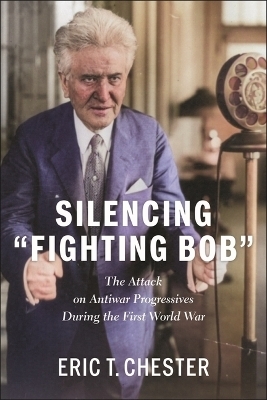
Silencing Fighting Bob
The Attack on Antiwar Progressives During the First World War The
Seiten
2026
Monthly Review Press,U.S. (Verlag)
978-1-68590-126-4 (ISBN)
Monthly Review Press,U.S. (Verlag)
978-1-68590-126-4 (ISBN)
Silencing "Fighting Bob” tells the story of the coordinated attack by the federal government on the progressive opponents of the first world war. As Eric Chester reminds us, the American people saw no reason for the United States to become directly involved in Europe’s conflict in 1917. President Woodrow Wilson, ignoring that fact, forced the
Silencing
"Fighting Bob” tells the story of the coordinated attack by the federal
government on the progressive opponents of the first world war. As Eric
Chester reminds us, the American people saw no reason for the United States
to become directly involved in Europe’s conflict in 1917. President Woodrow
Wilson, ignoring that fact, forced the United States to join with its allies
in carrying the war to the bitter end: the total and unconditional surrender
of Germany. To accomplish this, Wilson—notably, a Democrat—was convinced that
harsh repression of dissent was necessary. Reexamining a wide range of
archival sources from a new angle, Chester describes the rollout of this
campaign of suppression, showing that the most radical opponents of the war
were the first to come under attack, beginning with the imprisonment of
members of the Industrial Workers of the World and the sentencing of
left-wing socialists to long terms in prison. Chester reveals that, as soon
as the radical Left was quashed, the federal government turned its attention
to reformists committed to working within the system—that is, Progressives,
as led by Senator “Fighting Bob” LaFollette, the Wisconsin Republican at the
forefront of the Progressive movement. What does it say that, although some
of the first World War’s most ardent opponents were situated in the United
States, few today recall that most Americans opposed the decision to enter
the First World War? What can we learn from the fact that it was a Democrat
who brought that antiwar movement down? As Chester demonstrates, history
shows the struggle to uphold civil liberties can only succeed when everyone’s
right to dissent is defended, no matter what their views and no matter who
holds power. Chester documents the process by which a Democrat who viewed
himself as a reformer took down a Republican, along with the countless
Progressives he counted among his allies—leaving a lasting legacy for the
Democratic Party: the repression of the most potent Progressive forces in the
United States.
Silencing
"Fighting Bob” tells the story of the coordinated attack by the federal
government on the progressive opponents of the first world war. As Eric
Chester reminds us, the American people saw no reason for the United States
to become directly involved in Europe’s conflict in 1917. President Woodrow
Wilson, ignoring that fact, forced the United States to join with its allies
in carrying the war to the bitter end: the total and unconditional surrender
of Germany. To accomplish this, Wilson—notably, a Democrat—was convinced that
harsh repression of dissent was necessary. Reexamining a wide range of
archival sources from a new angle, Chester describes the rollout of this
campaign of suppression, showing that the most radical opponents of the war
were the first to come under attack, beginning with the imprisonment of
members of the Industrial Workers of the World and the sentencing of
left-wing socialists to long terms in prison. Chester reveals that, as soon
as the radical Left was quashed, the federal government turned its attention
to reformists committed to working within the system—that is, Progressives,
as led by Senator “Fighting Bob” LaFollette, the Wisconsin Republican at the
forefront of the Progressive movement. What does it say that, although some
of the first World War’s most ardent opponents were situated in the United
States, few today recall that most Americans opposed the decision to enter
the First World War? What can we learn from the fact that it was a Democrat
who brought that antiwar movement down? As Chester demonstrates, history
shows the struggle to uphold civil liberties can only succeed when everyone’s
right to dissent is defended, no matter what their views and no matter who
holds power. Chester documents the process by which a Democrat who viewed
himself as a reformer took down a Republican, along with the countless
Progressives he counted among his allies—leaving a lasting legacy for the
Democratic Party: the repression of the most potent Progressive forces in the
United States.
Eric T. Chester is the author of several books published by Monthly Review Press, including Rag-Tags, Scum, Riff-Raff, and Commies: The U.S. Intervention in the Dominican Republic, 1965–1966, and, more recently, Free Speech and the Suppression of Dissent During World War I. He taught economics at the University of Massachusetts in Boston and San Francisco State University, and also once ran as vice-presidential candidate for the Socialist Party. He has been a committed activist for more than fifty years.
| Erscheinungsdatum | 12.12.2025 |
|---|---|
| Verlagsort | New York |
| Sprache | englisch |
| Maße | 140 x 200 mm |
| Themenwelt | Geschichte ► Allgemeine Geschichte ► Neuzeit (bis 1918) |
| Geisteswissenschaften ► Geschichte ► Regional- / Ländergeschichte | |
| ISBN-10 | 1-68590-126-3 / 1685901263 |
| ISBN-13 | 978-1-68590-126-4 / 9781685901264 |
| Zustand | Neuware |
| Informationen gemäß Produktsicherheitsverordnung (GPSR) | |
| Haben Sie eine Frage zum Produkt? |
Mehr entdecken
aus dem Bereich


aus dem Bereich
Geschichte einer wilden Handlung
Buch | Hardcover (2024)
C.H.Beck (Verlag)
CHF 47,60


