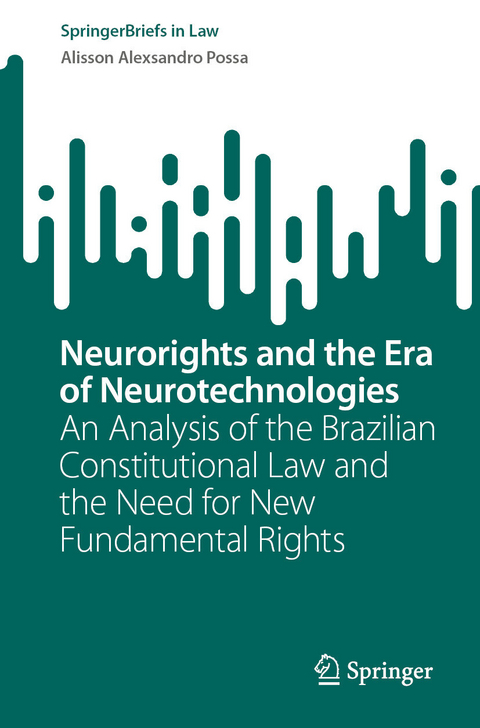
Neurorights and the Era of Neurotechnologies (eBook)
70 Seiten
Springer Nature Switzerland (Verlag)
978-3-031-92002-8 (ISBN)

This book provides an in-depth study on the theory of fundamental rights and the legal challenges posed by new technologies, with a particular focus on neurotechnologies and neurorights. The book begins with an overview of the evolution of neuroscience and neurotechnology, highlighting the current challenges these advancements pose to contemporary legal frameworks. It also discusses the potential for widespread adoption of these technologies, driven by significant investments from tech companies.
The first chapter delves into the development of neuroscience and neurotechnology, emphasizing the legal implications and future concerns associated with their mass adoption. It explores how these technologies are being integrated into society and the legal challenges they present.
The second chapter examines the concept of neurorights, identifying the legal objects these rights aim to protect and the new risks introduced by neurotechnologies. It provides a comprehensive review of the main neurorights proposals from recent decades, with a detailed analysis of the theoretical framework proposed by Marcello Ienca and Roberto Andorno in 2017. Their proposal includes four new human rights: cognitive freedom, mental privacy, mental integrity, and psychological continuity.
The final chapter analyzes the relationship between neurorights and existing constitutional protections, focusing on the protection of human dignity. It discusses the right to free development of personality, physical and psychological integrity, and privacy and data protection. The chapter draws on theories of fundamental rights from Brazilian constitutionalists to provide a thorough examination of these issues.
The book offers a broad analysis of the main neurorights proposals by international researchers, comparing them with the fundamental rights recognized in the Brazilian Constitution. It aims to determine whether new fundamental rights are necessary to protect Brazilian citizens from the potential harms of neurotechnology. This study is essential for researchers in neuroethics, neurorights, and fundamental rights, providing valuable insights into the intersection of law and emerging technologies.
| Erscheint lt. Verlag | 12.6.2025 |
|---|---|
| Reihe/Serie | SpringerBriefs in Law |
| Zusatzinfo | VII, 70 p. 5 illus., 4 illus. in color. |
| Sprache | englisch |
| Original-Titel | Era das Neurotecnologias |
| Themenwelt | Geisteswissenschaften ► Philosophie ► Ethik |
| Informatik ► Netzwerke ► Sicherheit / Firewall | |
| Recht / Steuern ► Allgemeines / Lexika | |
| Recht / Steuern ► Öffentliches Recht ► Verfassungsrecht | |
| Recht / Steuern ► Privatrecht / Bürgerliches Recht | |
| Sozialwissenschaften ► Politik / Verwaltung | |
| Schlagworte | Brain-computer interfaces • Brazilian Constitutional Law • constitutional law • Fundamental Rights • Human Rights • Mental Privacy • Neuroethics • NeuroRights • Neurotechnologies • New Technologies Harms • Regulation of New Technologies |
| ISBN-10 | 3-031-92002-3 / 3031920023 |
| ISBN-13 | 978-3-031-92002-8 / 9783031920028 |
| Informationen gemäß Produktsicherheitsverordnung (GPSR) | |
| Haben Sie eine Frage zum Produkt? |
 PDF (Wasserzeichen)
DRM: Digitales Wasserzeichen
Dieses eBook enthält ein digitales Wasserzeichen und ist damit für Sie personalisiert. Bei einer missbräuchlichen Weitergabe des eBooks an Dritte ist eine Rückverfolgung an die Quelle möglich.
Dateiformat: PDF (Portable Document Format)
Mit einem festen Seitenlayout eignet sich die PDF besonders für Fachbücher mit Spalten, Tabellen und Abbildungen. Eine PDF kann auf fast allen Geräten angezeigt werden, ist aber für kleine Displays (Smartphone, eReader) nur eingeschränkt geeignet.
Systemvoraussetzungen:
PC/Mac: Mit einem PC oder Mac können Sie dieses eBook lesen. Sie benötigen dafür einen PDF-Viewer - z.B. den Adobe Reader oder Adobe Digital Editions.
eReader: Dieses eBook kann mit (fast) allen eBook-Readern gelesen werden. Mit dem amazon-Kindle ist es aber nicht kompatibel.
Smartphone/Tablet: Egal ob Apple oder Android, dieses eBook können Sie lesen. Sie benötigen dafür einen PDF-Viewer - z.B. die kostenlose Adobe Digital Editions-App.
Buying eBooks from abroad
For tax law reasons we can sell eBooks just within Germany and Switzerland. Regrettably we cannot fulfill eBook-orders from other countries.
aus dem Bereich