


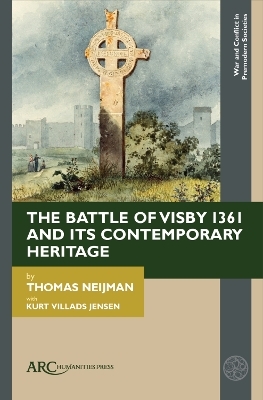
The Battle of Visby 1361 and Its Contemporary Heritage
Seiten
2025
|
New edition
ARC Humanities Press (Verlag)
978-1-64189-063-2 (ISBN)
ARC Humanities Press (Verlag)
978-1-64189-063-2 (ISBN)
The Danish conquest of Gotland in 1361 changed the balance of power in the Baltic and this book frames the crucial Battle of Visby within its historical context, discussing both the military process and the broader historical and heritage context.
In summer of 1361, the Danish king conquered the island of Gotland, the centre of Baltic communication and trade. The invaders clashed with local forces outside the walls of Visby. The battle is well known from the excavated mass graves with human skeletons and large quantities of armour, which reveal the savage reality of the medieval battlefield. How was victory possible? Did Danish hyper-professional armies with mercenaries slaughter ill-equipped Gotlandic peasants, while German merchants were passive spectators from the walls of the main city, as historians have claimed? This book challenges traditional interpretations by investigating the human remains and equipment from their societal position, and puts the conquest of Gotland into a broader historical context of the medieval battle for dominium over the Baltic. It also discusses contemporary interpretations of the battle in museums, literature, media, and legends.
In summer of 1361, the Danish king conquered the island of Gotland, the centre of Baltic communication and trade. The invaders clashed with local forces outside the walls of Visby. The battle is well known from the excavated mass graves with human skeletons and large quantities of armour, which reveal the savage reality of the medieval battlefield. How was victory possible? Did Danish hyper-professional armies with mercenaries slaughter ill-equipped Gotlandic peasants, while German merchants were passive spectators from the walls of the main city, as historians have claimed? This book challenges traditional interpretations by investigating the human remains and equipment from their societal position, and puts the conquest of Gotland into a broader historical context of the medieval battle for dominium over the Baltic. It also discusses contemporary interpretations of the battle in museums, literature, media, and legends.
Thomas Neijman is a doctoral student at the Centre for Medieval Studies, Stockholm, and a specialist on the invasion of Gotland in 1361. He is the founder of the Battle of Visby re-enactment event. Kurt Villads Jensen is Director of the Centre for Medieval Studies, Stockholm and a specialist on crusading history in the Baltic and in Iberia.
List of Illustrations
Abbreviations
Preface
Introduction
Chapter 1. Why Gotland?
Chapter 2. Invaders and Defenders
Chapter 3. The Fallen
Chapter 4. Armament
Chapter 5. The Invasion of Gotland in 1361
Chapter 6. Results: Danish Dominium
Chapter 7. Gotland and Gothicism
Chapter 8. The Impact of Mass Graves
Bibliography
| Erscheinungsdatum | 04.10.2025 |
|---|---|
| Reihe/Serie | War and Conflict in Premodern Societies |
| Co-Autor | Kurt Villads Jensen |
| Zusatzinfo | 16 Illustrations, black and white; 8 Maps; 2 Tables, black and white; 18 Illustrations, color |
| Sprache | englisch |
| Maße | 152 x 229 mm |
| Themenwelt | Geschichte ► Allgemeine Geschichte ► Mittelalter |
| ISBN-10 | 1-64189-063-0 / 1641890630 |
| ISBN-13 | 978-1-64189-063-2 / 9781641890632 |
| Zustand | Neuware |
| Informationen gemäß Produktsicherheitsverordnung (GPSR) | |
| Haben Sie eine Frage zum Produkt? |
Mehr entdecken
aus dem Bereich



aus dem Bereich
Geschichte einer Augsburger Familie (1367-1650)
Buch | Softcover (2024)
Kohlhammer (Verlag)
CHF 47,60


