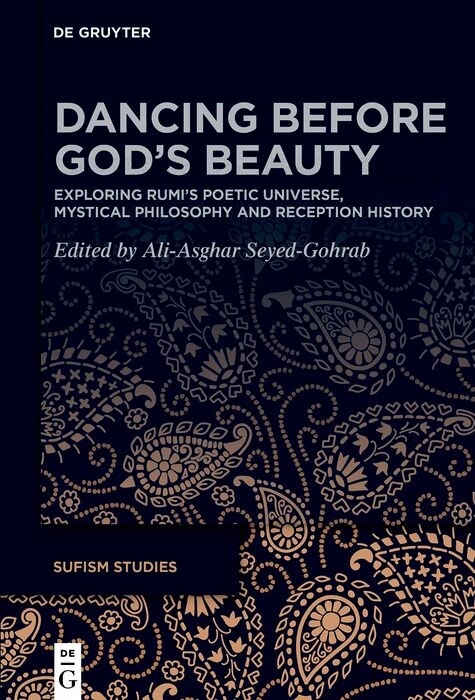
Dancing before God’s Beauty (eBook)
311 Seiten
De Gruyter (Verlag)
978-3-11-170882-9 (ISBN)
This book presents fresh insights into the life, teachings, and enduring legacy of the Persian mystic poet Jalal al-Din Rumi. Across thirteen chapters, scholars introduce innovative perspectives on under-explored and emerging themes, from the hagiography written by Rumi's son, Sul?an Valad, and his journey towards accepting spiritual leadership, to Rumi's passionate relationship with his beloved friend, Shams-i Tabrizi. The volume also provides new approaches to reading Rumi's monumental didactic narrative, the Mathnavi. Topics range from shahid-bazi - worshipping a beautiful face to commune with the divine - to supplication (munajat), immolation, sensory perception, and the transformative role of music in reaching ecstatic states. Chapters deal with Rumi's reception history, examining the works of figures such as Anqaravi (d. 1041/1631) and Abdülbâki Gölpinarli (1900-1982), as well as the Dutch-Iranian novelist Kader Abdolah. The book further explores Rumi's visual reception history and his impact on contemporary artists. Finally, it examines Rumi's popularity in the United States, analysing how his poetry continues to offer people from diverse backgrounds a Lacanian 'imaginary': an internalized representation of the spiritual.
Rūmī Revisited: New Insights into His Life, Teaching and Legacy
This book is a collection of studies of the Persian mystic poet Jalāl al-Dīn Rūmī. He has a special place in the West today.1 He is one of the best-selling authors in America. Brad Pitt tattooed a line from his poetry on his arm; Beyonce called her son Rumi; and pop divas such as Madonna are inspired by Rūmī, she has based her album ‘A Gift of Love’ on Rūmī’s poetry. Other musicians also take Rūmī as inspiration; a huge trade in adaptations of his poetry has even sprung up; and there is a wide range of merchandise such as calendars, key rings and T-shirts with Rūmī’s verses and portrait.
Jalāl al-Dīn Rūmī was born on 30 September 1207 (Rabīʿ I 604) in the village of Vakhsh in present-day Tajikistan and he died on 17 December 1273 (5 Jumāda II 672) in Konya, in present-day Turkey.2 He is known by his nickname, Mowlānā (or Mowlavī, Mevlānā), meaning ‘our master’ in various Islamic countries. The name Rūmī means ‘from Rūm,’ the Persian designation for the west from a Persian topographical perspective, alluding usually to the Byzantine and Greek cultural areas. Rūmī’s family originally hailed from the city of Balkh in present-day Afghanistan, but in 609/1212 the family emigrated to Samarkand, in present-day Uzbekistan, with the five-year-old Rūmī. Rūmī’s father, Bahāʾ al-Dīn, was a preacher and religious scholar, and the reason the family left Balkh was a disagreement between Baha al-Dīn and the philosopher Fakhr al-Dīn al-Rāzī (who died about 606/1209). For years, the family travelled from one town to another, staying for four years in Sivas and seven years in Karaman, where Rūmī’s mother died. In 626/1228, the Saljuq Sultan, Key Qubād, invited Rūmī’s father to Konya to run a college. The family moved to Konya, but Rūmī’s father died just three years later. When one of his former students, Sayyid Burhān al-Dīn Muḥaqqiq, a learned theologian, came to Konya to visit his teacher, he found that he had died a year earlier. He decided to stay in Konya, teaching at the college, and Rūmī became his pupil. Muḥaqqiq died in 637/1239. During this period, Rūmī grew into a distinguished theologian who himself attracted students.
In 642/1244, Rūmī's life changed forever. He met the wandering dervish, Shams al-Dīn Muḥammad Tabrīzī, who had just come to Konya. Shams was a qalandar mystic (a ‘vagabond’). These mystics criticised the hypocritical piety of the established religious representatives in society by flouting the holiest norms, values and rituals of Islam with their provocative behaviour, for instance by drinking wine in public, praising other religions such as Christianity and Zoroastrianism, or by appearing (semi‐)naked in the streets with, at most, some rags around their waists. The qalandars were very pious but hid their piety behind sinful behaviour. They radically renounced worldly existence and disapproved of outward shows of faith. Shams, as a qalandarī type of mystic, had been nicknamed ‘the flyer’ or ‘the kite’ (paranda) because of his constant wanderings from one place to another. Rūmī's son, Sulṭān Valad, described Shams in his book, Ibtidā-nāma (‘The Book of Beginnings’), as a perfect lover of God and a saint. According to Sulṭān Valad, Shams had attained the highest mystical stage possible.
Rūmī was so profoundly moved by his encounter with Shams, whom he revered as a beloved spiritual guide, that he was transformed. The intensity of their relationship sparked jealousy among Rūmī’s students, leading to threats being made against Shams. These threats eventually forced Shams to flee to Damascus on 11 March 1246 (21 Shavvāl 643). In his despair, Rūmī began composing love poems that expressed his deep longing for Shams. Desperate to reunite with his spiritual guide, Rūmī sent his son, Sulṭān Valad, to Damascus to bring Shams back. Upon Shams’ return to Konya tensions resurfaced, and the students once again plotted to kill him. Shams fled a second time, but he was persuaded to return once more. His ultimate fate remains shrouded in mystery, but it is believed that he was murdered in 1247/644. Unaware of this, Rūmī assumed that Shams had left again and journeyed to Damascus in search of his cherished friend.
In 1249, Rūmī encountered Ṣalāḥ al-Dīn Zarkūb, an illiterate blacksmith with a pleasant personality. Recognising Shams’ spirit in Ṣalāḥ al-Dīn, Rūmī chose him as his new companion. This decision again provoked jealousy among his followers, who could not understand why Rūmī would select an uneducated man as his closest confidant. Rumours of a plot to murder Ṣalāḥ al-Dīn began to circulate. When Rūmī learned of these plans, he threatened to leave Konya. His followers, realising their mistake, repented and begged for forgiveness. Ṣalāḥ al-Dīn Zarkūb remained Rūmī’s companion for 10 years until his death on 29 December 1258 (1 Muharram 657).
A new chapter in Rūmī’s life began with his encounter with Ḥusām al-Dīn Ḥasan Chalabī (d. 683/1284), with whom he maintained a close friendship for 10 years until Rūmī’s death on 17 December 1273.3 Ḥusām al-Dīn was the inspiration behind Rūmī’s great mystical epic, The Spiritual Couplets (Mathnavī-yi maʿnavī). This work is an unconventional commentary on the Qurʾān, often called ‘the Qurʾān in Persian’ due to its religious themes. The poem, consisting of 25,683 couplets, contains several references to Ḥusām al-Dīn. It is said that when Ḥisām al-Dīn asked Rūmī to compose a spiritual poem, Rūmī had already written 18 couplets of the famous introduction about the reed flute, and he withdrew the poem from his turban. The Mathnavī is a huge poem, almost as long as Homer’s Iliad and Odyssey taken together.4 The term mathnavī refers to a poetic form which has been widely used in Persian poetry, and several monumental works such as Firdowsī’s Shāh-nāma and Niẓāmī’s romances are written in the mathnavī form. It refers to rhyming couplets using scheme aa, bb, cc, etc. which allow the poet to continue his poem ad infinitum. The form is used especially for epic poetry in different genres ranging from heroic epic and romantic to ethical, didactic, philosophical and even medical. Rūmī’s poem is inspired by the poet Ḥakīm Sanāʾī of Ghazna (d. 525/1130) who wrote an influential didactic poem, Ḥadīqat al-ḥaqīqa va sharīʿat al-ṭarīqa (‘The Garden of the Truth and the Laws of the Path’), which has over several centuries become a source of inspiration for generations of poets in the Persian cultural areas. Rūmī’s Mathnavī addresses mystical topics in a random order, with the themes connected associatively through long and short stories that illustrate mystical and theological concepts. From the 14th century onwards, this monumental poem was read, recited and commented upon in Persian, from Bosnia to Bengal. The Mathnavī is written in such a way that people of all walks of life can easily understand it and in many ways its readers can identify with the poem’s characters. The anecdotes and stories used to convey religious themes and concepts show the poem’s didactic nature. It is no surprise that the Mathnavī is the most widely read poem in the Islamic world.
In contrast to his Mathnavī, in which Rūmī assumes the role of a teacher, he presents himself in his lyrical poems (ghazals) as an emotional poet, a man deeply in love, who identifies himself with his beloved. Rūmī often uses the pen name Shams or variations of it to demonstrate that his identity has merged with that of Shams. In many places, the allusion to Shams serves as a pretext for praising the divine beloved. Rūmī composed around 3,300 ghazals, an unprecedented number of poems in the Persian literary tradition, especially when we compare this number to the output of the greatest lyric poet of Persia, Ḥāfiẓ (715 – 792/1315 – 1390), who wrote fewer than 500 ghazals.5 In addition to the ghazals, Rūmī also composed several panegyrics (qaṣīda), strophic poems and approximately 2,000 quatrains (rubāʿī).6 The Persian scholar, Badīʿ al-Zamān Furūzānfar, published these poems in 10 volumes under the title Dīvān-i Kabīr or Kulliyyāt-i Shams-i Tabrīzī.7 Rūmī’s lyrical poetry not only explores the longing for a (transcendental) beloved, but also treats philosophical, ethical and mystical themes. In his love poems, we witness a lover expressing his yearning for Shams, his overwhelming sense of loss, and his boundless sorrow. He also wrote ghazals for his other beloved companions. In addition to his poetry, Rūmī authored several prose works on mystical and religious subjects. The most famous of these are probably Fīhi mā fīhi (‘It Is What It Is’), seven sermons entitled Majālis-i sabʿa (‘Seven Sessions’), and a collection of letters (Maktūbāt).8
As I mentioned at the beginning of this introduction, Rūmī is exceptionally popular today, with an amazingly increasing number of translations and adaptations into European languages in recent years. There are...
| Erscheint lt. Verlag | 30.6.2025 |
|---|---|
| Reihe/Serie | Sufism Studies |
| Zusatzinfo | 12 col. ill., 1 b/w tbl. |
| Sprache | englisch |
| Themenwelt | Geisteswissenschaften ► Religion / Theologie ► Islam |
| Schlagworte | classical Persian poetry • Ǧalāl-ad-Dīn Rūmī • Persianate world • Persisch • Poesie • Rumi • Sufism • Sufismus |
| ISBN-10 | 3-11-170882-9 / 3111708829 |
| ISBN-13 | 978-3-11-170882-9 / 9783111708829 |
| Informationen gemäß Produktsicherheitsverordnung (GPSR) | |
| Haben Sie eine Frage zum Produkt? |
 EPUB (Wasserzeichen)
Größe: 4,5 MB
DRM: Digitales Wasserzeichen
Dieses eBook enthält ein digitales Wasserzeichen und ist damit für Sie personalisiert. Bei einer missbräuchlichen Weitergabe des eBooks an Dritte ist eine Rückverfolgung an die Quelle möglich.
Dateiformat: EPUB (Electronic Publication)
EPUB ist ein offener Standard für eBooks und eignet sich besonders zur Darstellung von Belletristik und Sachbüchern. Der Fließtext wird dynamisch an die Display- und Schriftgröße angepasst. Auch für mobile Lesegeräte ist EPUB daher gut geeignet.
Systemvoraussetzungen:
PC/Mac: Mit einem PC oder Mac können Sie dieses eBook lesen. Sie benötigen dafür die kostenlose Software Adobe Digital Editions.
eReader: Dieses eBook kann mit (fast) allen eBook-Readern gelesen werden. Mit dem amazon-Kindle ist es aber nicht kompatibel.
Smartphone/Tablet: Egal ob Apple oder Android, dieses eBook können Sie lesen. Sie benötigen dafür eine kostenlose App.
Geräteliste und zusätzliche Hinweise
Buying eBooks from abroad
For tax law reasons we can sell eBooks just within Germany and Switzerland. Regrettably we cannot fulfill eBook-orders from other countries.
aus dem Bereich