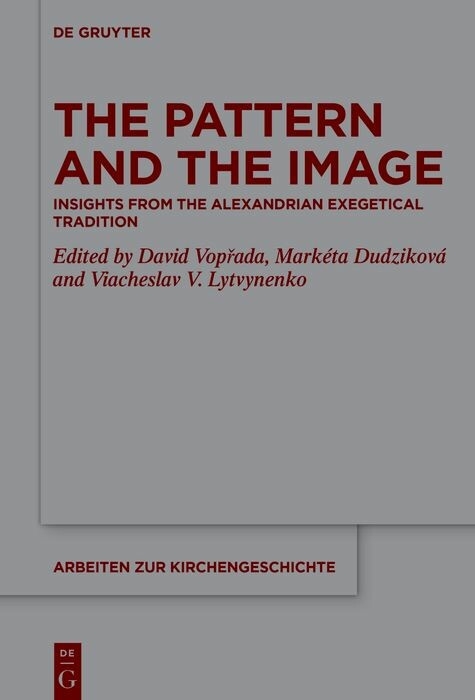
The Pattern and the Image (eBook)
298 Seiten
De Gruyter (Verlag)
978-3-11-156268-1 (ISBN)
One of Plato's best-known ideas is that the sensible world is an image of the intelligible pattern. The book examines the second life of this concept in late antiquity, especially in the Hellenistic Jewish and Christian milieu. It opens with the discussion of the key features of the pattern-image concept in Plato and Plotinus, and then focuses on the adoption of this concept in the works of Philo of Alexandria and the early Christian authors-Clement of Alexandria, Origen, Eusebius, Athanasius, Gregory Nazianzus, Didymus the Blind, Ambrose of Milan, and Pseudo-Athanasius. The collected papers illuminate various aspects of the topic, including the importance of the visible world and art in Platonism, allegorical and Christological interpretations of the biblical account of creation, and relation of the intelligible pattern in the Logos to the world. The authors analyze the Jewish and Christian reinterpretations of the pattern-image structure by looking into the ontological dignity of the image, its similarity and dissimilarity to the pattern, and the mutual chronology of the pattern and the image. Combining theological, philosophical, and philological approaches, the book offers a complex view of the pattern-image relationship in various contexts.
Philosophical Roots
The Iconic Structure of Reality in the Platonic Tradition and Its Christian Reinterpretation
Abstract
The myth in Plato’s Timaeus narrates the process of organizing the chaotic traces of ideas, mirrored in the medium of the chora, into the cosmic order, the beautiful corporeal world as the divine image. In his exegesis of the Timaeus, Plotinus enlarges the iconic structure, applying it to the whole of reality, including the Intellect as the image of the One, the soul as the image of the Intellect, and the cosmos as the image of the soul. As inheritors of this tradition and interpreters of the Bible, early Christian authors present not only human beings as the image of God (Gen 1:26 – 27) or Christ but, at the same time, Christ as the privileged Image of God (Col 1:15).
In this study, I will present the iconic structure of reality as understood in the Platonic tradition by two important figures: first, Plato himself, specifically in his dialogue the Timaeus, and second, Plato’s original interpreter Plotinus, a thinker of Alexandrian education who taught philosophy in Rome. In conclusion, I will sketch in rough outline the Christian reinterpretation of the iconic structure of reality by three Greek authors who were also partly of Alexandrian orientation: Origen, Athanasius of Alexandria, and Gregory of Nazianzus.
From Chaotic Traces to a Beautiful Image: Plato’s Timaeus
According to the cosmogonic myth in Plato’s Timaeus, “our world must necessarily be an image of something” (πᾶσα ἀνάγκη τόνδε τὸν κόσμον εἰκόνα τινὸς εἶναι).1 This assertion is justified, on one hand, by the fact that the world, because of its visible, tangible, and corporeal nature, must be among the things “that arise and are generated” (γιγνόμενα καὶ γεννητά),2 not existing without change; on the other hand, it is substantiated by Plato’s conviction that the world is “beautiful” (καλός).3 From these assumptions, Plato develops the argument that if the world arose, it must have a cause,4 and if it is beautiful, it must have a perfect paradigm.5 Its creator, therefore, was not only himself perfectly good,6 but also, in creating the world he looked at a perfect paradigm, i. e. an archetype which is understandable by reason (τὸ λόγῳ καὶ φρονήσει περιληπτόν), unchanging (κατὰ ταὐτὰ ἔχον), and eternal (ἀίδιον).7
As Plato himself admits, his exposition is based on conviction rather than logical necessity, a kind of mythical narrative, as speech always imitates the nature of what it is speaking about. Therefore, concerning something that is not immutable, it can give only an interpretation “similar” to the truth (τὸν εἰκότα μῦθον).8 Timaeus’ cosmogony is thus presumably not to be understood as a process involving time but as a narrative description of the ontological structure of reality.9 Plato’s idea of the world as an image should probably be read along these lines; at most, we can attempt a kind of back-verification of it. That is, we can ascertain, with Timaeus, what we can see of the world under this presupposition and consider whether it is a heuristic approach.
If this cosmic image was to be as perfect as possible, it would have to be, according to Plato, rational and therefore endowed with a soul that could accept reason (νοῦν).10 Moreover, it would have to be modeled according to a paradigm that presented the same whole and included the same species of animals as our world.11 These species, according to Timaeus’ account, are four:12 the gods in the sky (i. e., the stars, created by the demiurge himself),13 the animals flying in the air, those living in water, and the terrestrial ones. The last three groups are created by a gradual degradation of human beings or, more precisely, men whose souls have been fashioned from the scraps of the world soul by the demiurge, while their mortal bodies are a work of the inferior gods, the planets.14 Our world, with all its inhabitants, is the “only-begotten” (μονογενής)15 image of its prototype; otherwise, several identical worlds would require a prototype comprising more of them. The uniqueness of the world is thus derived from its presumed single prototype and is therefore rather hypothetical too.16
The visibility and tangibility of the world body are made possible by the fire and the earth contained therein, connected to each other by water and air according to an analogous ratio.17 Its shape is that of a sphere, which contains all the forms and is the most symmetrical of them.18 Its motion is the most perfect of all as well; specifically, it moves in place around its own axis.19 The soul is inserted into its center but, at the same time, penetrates the world body and encircles it from without.20 The world soul, too, is made according to mathematical proportions, of a dough containing being, identity, and difference, mixed from both divisible and indivisible elements. From this mixture, the demiurge fashioned two circles, the circle of sameness and that of diversity, embedded in each other in the form of the letter X. He also spun it around its own axis.21 The world, composed of the soul and body, is a rational animal,22 even a god, blissful and self-sufficient, a friend to itself, but a god who had a beginning.23 Therefore, instead of the eternity of its unchanging prototype, it lives in time with a past and future, a kind of “moving image of eternity,” namely, the recurring numerical periods of days, months, and years, even the “perfect year” of the whole cosmos.24
However, the perfection of the paradigm and the goodness of the demiurge are clearly not enough to produce a perfect image. For the creator “took over all that is visible, not at rest, but in discordant and unordered motion,”25 which he had yet to organize. This comes out even more clearly in the second sequence of Timaeus’ exposition, where he no longer considers only the image and the paradigm, but also the medium in which the image is created, the chora. Already in the chaotic state prior to the demiurge’s intervention, this receiving medium revealed some kinds of “traces” (ἴχνη) of the individual elements, but in a completely disordered manner:
At first, however, they were all without proportion and measure (ἀλόγως καὶ ἀμέτρως). But when the world began to get into order, fire and water and earth and air did indeed show faint traces (ἴχνη) of themselves, but were altogether in such a condition as one may expect to find wherever God is absent. Such, I say, being their nature, God now fashioned them by forms and numbers (διεσχηματίσατο εἴδεσί τε καὶ ἀριθμοῖς).26
How we are to understand these “traces” is not immediately clear from the text. Are they some emerging germs of future elements in the chora itself? However, if this medium is entirely without the forms it is supposed to receive (like the odorless liquid in manufacturing artificial perfumes),27 then presumably these “traces” must have their origin elsewhere than in the chora itself.
Perhaps they are reflections of the paradigm, but chaotic ones, because the demiurgic arrangement by “forms and numbers”28 has not taken place yet. Timaeus explicitly presupposes the ideas of the four elements, which are objects of rational insight (νοῦς), not of sense perception (e. g., “fire itself” preceding its appearance in the chora).29 In its beauty, the “image” can be obtained from the intelligible paradigm only by the demiurgic work of arranging these reflections.30 In this case, the mirroring structure already precedes the image; the reflections just have to be arranged from chaos into a beautiful image. However, how are we to explain the mirroring structure?31 According to Plato’s account, the prototypes themselves do not enter the chora in any way,32 so that the chora has to mirror them spontaneously. Thus, it plays a fundamental role in the mirroring structure, although, without the intervention of the demiurge, it would not mirror the beautiful image but would be a complete mess.
Another alternative is that the demiurge himself depicted the patterns in the chora by “always looking at them” while building the world, as Plato puts it.33 In this case,...
| Erscheint lt. Verlag | 2.6.2025 |
|---|---|
| Reihe/Serie | Arbeiten zur Kirchengeschichte |
| Zusatzinfo | 9 b/w tbl. |
| Sprache | englisch |
| Themenwelt | Geisteswissenschaften ► Religion / Theologie ► Christentum |
| Schlagworte | Alexandrian exegesis • and Origenian studies • Arian • Arian Controversy • Exegese • Muster • Pattern and Image • Philonic • Platon • Platonic |
| ISBN-10 | 3-11-156268-9 / 3111562689 |
| ISBN-13 | 978-3-11-156268-1 / 9783111562681 |
| Informationen gemäß Produktsicherheitsverordnung (GPSR) | |
| Haben Sie eine Frage zum Produkt? |
 EPUB (Wasserzeichen)
Größe: 1,5 MB
DRM: Digitales Wasserzeichen
Dieses eBook enthält ein digitales Wasserzeichen und ist damit für Sie personalisiert. Bei einer missbräuchlichen Weitergabe des eBooks an Dritte ist eine Rückverfolgung an die Quelle möglich.
Dateiformat: EPUB (Electronic Publication)
EPUB ist ein offener Standard für eBooks und eignet sich besonders zur Darstellung von Belletristik und Sachbüchern. Der Fließtext wird dynamisch an die Display- und Schriftgröße angepasst. Auch für mobile Lesegeräte ist EPUB daher gut geeignet.
Systemvoraussetzungen:
PC/Mac: Mit einem PC oder Mac können Sie dieses eBook lesen. Sie benötigen dafür die kostenlose Software Adobe Digital Editions.
eReader: Dieses eBook kann mit (fast) allen eBook-Readern gelesen werden. Mit dem amazon-Kindle ist es aber nicht kompatibel.
Smartphone/Tablet: Egal ob Apple oder Android, dieses eBook können Sie lesen. Sie benötigen dafür eine kostenlose App.
Geräteliste und zusätzliche Hinweise
Buying eBooks from abroad
For tax law reasons we can sell eBooks just within Germany and Switzerland. Regrettably we cannot fulfill eBook-orders from other countries.
aus dem Bereich