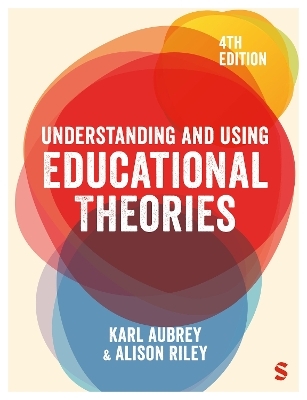
Understanding and Using Educational Theories
SAGE Publications Ltd (Verlag)
978-1-0362-0691-8 (ISBN)
This textbook gives readers an accessible overview of 20 of the most influential thinkers on education, including long-established names (Vygotsky, Piaget, Bruner), more recent theorists (Dweck, Goleman, Rosenshine) and other key individuals whose writing has helped shaped our views on teaching and learning.
Each chapter includes practical examples showing how theories can be used to inform classroom teaching, and critiques of each theorist exploring opposing viewpoints and the strengths and weaknesses of different ideas.
This fourth edition includes:
A new chapter on John Sweller and cognitive load theory
A new ′next steps′ feature in every chapter, offering research project suggestions for students, and suggestions for essay questions and discussion topics for tutors.
This is essential reading for any university course that covers learning theory, with particular relevance for initial teacher education, education studies and early childhood degrees.
Karl Aubrey is a Visiting Tutor on the Professional Studies in Education programmes at Bishop Grosseteste University. Prior to this Karl was the Programme Leader for a range of initial teacher education and professional development programmes at a large city further education college. Between 2003 and 2005 he was seconded to the DfES Standards Unit as a learning and teaching practitioner in the East Midlands. Karl has contributed to the Oxford Dictionary of Education. His doctoral thesis explored the reforms in further education teacher education from 2000 to 2010, from the viewpoint of teacher educators. Karl’s research interests include inclusion, education policy, pedagogy and work-based learning. Alison Riley is the Programme Leader for the BA(Hons) Early Childhood Studies degree at Bishop Grosseteste University, she has also worked on a number of educational-related programmes at the university including initial teaching training courses. Prior to joining Bishop Grosseteste University Alison spent sixteen years working in primary education, as a classroom teacher, deputy head teacher and finally head teacher of a large junior school. Alison has been involved in a number of collaborative projects and has recently been involved in an EU-funded project researching ‘Creativity in Early Science and Mathematics Education’. Alison has recently commenced doctoral studies in which she is researching the journey of students entering higher education with alternative qualifications.
Introduction
Chapter 1: John Dewey: A democratic notion of learning
Chapter 2: Maria Montessori: Liberating the child
Chapter 3: Jean Piaget: Understanding the mind of the child
Chapter 4: Lev Vygotsky: An early social constructivist viewpoint
Chapter 5: B.F. Skinner: The father of operant conditioning
Chapter 6: Benjamin Bloom: Learning through taxonomies
Chapter 7: Malcolm S. Knowles: Contextualising adult learning
Chapter 8: Jerome Bruner: An evolution of learning theories
Chapter 9: Albert Bandura: Learning through observation
Chapter 10: Urie Bronfenbrenner: The ecology of human development
Chapter 11: Paulo Freire: Oppression, freedom and critical approaches to education
Chapter 12: Donald Schön: Reflection and learning
Chapter 13: David Kolb: Experiential Learning Theory
Chapter 14: Jean Lave and Etienne Wenger: Socially situated learning and communities of practice
Chapter 15: Barak Rosenshine: Principles of instruction
Chapter 16: Daniel Goleman: Emotional intelligence
Chapter 17: Guy Claxton: Learning power
Chapter 18: Dylan Wiliam: Assessment for learning
Chapter 19: Carol Dweck: Mindsets and motivation
Chapter 20: John Sweller: Cognitive Load Theory
| Erscheinungsdatum | 25.11.2025 |
|---|---|
| Verlagsort | London |
| Sprache | englisch |
| Maße | 189 x 246 mm |
| Gewicht | 800 g |
| Themenwelt | Geisteswissenschaften ► Psychologie ► Pädagogische Psychologie |
| Sozialwissenschaften ► Pädagogik ► Allgemeines / Lexika | |
| Sozialwissenschaften ► Pädagogik ► Bildungstheorie | |
| Sozialwissenschaften ► Pädagogik ► Schulpädagogik / Grundschule | |
| ISBN-10 | 1-0362-0691-2 / 1036206912 |
| ISBN-13 | 978-1-0362-0691-8 / 9781036206918 |
| Zustand | Neuware |
| Informationen gemäß Produktsicherheitsverordnung (GPSR) | |
| Haben Sie eine Frage zum Produkt? |
aus dem Bereich