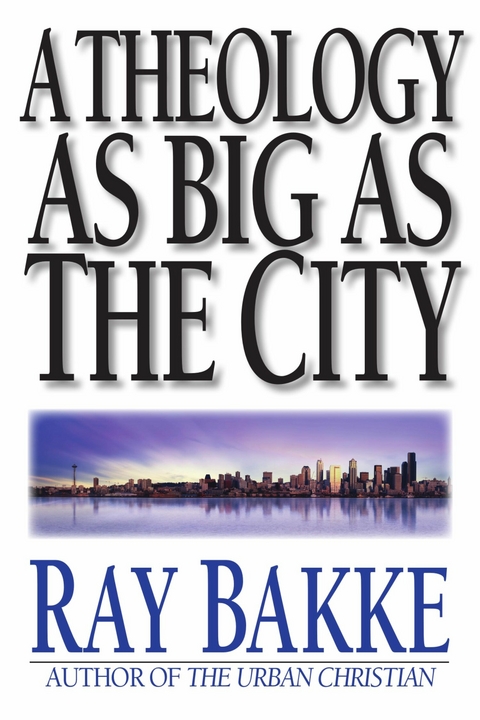
A Theology as Big as the City (eBook)
221 Seiten
IVP Academic (Verlag)
978-1-5140-1463-9 (ISBN)
Raymond J. Bakke is senior associate of Ray Bakke Associates, a nonprofit organization that partners with those who are passionate about empowering the church to be creatively missional in an urban world. He is the former chancellor and professor of global urban studies at Bakke Graduate University and former executive director of International Urban Associates in Chicago, Illinois.
2
God’s Hands Are in the Mud
In the beginning God created the heavens and the earth. Now the earth was formless and empty, darkness was over the surface of the deep, and the Spirit of God was hovering over the waters.
The LORD God formed the man from the dust of the ground and breathed into his nostrils the breath of life, and the man became a living being.
Now the LORD God had planted a garden in the east, in Eden; and there he put the man he had formed. And the LORD God made all kinds of trees grow out of the ground—trees that were pleasing to the eye and good for food. In the middle of the garden were the tree of life and the tree of the knowledge of good and evil.
CHICAGO OCCUPIES THIRTY-FIVE MILES of shoreline on Lake Michigan, one of the five so-called “Great Lakes.” Great is the appropriate word, for these five remarkable lakes contain approximately 20 percent of the world’s total surface fresh water supply. For years I’ve watched as rural agricultural pesticides, urban storm-drain overflow and exhaust-produced acid rain make their way into these great water basins. I’ve also observed the gradual clean-up of these lakes and the rebirth of the fishing and recreational industries as a result. Yet I hear many Christians crying for less environmental concern and fewer restrictions on the industrial and commercial activities that caused the problems in the first place. Does God care about these issues?
As a pastor and a father, I can hardly describe the pain I felt as I visited my people who lived in slum conditions. Baby cribs were pushed up against walls where old lead paint was cracking, curling and being broken off by the children, who would chew it like gum, sending toxins straight to their little brains and reducing their potential for life. Lead in paint is illegal now, of course. But old paints, like asbestos and lead pipes, still remain in many buildings and along with other code violations create enormous problems for urban families.
Is it enough to care only about the spiritual or eternal souls of kids under such circumstances? I didn’t think so, but where in Scripture does one turn to start the discussion?
Many years ago I was invited to the Billy Graham Center at Wheaton College, along with a few other Chicago pastors, to discuss with college trustees how Wheaton might relate to the city and its troublesome issues. It was a very frank exchange. At one point a trustee said, “Ray, I get very excited when you, Bill (Leslie) and the others talk about evangelism in the city, but I get very nervous when you talk about social action, social justice and social involvement. Isn’t that the social gospel?”
At first flush I felt some defensiveness, but then after a quick prayer for help I asked the businessman where he lived and why he lived there. He very calmly described his nice, safe, good, clean, suburban community where housing values increase and where he feels his family can be secure while he travels.
Finally, I said, “Every reason you’ve given for living where you live is a social reason. If those social systems of education, police and fire protection, economy and such didn’t exist, you’d leave. If anybody believes in the social gospel, it’s you! You’ve committed your whole life and family to those values.”
His response was, “I never thought of that.”
I went on to say that he and I agreed that all these social or public systems are important. The only difference was, his family had them while my family did not. Moreover, I suggested, if he were in my community, there would be no way he could say we evangelicals should just preach the gospel.
Frankly, there has been some hypocrisy in the evangelical community on these issues. I’ve watched Christians flock to the suburbs over the years so they could access the best our society could offer for their families, while raising suspicions about those of us who sought transformed communities of justice, peace, health and economic opportunity for those left behind. If we are brothers and sisters in Christ, how can we tolerate such disparities?
Much More Is Now at Stake
The issues are much larger today, because the majority of the world’s Christians live outside the Western, developed rich countries. Christians struggling to see the whole world as God surely sees it have new reasons to ask how we can bridge the have-have not gaps between the nations of the world. These aren’t just poor nations; they are poor nations with incredible numbers of new Christian brothers and sisters, who read the same Bible we do and expect it will make difference in both global and local relationships.
In this context we return to the opening photographs of the Bible and discover that God’s hands are in the mud, making people out of earth’s dirt (Gen 2:7). In his marvelous little book Christianity and the Social Order,1 William Temple helped me see the theological significance of this photograph, as he calls it. It’s so totally contrary to the pictures of other gods in the ancient world, which, like the Greek mythology, tended to put layers of protection between their spiritual deities and the physical matter of earth, lest the gods become contaminated.
Temple further observes that the Bible concludes with the photograph of our God cleaning up the cosmos after the final holocaust, and that this same Bible pictures a God who occupies real physical bodies, Christ’s and ours. His conclusion: Christianity is the most materialistic religion on the entire earth. It’s the only religion that successfully integrates matter and spirit with integrity.
After many years of teaching and preaching the Old Testament and learning from biblical theologians such as H. Wheeler Robinson and Walter Brueggemann, I am convinced that the ancient Hebrews had a holistic view of faith and world that today’s Christians need to recover.2 If Temple is correct, we Christians are the only people who can truly discuss the salvation of souls and the rebuilding of city sewer systems in the same sentence.
Sin has profoundly scarred the world as well as its people. A cursory reading in the history of civilizations does not present much optimism about the essential goodness of people and governments. Urban ministers need a reasonable hope. Progress is possible at times, but perfection will await Christ’s return.
While in Genesis we read that God is connected to the earth, John 1:3 reminds us that Jesus Christ as God actually participated as the agent through which creation came into existence.
God Lives in Community and Works in Partnerships
In Ephesians 1 Paul describes “redemption activities” performed by each member of the Trinity that parallel the creation activities. The concept of Trinity suggests that God is three persons in an eternal set of relationships, three distinct yet interpenetrating persons in an eternal love bond, working on cooperative work projects. Paul reminds us that before the world was created, the Father chose us for salvation; then (two thousand years ago) the Son sacrificed his life for us; now the Spirit seals us like an engagement ring until the day of redemption.
Nothing can be clearer about the spiritual essence of the Trinity than that God lives in community and works in partnership for both the creation and the redemption of the world. Under the pressure of a billion “lost souls,” however, many overly pragmatic Western Christians have adopted a hierarchy of values—redemption over creation—for the sake of the evangelistic mandate. This hierarchy has created the great divorce and resulted in a canon within the canon of Scriptures—that is, while they believe the whole Bible is the Word of God, they treat certain parts as more valuable or useful than others. As a result, many Christians justify throwing away neighborhoods like styrofoam cups when they cease to function for our benefit. They deny that the salvation or destruction of communities is a spiritual issue.
Remember, you are never more like God than when you are living in relationships with God’s people and working in partnerships for the re-creation and redemption of God’s world.
A long-time colleague, Ed Dayton of World Vision, often reminded us that “a point of view is a view from a point.” For evangelicals, the Great Commission of Jesus to go, evangelize and make disciples among the nations is a very significant command, and rightly so. We ought to obey our Lord. But which of the commission texts will we take as normative? Matthew 28:19, “Make disciples of all nations,” focuses on the ethnē or peoples. Mark 16:15, on the other hand, says to “preach the good news to all creation.”
Over the past twenty years I’ve been very active as a founder and chair of Evangelicals for Middle East Understanding, a group that includes many Orthodox believers. In Bible studies and conferences over those years, they have reminded me that God’s redemption includes...
| Erscheint lt. Verlag | 29.7.2025 |
|---|---|
| Sprache | englisch |
| Themenwelt | Religion / Theologie ► Christentum ► Kirchengeschichte |
| Schlagworte | AIDS • Biblical • Christian • Church • Community • Drugs • Ethnicity • Evangelism • God • Great Commission • Gun Violence • HIV • Homeless • John • Justice • Location • Mark • ministry • Missiology • Missionary • missions • New Testament • Paul • Place • Race • Scripture • share the gospel • Urban |
| ISBN-10 | 1-5140-1463-7 / 1514014637 |
| ISBN-13 | 978-1-5140-1463-9 / 9781514014639 |
| Informationen gemäß Produktsicherheitsverordnung (GPSR) | |
| Haben Sie eine Frage zum Produkt? |
 EPUB (Wasserzeichen)
DRM: Digitales Wasserzeichen
Dieses eBook enthält ein digitales Wasserzeichen und ist damit für Sie personalisiert. Bei einer missbräuchlichen Weitergabe des eBooks an Dritte ist eine Rückverfolgung an die Quelle möglich.
Dateiformat: EPUB (Electronic Publication)
EPUB ist ein offener Standard für eBooks und eignet sich besonders zur Darstellung von Belletristik und Sachbüchern. Der Fließtext wird dynamisch an die Display- und Schriftgröße angepasst. Auch für mobile Lesegeräte ist EPUB daher gut geeignet.
Systemvoraussetzungen:
PC/Mac: Mit einem PC oder Mac können Sie dieses eBook lesen. Sie benötigen dafür die kostenlose Software Adobe Digital Editions.
eReader: Dieses eBook kann mit (fast) allen eBook-Readern gelesen werden. Mit dem amazon-Kindle ist es aber nicht kompatibel.
Smartphone/Tablet: Egal ob Apple oder Android, dieses eBook können Sie lesen. Sie benötigen dafür eine kostenlose App.
Geräteliste und zusätzliche Hinweise
Buying eBooks from abroad
For tax law reasons we can sell eBooks just within Germany and Switzerland. Regrettably we cannot fulfill eBook-orders from other countries.
aus dem Bereich