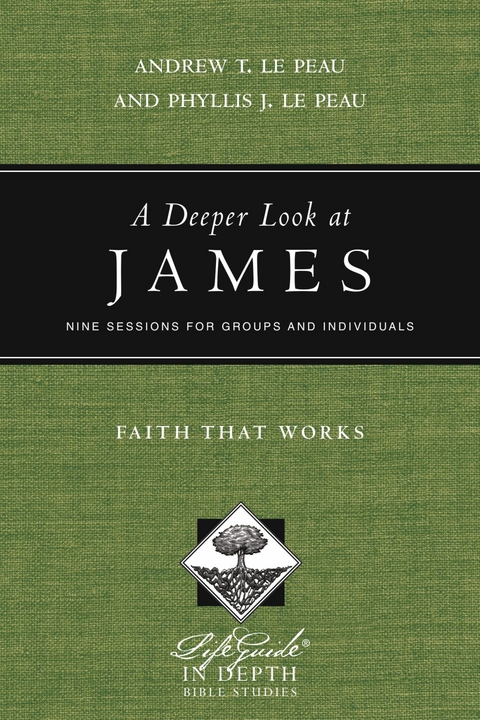
A Deeper Look at James (eBook)
161 Seiten
IVP Bible Studies (Verlag)
978-1-5140-1507-0 (ISBN)
Phyllis J. Le Peau (1944-2022) worked with InterVarsity Christian Fellowship for over two decades in St. Louis and the Chicago metro area. She is the author or coauthor of several Bible study guides, including Ephesians, Women of the New Testament, and Grandparenting in the LifeGuide Bible Studies series. She and her husband, Andy, have four married children and thirteen grandchildren.
Part 2. Connect
Scripture to Scripture
(On Your Own)
THE TWELVE TRIBES
Who are “the twelve tribes scattered among the nations” that James directs his letter to (v. 1)? The nation of Israel began with a single man—Abraham, who lived perhaps four thousand years ago. Originally called Abram, he was born in Ur of the Chaldees in modern-day southeastern Iraq.
In Genesis 12:1-9 God tells him to go with his whole household to Canaan on the eastern coast of the Mediterranean Sea. In doing so, God promises Abraham several things. Read Genesis 12:1-3 and list the different promises:
God gave a son, Isaac, to Abraham and his wife, Sarah. In turn, Isaac had a son named Jacob—to whom God gave the name Israel—who had twelve sons of his own (see Genesis 35:23-26). Each of these sons became the patriarch of a tribe. All of the tribes increased during the four hundred years that they were in Egypt. Thus, even during their years of oppression and enslavement in Egypt, God’s promise to Abraham was fulfilled.
After Moses led Israel out of Egypt, God gave the nation the Ten Commandments and other instructions on how they were to live. He also (through Moses) gave them a promise and a warning regarding the Promised Land that he was leading them to possess as their own.
Paraphrase the warning found in Deuteronomy 4:25-27.
In contrast, what promise is offered in Deuteronomy 4:40?
Because the nation disobeyed God, the tribes and people of Israel were scattered. The prophet Amos brought God’s word against them for the twin sins of worshiping other gods and oppressing the poor. After the northern tribes of Israel rejected God’s ways, they were conquered by Assyria as is summarized in 1 Kings 17. This left only the tribe of Judah in the land and some of the small tribe of Benjamin. So, long before the time of James, the tribes of Israel were scattered, expelled from Palestine.
Yet God in his mercy promised that one day, at the end of the age when the Messiah comes, all the scattered tribes of Israel will be regathered. Isaiah 11:1-10 describes what this will be like: “The wolf will live with the lamb, the leopard will lie down with the goat, the calf and the lion and the yearling together; and a little child will lead them” (v. 6). Isaiah continues:
In that day the Lord will reach out his hand a second time to reclaim the surviving remnant of his people from Assyria, from Lower Egypt, from Upper Egypt, from Cush, from Elam, from Babylonia, from Hamath and from the islands of the Mediterranean.
He will raise a banner for the nations
and gather the exiles of Israel;
he will assemble the scattered people of Judah
from the four corners of the earth. (Isaiah 11:11-12)
We find a similar prophecy in Jeremiah 31:8-14 and Zechariah 8:7-8 and 10:6-12. Craig Keener writes, “Most Jewish people believed that ten of the twelve tribes had been lost for centuries, and they would be restored only at the end of the age.”1 Then Israel would worship one God instead of committing idolatry and would be just to the poor instead of oppressing them.
Only the tribes of Judah and Benjamin remained in Palestine in Jesus’ day. By addressing his letter “to the twelve tribes,” James is suggesting that all twelve tribes have been found among those who believe Jesus is Lord. Jesus has ushered in the final age—but the kingdom has not fully come. The kingdom is already here in some respects, but not yet completely. James acknowledges that the twelve tribes have been identified, as the prophets said that they would in the age to come. But he also says they are scattered, as Jesus’ followers had been scattered across the Mediterranean basin by persecution. The kingdom has dawned, but much that is imperfect remains.
Likewise for us, while trials and temptations remain for the moment, we hold firm to the hope of Jesus’ final triumph while we wait.
Read Matthew 19:28-29. What does Jesus say about the final age?
COUNT IT ALL JOY
As we noted in the introduction to James (see the chart comparing James and the Sermon on the Mount), we will see throughout James’s letter that he often seems to offer a commentary on Jesus’ sermon (Matthew 5–7). Here is one of the first instances in which we see how they interconnect.
What similarities do you see between James 1:2, 12 and Matthew 5:11-12?
In fact, all of James 1:1-18 can be seen as an expansion on these two verses in Matthew. James includes Jesus’ particular focus—persecution because of our loyalty to Jesus—but is addressing a wider range of “trials of many kinds” that are not included in the passage in Matthew. He also offers an extended explanation of why such trials would be a cause for rejoicing.
ASKING GOD FOR WISDOM
James also has a fair amount to say about wisdom. In verse 5, he emphasizes the importance of asking God for wisdom.
The book of the Bible best known for the theme of wisdom is Proverbs. But wisdom is emphasized throughout the rest of the Old Testament as well. Wisdom in the Bible is not just being smart, intelligent or educated, though it does not exclude those. Rather, first, biblical wisdom is defined as “skill for living.”2
One of the early mentions of wisdom is found in Exodus 28:3 and 31:2-5. According to these verses, what does wisdom give people the ability to do?
Second, wisdom is also evident when people obey God’s law. For example, Deuteronomy 4:5-6 says,
See, I have taught you decrees and laws as the LORD my God commanded me, so that you may follow them in the land you are entering to take possession of it. Observe them carefully, for this will show your wisdom and understanding to the nations, who will hear about all these decrees and say, “Surely this great nation is a wise and understanding people.” (See also Deuteronomy 34:9 and Proverbs 4:4-5 among many passages.)
The foolish ignore God’s words and his commands. The wise hold them close.
Third, Scripture reveals that wisdom is especially important for rulers. As Solomon asked God, “Give me wisdom and knowledge, that I may lead this people, for who is able to govern this great people of yours?” (2 Chronicles 1:10; see also Ezra 7:25).
What does governing with wisdom look like in particular? In 1 Kings 3:16-28 we read the famous story of Solomon trying to determine which of two women is the real mother of a baby. So he gives the order to divide the child and give half to each. The one who wanted the child to live was the true parent. The one who was willing for the child to die was not.
In 1 Kings 3:28, it says Israel was in awe when they heard this story because Solomon had the wisdom to do what?
We find this same theme in Psalm 37:30. The verse is an example of parallelism—a common poetic form in which the same idea is repeated for emphasis in two different ways. What does the psalmist say speaking wisdom is equivalent to?
Proverbs 2:9-10 also tells us that wisdom is equivalent to doing what is just and right.
How do Jeremiah 7:5-6 and 22:3 define what it means to do what is just and right?
The Old Testament tells us that one of the key ways wisdom is shown is by doing justice for the poor, the oppressed. To execute this kind of justice is a matter for individuals to be concerned about, but it especially pertains to how rulers and nations show wisdom.
In fact, Isaiah 11:1-5, which we looked at earlier, makes this very point about wisdom when it describes how the Messiah will rule in the age to come. First, Isaiah 11:2 describes four ways in which the Spirit will rest on him. Fill in what’s missing.
The Spirit of __________________________will rest upon him—
the Spirit of ______________________ and ______________________,
the Spirit of ______________________ and ______________________,
the Spirit of ______________________ and ______________________.
Then Isaiah 11:3-4 describes how he will use this wisdom to judge—with righteousness for the poor and justice for the needy. Rulers and governors of nations show wisdom when they help those who are oppressed, who do not have power in society, rather than side with the rich and powerful.
This is one of the main kinds of wisdom James has in mind as we will see throughout his letter. Where do you see this kind of wisdom under consideration in James 1:1-18?
BLESSED IS THE MAN
James alludes to the Psalms when he offers a description in verse 12 of the kind of person who is blessed. In fact the whole book of Psalms begins with this famous phrase: “Blessed is the man who walks not in the counsel of the wicked, nor stands in the way of sinners, nor sits in the seat of scoffers” (ESV). Read Psalm 1.
How is this...
| Erscheint lt. Verlag | 22.7.2025 |
|---|---|
| Sprache | englisch |
| Themenwelt | Geisteswissenschaften ► Religion / Theologie ► Christentum |
| Schlagworte | Bible • Christ • Cultural • Discipleship • discussion • Exercises • Financial • Historical • Humble • in depth • inductive • Jesus • Justice • Lid • Lifeguide • Listen • Material • New • Old • resource • Rich • Scripture • Sermon • small group • struggle • Study • Testament • Trial • Wealth • Weekly • wisdom |
| ISBN-10 | 1-5140-1507-2 / 1514015072 |
| ISBN-13 | 978-1-5140-1507-0 / 9781514015070 |
| Informationen gemäß Produktsicherheitsverordnung (GPSR) | |
| Haben Sie eine Frage zum Produkt? |
 EPUB (Wasserzeichen)
DRM: Digitales Wasserzeichen
Dieses eBook enthält ein digitales Wasserzeichen und ist damit für Sie personalisiert. Bei einer missbräuchlichen Weitergabe des eBooks an Dritte ist eine Rückverfolgung an die Quelle möglich.
Dateiformat: EPUB (Electronic Publication)
EPUB ist ein offener Standard für eBooks und eignet sich besonders zur Darstellung von Belletristik und Sachbüchern. Der Fließtext wird dynamisch an die Display- und Schriftgröße angepasst. Auch für mobile Lesegeräte ist EPUB daher gut geeignet.
Systemvoraussetzungen:
PC/Mac: Mit einem PC oder Mac können Sie dieses eBook lesen. Sie benötigen dafür die kostenlose Software Adobe Digital Editions.
eReader: Dieses eBook kann mit (fast) allen eBook-Readern gelesen werden. Mit dem amazon-Kindle ist es aber nicht kompatibel.
Smartphone/Tablet: Egal ob Apple oder Android, dieses eBook können Sie lesen. Sie benötigen dafür eine kostenlose App.
Geräteliste und zusätzliche Hinweise
Buying eBooks from abroad
For tax law reasons we can sell eBooks just within Germany and Switzerland. Regrettably we cannot fulfill eBook-orders from other countries.
aus dem Bereich