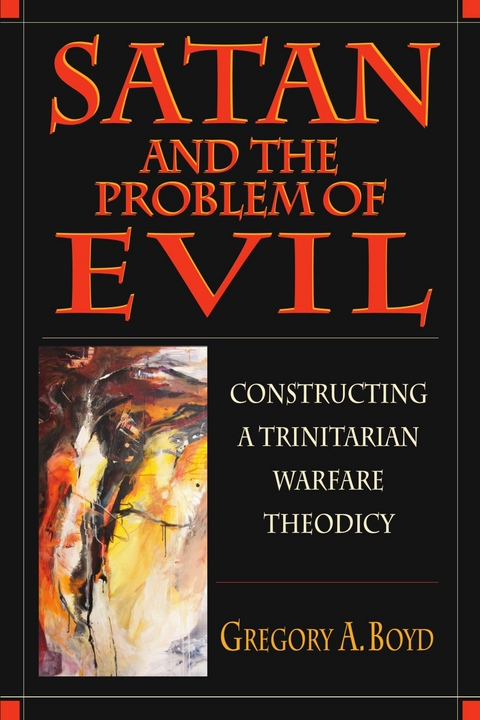
Satan and the Problem of Evil (eBook)
456 Seiten
IVP Academic (Verlag)
978-1-5140-1510-0 (ISBN)
Gregory A. Boyd (Ph.D., Princeton Theological Seminary) is a pastor at Woodland Hills Church in St. Paul, Minnesota. Previously, he was a professor of theology at Bethel University, also in St. Paul. His books include Recovering the Real Jesus in an Age of Revisionist Replies, Letters from a Skeptic, God of the Possible, Repenting of Religion, Seeing is Believing, Escaping the Matrix, The Jesus Legend, Myth of a Christian Nation, Is God to Blame, God at War and Satan and the Problem of Evil.
1
THE WORLD AT WAR
The Warfare Worldview of the Bible & the Early Church
And war broke out in heaven; Michael and his angels fought
against the dragon. The dragon and his angels fought back,
but they were defeated, and there was no longer any place for them in heaven.
The great dragon was thrown down, that ancient serpent,
who is called the Devil and Satan, the deceiver of the whole world—
he was thrown down to the earth, and his angels were thrown down with him.
No one. . . who has not heard what is related of him who is called “devil,”
and his “angels,” and what he was before he became a devil,
and how he became such, and what was the cause of the simultaneous apostasy
of those who are termed his angels, will be able to ascertain the origin of evils.
No theodicy that does not take the Devil fully into consideration
is likely to be persuasive.
War is the father of all and the king of all.
As noted in the introduction, this work is an attempt at making philosophical sense of the warfare worldview of the Bible. How can the scriptural depiction of God striving to accomplish his will against agents who genuinely resist it be reconciled with Scripture’s uniform testimony that God is all-powerful? The answer, I will argue, lies in the necessary conditions of creatures possessing the capacity to love. Before exploring these conditions, however, we must first have an adequate appreciation of the biblical material that gives rise to the question.
Toward this end, I first consider various ways the Old Testament expresses a warfare worldview. I then discuss the manner in which Jesus’ ministry reflects a warfare worldview, followed by an examination of how it gets reflected throughout the remainder of the New Testament. I conclude with a brief examination of the warfare mindset reflected in the writings of the postapostolic fathers. This chapter’s thesis is that, as much as Scripture emphasizes God’s control of the world, this pervasive warfare motif suggests that he does not control everything. One important implication of this is that one cannot posit a specific divine reason for the behavior of beings who resist God’s will.
The Warfare Worldview of the Old Testament
In sharp contrast to the New Testament, Satan plays a minor role in the Old Testament. Instead, the warfare worldview in the Old Testament is expressed in terms of God’s conflict with hostile waters, with cosmic monsters, and with other gods. We will examine these three motifs in this order.
Rebuking hostile waters. Like their ancient Near Eastern neighbors, ancient Jews believed that the earth was founded on and encircled by water (e.g., Ps 104:2-3, 5). And, as was the case with these neighbors, ancient Israelites often depicted these waters as a chaotic or hostile force. This was one of the ways ancient authors expressed the conviction that there was something that opposes God and his creation in the cosmic environment of the earth. The Creator thus had to fight to preserve the order of creation.
Whereas other cultures credited one of their chief god(s) with preserving order against hostile forces of chaos, biblical authors always acknowledge Yahweh as the earth’s defender. It is Yahweh’s “rebuke” (i.e., not the rebuke of a pagan god) that causes the hostile waters to “flee.” It is “at the sound of [his] thunder” that “they take to flight” (Ps 104:7). Indeed, these hostile waters take flight at the very sight of God (Ps 77:16).
Moreover, it was the Lord who assigns these rebel waters a “boundary that they may not pass” (Ps 104:9, cf. Job 38:6-11; Prov 8:27-29). It is the Lord and none other who defeats these enemies, who tramples on the sea with his warring horses (Hab 3:15), and who sits enthroned above “the mighty waters” (Ps 29:3-4, 10).
In sum, as Jon Levenson notes, the view here is that “the Sea [is] a somewhat sinister force that, left to its own, would submerge the world and forestall the ordered reality we call creation. What prevents this frightening possibility is the mastery of YHWH, whose blast and thunder. . . force the Sea into its proper place.”1
Biblical authors are of course confident that the Lord is capable of containing, and ultimately defeating, these rebel waters. But there is no suggestion here that Yahweh’s war against these forces is prescripted or inauthentic. To the contrary, as a number of exegetes have noted, biblical authors exalt God’s sovereignty precisely because they are certain that these raging forces are real, formidable foes.2
Leviathan and Rahab. Another common ancient Israelite way of expressing the Creator’s warfare against anticreational forces was to depict them as cosmic monsters. Here too the Jews share much in common with the mythology of their Near Eastern neighbors. The two most frequently mentioned “monsters” in the Old Testament are Leviathan and Rahab.
As in Canaanite mythology, Leviathan was believed to be a ferocious, twisting serpent of the sea encircling the earth. He had (on some accounts) many heads (Ps 74:14) and could blow smoke out of his nose(s) and fire out of his mouth(s) (Job 41:18-21). Humans could not defeat or control this beast, for human weapons were useless against a creature of such power. Indeed, this monster could eat iron like straw and crush bronze as if it were decayed timber (Job 41:26-27).
Nevertheless, biblical authors were confident that Leviathan was no match for Yahweh. At the time of creation as well as in subsequent battles against Israel’s enemies, Yahweh “broke the heads of the dragons in the waters [and] crushed the heads of Leviathan” (Ps 74:13-14). Looking forward to God’s ultimate victory wherein all of creation would be freed from evil, Isaiah writes: “On that day the LORD with his cruel and great and strong sword will punish Leviathan the fleeing serpent, Leviathan the twisting serpent, and he will kill the dragon that is in the sea” (Is 27:1).3
Given the mythical-poetic nature of this literature, we should not suppose any contradiction between the claim that Leviathan’s heads were crushed in the primordial past and the claim that someday Yahweh will kill this dragon. The point of such passages is that the Creator has had and will continue to have strong opposition from cosmic forces and that he has been able and will continue to be able to contain, and ultimately defeat, these forces.
Rahab is portrayed in similar terms. This cosmic creature inhabiting the waters that encircle the earth threatened the whole earth but was no match for Yahweh. When Yahweh expressed his wrath against evil, “the helpers of Rahab bowed beneath him” (Job 9:13). In the primordial past Yahweh’s power “churned up the sea,” his wisdom “cut Rahab to pieces,” and his hand “pierced the gliding serpent” (Job 26:12-13 NIV). The psalmist also celebrated Yahweh’s sovereignty over “the raging of the sea” by announcing that he had “crushed Rahab like a carcass” and “scattered [his] enemies with [his] mighty arm” (Ps 89:9-10). In similar fashion Isaiah reassured himself that Yahweh would “awake” to deliver Israel by remembering that in the primal past he had “cut Rahab in pieces” and “pierced the dragon” (Is 51:9).
Contrary to the convictions of most contemporary Western people, but in keeping with the basic assumptions of ancient people and primordial people groups today, Old Testament authors did not draw a sharp distinction between “spiritual” and “physical” realities. The world “above” and the world “below” were seen as intertwined. Hence biblical authors frequently see battles between nations as participating in God’s ongoing battle with cosmic forces. For example, the evil character and threatening power of Rahab on a cosmic level was understood to be revealed in and channeled through the evil character and threatening power of Egypt (Ps 87:4; Is 30:7; cf. Jer. 51:34; Ezek 29:3; 32:2).
For this reason, Israel’s defeat of an opponent was sometimes construed as the Lord once again defeating cosmic forces of chaos (Is 17:12-14). When Yahweh freed the children of Israel from Egypt, for example, this was considered his defeat of the raging waters (Hab 3:12-13; cf. Nahum 1:4).4 And when he further delivered Israel by parting the Red Sea, this was seen as a new application of Yahweh’s victory over Rahab (Ps 77:16; Is 51:9-10).5
Conversely, Israel’s defeat by an enemy...
| Erscheint lt. Verlag | 4.8.2025 |
|---|---|
| Sprache | englisch |
| Themenwelt | Religion / Theologie ► Christentum ► Kirchengeschichte |
| Religion / Theologie ► Christentum ► Moraltheologie / Sozialethik | |
| Schlagworte | Apologetics • Belief • Calvinist • Choice • Christian • Church • Demons • Devil • Doctrine • Doubt • Faith • Fall • Holy Spirit • is god real • Jesus • miracles • original sin • Prayer • questions • reasons to believe • Sovereignty • Suffering • Supernatural • Theology • Trinity • Truth • Worldview |
| ISBN-10 | 1-5140-1510-2 / 1514015102 |
| ISBN-13 | 978-1-5140-1510-0 / 9781514015100 |
| Informationen gemäß Produktsicherheitsverordnung (GPSR) | |
| Haben Sie eine Frage zum Produkt? |
 EPUB (Wasserzeichen)
DRM: Digitales Wasserzeichen
Dieses eBook enthält ein digitales Wasserzeichen und ist damit für Sie personalisiert. Bei einer missbräuchlichen Weitergabe des eBooks an Dritte ist eine Rückverfolgung an die Quelle möglich.
Dateiformat: EPUB (Electronic Publication)
EPUB ist ein offener Standard für eBooks und eignet sich besonders zur Darstellung von Belletristik und Sachbüchern. Der Fließtext wird dynamisch an die Display- und Schriftgröße angepasst. Auch für mobile Lesegeräte ist EPUB daher gut geeignet.
Systemvoraussetzungen:
PC/Mac: Mit einem PC oder Mac können Sie dieses eBook lesen. Sie benötigen dafür die kostenlose Software Adobe Digital Editions.
eReader: Dieses eBook kann mit (fast) allen eBook-Readern gelesen werden. Mit dem amazon-Kindle ist es aber nicht kompatibel.
Smartphone/Tablet: Egal ob Apple oder Android, dieses eBook können Sie lesen. Sie benötigen dafür eine kostenlose App.
Geräteliste und zusätzliche Hinweise
Buying eBooks from abroad
For tax law reasons we can sell eBooks just within Germany and Switzerland. Regrettably we cannot fulfill eBook-orders from other countries.
aus dem Bereich