


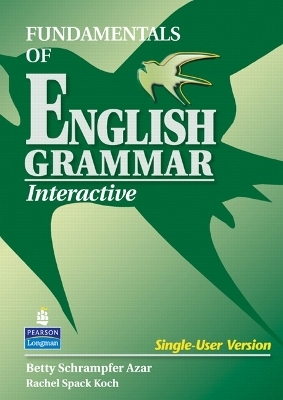
Fundamentals of English Grammar Interactive CD-ROM
Pearson Education (US) (Hersteller)
978-0-13-184414-8 (ISBN)
- Keine Verlagsinformationen verfügbar
- Artikel merken
Features
Animated Grammar Presentation: “Talking Heads” inform students about grammar and usage in lively, accessible and engaging ways.
Development of Grammatical Awareness: Introductory dialogues help students notice how grammar works by highlighting use of forms.
Extensive Grammar Practice: More than 500 new interactive exercises including listening, speaking and reading.
Learner Support: Easy access to information through pop-up notes and grammar charts with clear examples and explanations of key points.
Ongoing Assessment: Students can monitor their progress through immediate feedback on practice exercises, chapter tests, and score reports.
System Requirements
Windows 98, Windows XP, Windows 2000 with Service Pack 2 (or higher), or Windows NT 4.0 with Service Pack 5 (or higher)
Non-English Windows 2000 systems require the Professional edition
Pentium II processor 400+ MHz
64+ MB RAM (128 MB recommended)
16-bit graphics card
Monitor resolution of 800 x 600 or higher
Sound card, microphone, and speakers (Microphones plugged into USB ports are not supported)
10X CD-ROM drive
Internet Explorer 5.0 or higher (Internet Explorer 5.5 or higher recommended) ( Note: Netscape and AOL browser software are not supported.)
Macromedia’s Flash 6 (or higher) and Shockwave 8 (or higher), Apple’s QuickTime 5 (or higher), and Sun’s Java 1.4.1_01 plug-ins ( Note: If your computer does not have these plug-ins, they will be installed automatically when you install the course.)
Adobe Acrobat Reader 4.0 (or higher) software
For more information on this product and our other Multimedia products, please visit the Pearson Longman Multimedia website.
CHAPTER 1 PRESENT TIME
1-1 The Simple Present and the Present Progressive
1-2 Forms of the Simple Present and the Present Progressive
1-3 Frequency Adverbs
1-4 Final -s
1-5 Spelling of Final -s/-es
1-6 Non-Action Verbs
1-7 Present Verbs: Short Answers to Yes/No Questions
Game: Crossword
Listening
Speaking
Reading comprehension
Test
CHAPTER 2 PAST TIME
2-1 Expressing Past Time: The Simple Past
2-2 Forms of the Simple Past: Regular Verbs
2-3 Forms of the Simple: Be
2-4 Regular Verbs: Pronunciation of -ed Endings
2-5 Spelling of -ing and -ed Forms
2-6 The Principle Parts of a Verb
2-7 Irregular Verbs: A Reference List
2-8 The Simple Past and the Past Progressive
2-9 Forms of the Past Progressive
2-10 Expressing Past Time: Using Time Clauses
2-11 Expressing Past Habit: Used to
Game: Concentration
Listening
Speaking
Reading
Reading comprehension
Test
CHAPTER 3 FUTURE TIME
3-1 Expressing Future Time: Be going to And Will
3-2 Forms with Be going to
3-3 Forms with Will
3-4 Sureness about the Future
3-5 Be going to vs. Will
3-6 Expressing Future Time in Time Clauses and If-Clauses
3-7 Using the Present Progressive to Express Future Time
3-8 Using the Simple Present to Express Future Time
3-9 Immediate Future: Using Be about to
3-10 Parallel Verbs
Game: Crossword
Listening
Speaking
Reading
Reading comprehension
Test
CHAPTER 4 THE PRESENT PERFECT AND THE PAST PERFECT
4-1 Past Participle
4-2 Forms of the Present Perfect
4-3 Meanings of the Present Perfect
4-4 Simple Past vs. Present Perfect
4-5 Using Since and For
4-6 Present Perfect Progressive
4-7 Present Perfect Progressive vs. Present Perfect
4-8 Using Already, Yet, Still, and Anymore
4-9 Past Perfect
Game: Concentration
Listening
Speaking
Reading comprehension
Test
CHAPTER 5 ASKING QUESTIONS
5-1 Yes/No Questions and Short Answers
5-2 Yes/No Questions and Information Questions
5-3 Questions with Who, Who(m), and What
5-4 Using Could to Express Possibility
5-5 Spoken and Written Contractions with Question Words
5-6 Using What + a Form of Do
5-7 Using What kind of
5-8 Using Which
5-9 Using Whose
5-10 Using How
5-11 Using How Often
5-12 Using How Far
5-13 Length of Time: It + take and How long
5-14 More Questions with How
5-15 Using How about and What about
5-16 Tag Questions
Game: Crossword
Listening
Speaking
Reading comprehension
Test
CHAPTER 6 NOUNS AND PRONOUNS
6-1 Pronunciation of Final -s/-es
6-2 Plural Forms And Nouns
6-3 Subjects, Verbs, and Objects
6-4 Objects of Prepositions
6-5 Prepositions of Time
6-6 Word Order: Place and Time
6-7 Subject-Verb Agreement
6-8 Using Adjectives to Describe Nouns
6-9 Using Nouns as Adjectives
6-10 Personal Pronouns: Subjects and Objects
6-11 Possessive Nouns
6-12 Possessive Pronouns and Adjectives
6-13 Reflexive Pronouns
6-14 Singular Forms of Other: Another vs. The other
6-15 Plural Forms of Other: Other(s) vs. The other(s)
6-16 Summary of Forms of Other
Game: Concentration
Listening
Speaking
Reading comprehension
Test
CHAPTER 7 MODAL AUXILIARIES
7-1 The Form of Modal Auxiliaries
7-2 Expressing Ability: Can and Could
7-3 Expressing Possibility: May and Might
Expressing Permission: May and Can
7-4 Using Could to Express Possibility
7-5 Polite Questions: May I, Could I, Can I
7-6 Polite Questions: Would you, Could you, Will you, Can you
7-7 Expressing Advice: Should and Ought to
7-8 Expressing Advice: Had better
7-9 Expressing Necessity: Have to, Have got to, Must
7-10 Expressing Lack of Necessity: Do not have to
Expressing Prohibition: Must not
7-11 Making Logical Conclusions: Must
7-12 Giving Instructions: Imperative Sentences
7-13 Making Suggestions: Let’s and Why don’t
7-14 Stating Preferences: Prefer, Like … Better, Would rather
Game: Crossword
Listening
Speaking
Reading
Reading comprehension
Test
CHAPTER 8 CONNECTING IDEAS
8-1 Connecting Ideas with And
8-2 Connecting Ideas with But and Or
8-3 Connecting Ideas with So
8-4 Using Auxiliary Verbs after But and And
8-5 Using And + too, So, Either, Neither
8-6 Connecting Ideas with Because
8-7 Connecting Ideas with Even though / Although
Game: Concentration
Listening
Speaking
Reading
Reading comprehension
Test
CHAPTER 9 COMPARISONS
9-1 Making Comparisons with As … as
9-2 Comparative and Superlative
9-3 Comparative and Superlative Forms of Adjectives and Adverbs
9-4 Completing a Comparative
9-5 Modifying Comparatives
9-6 Comparisons with Less … than And Not as … as
9-7 Unclear Comparisons
9-8 Using More with Nouns
9-9 Repeating a Comparison
9-10 Using Double Comparatives
9-11 Using Superlatives
9-12 Using The same, Similar, Different, Like, and Alike
Game: Crossword
Listening
Speaking
Reading
Reading comprehension
Test
CHAPTER 10 THE PASSIVE
10-1 Active Sentences and Passive Sentences
10-2 Form of the Passive
10-3 Transitive and Intransitive Verbs
10-4 Using the By-Phrase
10-5 The Passive Forms of the Present and Past Progressive
10-6 The Passive Modal Auxiliaries
10-7 Using Past Participles as Adjectives (Stative Passive)
10-8 Participial Adjectives: -ed vs. -ing
10-9 Get + Adjective; Get + Past Participle
10-10 Using Be used / accustomed to and Get used / Get accustomed to
10-11 Used to vs. Be used to
10-12 Using Be supposed to
Game: Concentration
Listening
Speaking
Reading comprehension
Test
CHAPTER 11 PASSIVE SENTENCES
11-1 A vs. An
11-2 Count and Noncount Nouns
11-3 Noncount Nouns
11-4 More Noncount Nouns
11-5 Using Several, A lot of, Many / Much, And A few / A little
11-6 Nouns that Can Be Count or Noncount
11-7 Using Units of Measure with Noncount Nouns
11-8 Guidelines for Article Usage
11-9 Using the or Ø with Names
11-10 Capitalization
Game: Crossword
Listening, Part 1
Listening, Part 2
Speaking
Reading
Reading comprehension
Test
CHAPTER 12 ADJECTIVE CLAUSES
12-1 Adjective Clauses: Introduction
12-2 Using Who and Whom in Adjective Clauses
12-3 Using Who, Who(m), and That in Adjective Clauses
12-4 Using Which and That in Adjective Clauses
12-5 Singular And Plural in Adjective Clauses
12-6 Using Prepositions in Adjective Clauses
12-7 Using Whose in Adjective Clauses
Game: Concentration
Listening
Speaking
Reading comprehension
Test
CHAPTER 13 GERUNDS AND INFINITIVES
13-1 Verb + Gerund
13-2 Go + ing
13-3 Verb + Infinitive
13-4 Verb + Gerund or Infinitive
13-5 Preposition + Gerund
13-6 Using By and With to Express How Something Is Done
13-7 Using Gerunds as Subjects; Using It + Infinitive
13-8 It + Infinitive: Using For (Someone)
13-9 Expressing Purpose with In order to and For
13-10 Using Infinitives with Too and Enough
Game: Crossword
Listening
Speaking
Reading comprehension
Test
CHAPTER 14 NOUN CLAUSES
14-1 Noun Clauses: Introduction
14-2 Noun Clauses that Begin with a Question Word
14-3 Noun Clauses with Who, What, Whose + Be
14-4 Noun Clauses that Begin with If or Whether
14-5 Noun Clauses that Begin with That
14-6 Other Uses of That-Clauses
14-7 Substituting So for a That-Clause in Conversational Responses
14-8 Quoted Speech
14-9 Quoted Speech vs. Reported Speech
14-10 Verb Forms in Reported Speech
14-11 Common Reporting Verbs: Tell, Ask, Answer/Reply
Game: Concentration
Listening
Speaking
Reading comprehension
Test
Appendix 1: Phrasal Verbs
Appendix 2: Preposition Combinations
| Erscheint lt. Verlag | 30.5.2007 |
|---|---|
| Verlagsort | Upper Saddle River |
| Sprache | englisch |
| Maße | 10 x 10 mm |
| Gewicht | 95 g |
| Themenwelt | Schulbuch / Wörterbuch ► Wörterbuch / Fremdsprachen |
| Geisteswissenschaften ► Sprach- / Literaturwissenschaft ► Sprachwissenschaft | |
| ISBN-10 | 0-13-184414-8 / 0131844148 |
| ISBN-13 | 978-0-13-184414-8 / 9780131844148 |
| Zustand | Neuware |
| Informationen gemäß Produktsicherheitsverordnung (GPSR) | |
| Haben Sie eine Frage zum Produkt? |


