


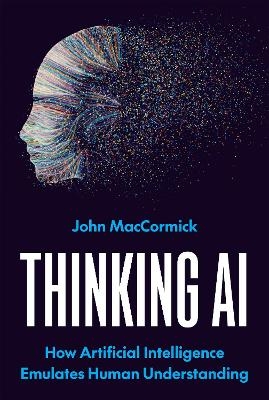
Thinking AI
How Artificial Intelligence Emulates Human Understanding
Seiten
2026
Princeton University Press (Verlag)
978-0-691-19173-7 (ISBN)
Princeton University Press (Verlag)
978-0-691-19173-7 (ISBN)
- Noch nicht erschienen (ca. April 2026)
- Versandkostenfrei
- Auch auf Rechnung
- Artikel merken
Can a computer program think like a human?
“Can machines think?” Ever since Alan Turing posed this question in an influential 1950 paper, it has been central to research in artificial intelligence. More than seventy-five years after Turing’s paper, we grapple with it every time we wonder if Watson was actually smarter than Jeopardy! champions, or if ChatGPT really knows what it’s talking about. In Thinking AI, computer scientist John MacCormick explores Turing’s question from a perspective informed by a detailed understanding of the way modern AI systems work. MacCormick explains, in accessible fashion, the ideas behind the two main pillars of the twenty-first century AI revolution: deep neural networks and reinforcement learning.
MacCormick offers a tour of the most famous AI systems, including AlexNet and VGG16, deep neural networks for object recognition that led to a Nobel prize; DeepMind’s AlphaGo, which shocked AI researchers with its superhuman performance in the game of Go; and OpenAI’s ChatGPT, which stunned the world with its natural language capabilities. He describes how each system works, and points to parallels with human brain processes. Both human minds and computer programs, MacCormick explains, can induce intelligence through emergence: the capability for new phenomena to emerge from the interactions of many small, simple components. Does this mean that a computer program can think like a human? In many ways, MacCormick argues, the answer is yes. In Thinking AI, he reveals a new landscape of emergent intelligence—a world in which computer programs can emulate many or all aspects of human thinking but humanity retains its meaning and purpose.
“Can machines think?” Ever since Alan Turing posed this question in an influential 1950 paper, it has been central to research in artificial intelligence. More than seventy-five years after Turing’s paper, we grapple with it every time we wonder if Watson was actually smarter than Jeopardy! champions, or if ChatGPT really knows what it’s talking about. In Thinking AI, computer scientist John MacCormick explores Turing’s question from a perspective informed by a detailed understanding of the way modern AI systems work. MacCormick explains, in accessible fashion, the ideas behind the two main pillars of the twenty-first century AI revolution: deep neural networks and reinforcement learning.
MacCormick offers a tour of the most famous AI systems, including AlexNet and VGG16, deep neural networks for object recognition that led to a Nobel prize; DeepMind’s AlphaGo, which shocked AI researchers with its superhuman performance in the game of Go; and OpenAI’s ChatGPT, which stunned the world with its natural language capabilities. He describes how each system works, and points to parallels with human brain processes. Both human minds and computer programs, MacCormick explains, can induce intelligence through emergence: the capability for new phenomena to emerge from the interactions of many small, simple components. Does this mean that a computer program can think like a human? In many ways, MacCormick argues, the answer is yes. In Thinking AI, he reveals a new landscape of emergent intelligence—a world in which computer programs can emulate many or all aspects of human thinking but humanity retains its meaning and purpose.
John MacCormick is professor of computer science at Dickinson College. He is the author of Nine Algorithms That Changed the Future: The Ingenious Ideas That Drive Today's Computers and What Can Be Computed? A Practical Guide to the Theory of Computation (both Princeton).
| Erscheint lt. Verlag | 21.4.2026 |
|---|---|
| Zusatzinfo | 82 b/w illus. 11 tables. |
| Verlagsort | New Jersey |
| Sprache | englisch |
| Maße | 156 x 235 mm |
| Themenwelt | Geisteswissenschaften ► Psychologie |
| Informatik ► Theorie / Studium ► Künstliche Intelligenz / Robotik | |
| Naturwissenschaften ► Biologie ► Humanbiologie | |
| Naturwissenschaften ► Biologie ► Zoologie | |
| Sozialwissenschaften ► Soziologie ► Empirische Sozialforschung | |
| ISBN-10 | 0-691-19173-5 / 0691191735 |
| ISBN-13 | 978-0-691-19173-7 / 9780691191737 |
| Zustand | Neuware |
| Informationen gemäß Produktsicherheitsverordnung (GPSR) | |
| Haben Sie eine Frage zum Produkt? |
Mehr entdecken
aus dem Bereich



aus dem Bereich
Eine praxisorientierte Einführung
Buch | Softcover (2025)
Springer Vieweg (Verlag)
CHF 53,15
Künstliche Intelligenz, Macht und das größte Dilemma des 21. …
Buch | Softcover (2025)
C.H.Beck (Verlag)
CHF 25,20
Buch | Softcover (2025)
Reclam, Philipp (Verlag)
CHF 11,20


