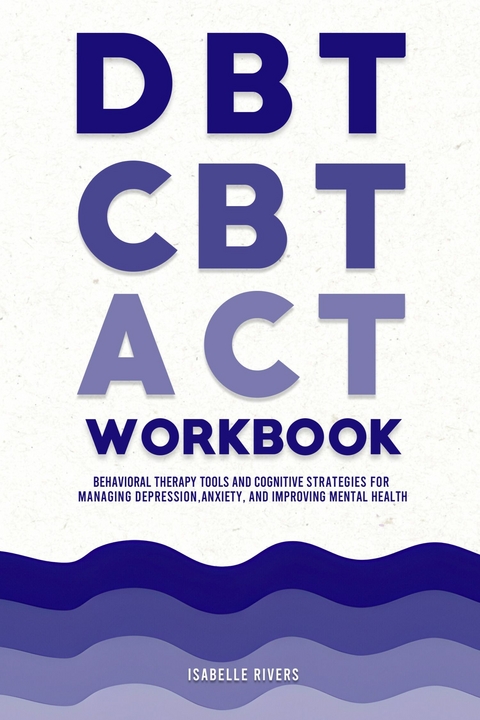
DBT, CBT, and ACT Workbook (eBook)
245 Seiten
Publishdrive (Verlag)
978-1-78793-812-0 (ISBN)
Do your emotions sometimes feel like a runaway train you can't stop?
Do anxiety, overthinking, or low self-worth keep you trapped in your own mind?
This comprehensive workbook blends three of the most effective therapeutic approaches-Dialectical Behavior Therapy (DBT), Cognitive Behavioral Therapy (CBT), and Acceptance and Commitment Therapy (ACT)-into one transformative guide designed to help you heal from emotional pain, regain mental clarity, and build a life aligned with your values.
Whether you're struggling with anxiety, depression, emotional dysregulation, or chronic stress, this book offers you science-based tools and guided exercises to restore emotional balance and live with purpose.
Do your emotions sometimes feel like a runaway train you can't stop?Do anxiety, overthinking, or low self-worth keep you trapped in your own mind?This comprehensive workbook blends three of the most effective therapeutic approaches Dialectical Behavior Therapy (DBT), Cognitive Behavioral Therapy (CBT), and Acceptance and Commitment Therapy (ACT) into one transformative guide designed to help you heal from emotional pain, regain mental clarity, and build a life aligned with your values.Whether you're struggling with anxiety, depression, emotional dysregulation, or chronic stress, this book offers you science-based tools and guided exercises to restore emotional balance and live with purpose.?? Here s a glimpse into your transformational journey:- A powerful technique to turn emotional storms into growth opportunities- The 3 What method for living fully in the present moment- Your personal emergency brake for halting runaway anxiety- The art of self-talk that boosts your self-esteem- Harnessing paradox to resolve seemingly impossible conflicts- How to become a thought detective and unmask limiting beliefs- The surprising way to transform your inner critic into an ally- A witness technique for breaking free from obsessive thoughts- The cognitive defusion key to regaining control of your mind- A 5-minute ritual to create your personal anti-stress shield- The DEAR MAN strategy for saying no without guilt- An intriguing empty chair method to resolve inner conflicts? Ready to break the cycle?If you re tired of fighting your own thoughts, if you re done watching anxiety or depression dictate your choices, this book is your toolkit to freedom.You don t need to be perfect. You need practical tools, daily support, and a plan that works.Take the first step turn the page and begin a new chapter of growth, healing, and emotional mastery.
Chapter 1:
The Basics of DBT
"Life is a balance of holding on and letting go." - Rumi
In this chapter, you will explore the foundations of Dialectical Behavior Therapy (DBT), an innovative approach to managing intense emotions and improving interpersonal relationships. DBT offers practical tools to balance self-acceptance with the desire for change, helping you navigate life's emotional challenges more effectively.
You'll start by discovering the origins of DBT and how it has evolved over time. You'll gain an understanding of the fundamental principles that guide it, including the key concept of dialectics. You'll also explore the four main modules of DBT and how they work together to promote emotional well-being.
Whether you're dealing with anxiety, depression, relationship issues, or simply looking to improve your mental health, this chapter will provide you with a solid foundation to understand how DBT can be beneficial in your life. Get ready to discover an approach that balances compassion and change, offering you new perspectives for facing daily challenges.
Origins and Development of DBT
Dialectical Behavior Therapy (DBT) didn’t emerge out of nowhere. It has a rich and fascinating history, deeply intertwined with the life and experiences of its creator, Dr. Marsha Linehan. In the 1970s, while working with patients who struggled with chronic suicidal thoughts and behaviors, Linehan became frustrated with the limitations of existing therapies and sought a more effective approach. Her brilliant insight was to combine two seemingly opposing concepts: acceptance and change.
Drawing on her training in Cognitive Behavioral Therapy (CBT), Linehan realized that CBT alone was insufficient for some patients, particularly those with Borderline Personality Disorder. These patients often felt invalidated and misunderstood, reacting negatively to immediate attempts to change their behaviors. To address this, Linehan incorporated elements of Zen philosophy, particularly the concepts of mindfulness and acceptance, providing a necessary counterbalance to CBT’s emphasis on change. She also introduced the concept of dialectics, derived from Western philosophy, which in DBT involves seeing reality as a continuous flow of opposing forces, each containing elements of truth. This approach helps overcome the “all-or-nothing” thinking common in emotional disorders.
Over the years, DBT has evolved from a specific treatment for Borderline Personality Disorder into a versatile approach applicable to a wide range of emotional and behavioral issues. Today, it is recognized as an evidence-based treatment for numerous conditions, including mood disorders, anxiety disorders, eating disorders, and addictions. What makes DBT unique is its balance between scientific rigor and human compassion. Linehan emphasized the importance of treating patients with dignity and respect, validating their experiences while encouraging change.
The story of DBT is also a testament to resilience and personal transformation. In 2011, Linehan publicly revealed her own struggles with mental health issues, including suicidal thoughts in her youth. This revelation added depth to her theory and demonstrated the potential for healing and growth within each of us. As you delve into the world of DBT, remember that you are following in the footsteps of countless individuals who have found hope and healing through this approach. DBT is not just a set of techniques but a way of viewing the world and yourself with greater understanding and compassion.
Fundamental Principles of DBT
Dialectical Behavior Therapy (DBT) is built on a set of interconnected principles that form its theoretical and practical foundation. At the core of this approach lies the concept of dialectics, a way of thinking that recognizes and accepts the existence of seemingly opposing truths. This principle is evident in the delicate balance between acceptance and change that DBT promotes.
When practicing DBT, you learn to accept yourself and your current reality without judgment while also acknowledging the necessity and possibility of change. This doesn’t mean resigning yourself to your situation; rather, it creates a space of understanding from which transformation can emerge. Closely tied to this concept is the practice of mindfulness. Through present-moment awareness, you observe your thoughts and emotions without being overwhelmed by them. Mindfulness in DBT goes beyond simple meditation; it becomes a way of approaching life with intentionality and presence.
Validation is another crucial element in this process. Recognizing and accepting your thoughts, feelings, and behaviors as understandable within the context of your experiences helps you build a solid foundation for change. Simultaneously, DBT teaches you to recognize and counteract invalidation, whether it comes from others or is self-inflicted. A fundamental principle of DBT is the belief that everyone is doing their best given their current circumstances. This compassionate perspective is not an invitation to complacency but a starting point for personal improvement.
DBT also emphasizes the importance of continuous learning, encouraging you to view every situation, even the difficult ones, as opportunities for growth. This ties into the idea that everything is interconnected: your thoughts influence your emotions, which in turn affect your behaviors, creating a continuous cycle. As you integrate these principles into your life, you’ll find that they are not just theoretical concepts but practical tools for navigating daily challenges.
The goal of DBT is not to eliminate pain or difficulties entirely—an unrealistic expectation—but to equip you to manage challenges more effectively, allowing you to live a richer and more meaningful life despite adversity.
The Four Modules of DBT
Dialectical Behavior Therapy (DBT) is structured around four main modules, each addressing specific aspects of emotional and relational well-being: Mindfulness, Distress Tolerance, Emotion Regulation, and Interpersonal Effectiveness. Together, these modules form a comprehensive and integrated approach to managing emotional and behavioral challenges.
Mindfulness: The Foundation of DBT
Mindfulness is the first module and serves as the foundation for all other DBT skills. In this module, you learn to focus your attention on the present moment, observing your thoughts, emotions, and bodily sensations without judgment. Mindfulness practices help you increase awareness of your mental processes, reduce emotional reactivity, improve concentration, and make more intentional decisions. The mindfulness skills in DBT are divided into "What" skills (observe, describe, participate) and "How" skills (non-judgmentally, one-mindfully, effectively).
Distress Tolerance: Navigating Crises
The Distress Tolerance module equips you with tools to handle crisis situations and moments of intense emotional stress. The skills you learn in this module enable you to overcome difficult moments without making the situation worse, accept reality as it is (radical acceptance), healthily distract yourself from painful thoughts and emotions, and calm yourself during high-stress times. This module includes strategies like STOP (Stop, Take a step back, Observe, Proceed mindfully) and TIPP (Temperature, Intense exercise, Paced breathing, Progressive muscle relaxation).
Emotion Regulation: Managing Emotions Effectively
The Emotion Regulation module teaches you how to understand and manage your emotions more effectively. The goals of this module include identifying and naming emotions, understanding the function of emotions, reducing emotional vulnerability, increasing positive emotions, and decreasing the intensity of negative emotions. You learn strategies such as the ABC model (Accumulation of positive emotions, Building mastery, Coping ahead) and techniques for modifying emotions through opposite action.
Interpersonal Effectiveness: Improving Relationships
The final module, Interpersonal Effectiveness, focuses on enhancing your relationships with others. The skills you acquire in this module help you communicate assertively, maintain self-respect in social interactions, balance your needs with those of others, and build and maintain healthy relationships. This module introduces techniques like DEAR MAN (Describe, Express, Assert, Reinforce, stay Mindful, Appear confident, Negotiate) for making effective requests, and GIVE (Gentle, Interested, Validate, Easy manner) for maintaining positive relationships.
Integrating the Modules
These four modules do not operate in isolation but are interconnected and support each other. For example, mindfulness skills help you stay centered while practicing distress tolerance. Improved emotion regulation can lead to more effective interpersonal interactions, and interpersonal effectiveness can reduce stress in relationships, thereby decreasing the need for distress tolerance strategies.
Regular practice of these skills creates a synergistic effect, leading to an overall improvement in your emotional well-being and quality of life. Over time, these skills become more natural, allowing you to face daily challenges with greater resilience and flexibility. While these modules are often presented in a specific order during DBT treatment, in real life, you will frequently use them in combination. The ultimate goal is to integrate them seamlessly into your daily life, creating a holistic approach to managing emotions and relationships.
As you progress in your DBT journey, you will discover how these modules work together to provide you with a complete set of tools for navigating the...
| Erscheint lt. Verlag | 27.5.2025 |
|---|---|
| Sprache | englisch |
| Themenwelt | Geisteswissenschaften ► Psychologie |
| Schlagworte | coping strategies for trauma and stress relief • emotional regulation techniques for adults • grounding exercises for anxiety and panic attacks • how to stop overthinking and calm your mind • mindfulness techniques for emotional stability • thought journaling prompts for self-discovery • tools to rewire negative thinking patterns |
| ISBN-10 | 1-78793-812-3 / 1787938123 |
| ISBN-13 | 978-1-78793-812-0 / 9781787938120 |
| Informationen gemäß Produktsicherheitsverordnung (GPSR) | |
| Haben Sie eine Frage zum Produkt? |
 EPUB (Ohne DRM)
Digital Rights Management: ohne DRM
Dieses eBook enthält kein DRM oder Kopierschutz. Eine Weitergabe an Dritte ist jedoch rechtlich nicht zulässig, weil Sie beim Kauf nur die Rechte an der persönlichen Nutzung erwerben.
Dateiformat: EPUB (Electronic Publication)
EPUB ist ein offener Standard für eBooks und eignet sich besonders zur Darstellung von Belletristik und Sachbüchern. Der Fließtext wird dynamisch an die Display- und Schriftgröße angepasst. Auch für mobile Lesegeräte ist EPUB daher gut geeignet.
Systemvoraussetzungen:
PC/Mac: Mit einem PC oder Mac können Sie dieses eBook lesen. Sie benötigen dafür die kostenlose Software Adobe Digital Editions.
eReader: Dieses eBook kann mit (fast) allen eBook-Readern gelesen werden. Mit dem amazon-Kindle ist es aber nicht kompatibel.
Smartphone/Tablet: Egal ob Apple oder Android, dieses eBook können Sie lesen. Sie benötigen dafür eine kostenlose App.
Geräteliste und zusätzliche Hinweise
Buying eBooks from abroad
For tax law reasons we can sell eBooks just within Germany and Switzerland. Regrettably we cannot fulfill eBook-orders from other countries.
aus dem Bereich