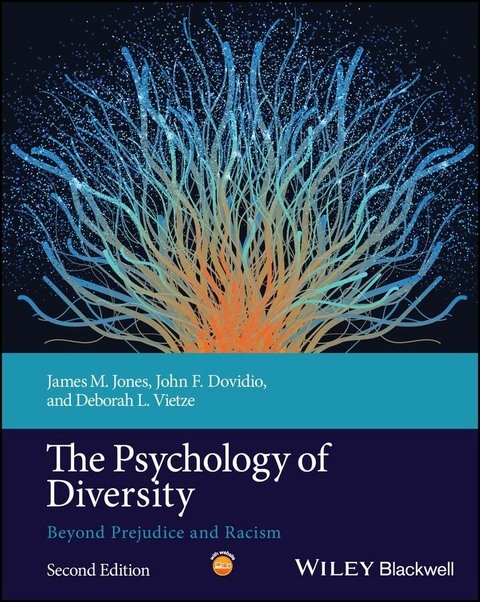
The Psychology of Diversity (eBook)
1001 Seiten
Wiley-Blackwell (Verlag)
978-1-394-23045-7 (ISBN)
Examines the barriers and benefits of diversity, offering a comprehensive framework for addressing systemic inequities and enhancing intergroup relations
The Psychology of Diversity: Beyond Prejudice and Racism provides a thorough exploration of how diversity influences individual and societal behavior. Now in its second edition, this fully revised textbook addresses the evolving challenges and opportunities of diversity in a world shaped by rapid demographic shifts, rising polarization, and the intensifying need for equity and inclusion. Integrating rigorous research, historical context, and actionable insights, the authors illuminate how understanding and embracing diversity can foster stronger communities and institutions.
Updated and expanded content responds to the evolving challenges of the past decade, such as rising political polarization, increasing resistance to equity initiatives, and the escalating diversity divide, while highlighting new opportunities for inclusion and mutual understanding. Entirely new chapters address health disparities, racial bias in policing, debates over affirmative action and Critical Race Theory, the historical and systemic roots of diversity challenges, and other contemporary issues.
Featuring timely coverage of diversity's complexities in the face of unprecedented societal changes, Psychology of Diversity: Beyond Prejudice and Racism:
- Explores diversity through psychological, historical, cultural, and institutional lenses while highlighting its broader societal impacts
- Provides evidence-based strategies and best practices for fostering inclusion, reducing bias, and building stronger intergroup relations
- Incorporates empirical research and case studies reflecting the latest findings in psychology, sociology, and neuroscience
- Contains new content on gender diversity, nonbinary identities, sexual orientation, and immigration as key diversity challenges and opportunities
- Integrates practical scenarios to illustrate key concepts and their application in everyday life
- Includes a wealth of teaching and learning tools and an online instructor's manual to support both independent study and classroom use
The Psychology of Diversity: Beyond Prejudice and Racism, Second Edition, is an excellent textbook for advanced undergraduate and graduate courses on social psychology, prejudice, intergroup relations, and multiculturalism. It is also a valuable reference for professionals working to address equity challenges in fields such as education, healthcare, public policy, and organizational leadership.
JAMES M. JONES is Trustees Distinguished Professor of Psychology and Africana Studies, Emeritus, at the University of Delaware. A renowned scholar, he authored Prejudice and Racism, a seminal work in the field. Jones earned his PhD. from Yale University and has taught at Harvard and Howard Universities. His leadership roles include Executive Director for Public Interest at the American Psychological Association and president of major psychological societies. Honored with numerous lifetime achievement awards, he is also a member of the National Academy of Sciences.
JOHN F. DOVIDIO is Carl Iver Hovland Professor of Psychology and Public Health, Emeritus, at Yale University and co-founder of Humanitas Institute for translating evidence into practice. With over 500 publications on prejudice, stereotyping, and diversity, Dovidio has received lifetime achievement awards from international psychological organizations. His recent books include Unequal Health and States of Belonging. He has held administrative roles at Yale and Colgate and led several professional organizations.
DEBORAH L. VIETZE is Professor Emerita of Psychology at the City University of New York, where she has contributed significantly to developmental psychology, public health, and education. Vietze has held positions at the American Psychological Association and the National Academy of Sciences, and has served on numerous national boards. Her research has been supported by federal agencies and private foundations, reflecting her commitment to advancing evidence-based policy and practice.
Examines the barriers and benefits of diversity, offering a comprehensive framework for addressing systemic inequities and enhancing intergroup relations The Psychology of Diversity: Beyond Prejudice and Racism provides a thorough exploration of how diversity influences individual and societal behavior. Now in its second edition, this fully revised textbook addresses the evolving challenges and opportunities of diversity in a world shaped by rapid demographic shifts, rising polarization, and the intensifying need for equity and inclusion. Integrating rigorous research, historical context, and actionable insights, the authors illuminate how understanding and embracing diversity can foster stronger communities and institutions. Updated and expanded content responds to the evolving challenges of the past decade, such as rising political polarization, increasing resistance to equity initiatives, and the escalating diversity divide, while highlighting new opportunities for inclusion and mutual understanding. Entirely new chapters address health disparities, racial bias in policing, debates over affirmative action and Critical Race Theory, the historical and systemic roots of diversity challenges, and other contemporary issues. Featuring timely coverage of diversity's complexities in the face of unprecedented societal changes, Psychology of Diversity: Beyond Prejudice and Racism: Explores diversity through psychological, historical, cultural, and institutional lenses while highlighting its broader societal impacts Provides evidence-based strategies and best practices for fostering inclusion, reducing bias, and building stronger intergroup relations Incorporates empirical research and case studies reflecting the latest findings in psychology, sociology, and neuroscience Contains new content on gender diversity, nonbinary identities, sexual orientation, and immigration as key diversity challenges and opportunities Integrates practical scenarios to illustrate key concepts and their application in everyday life Includes a wealth of teaching and learning tools and an online instructor's manual to support both independent study and classroom use The Psychology of Diversity: Beyond Prejudice and Racism, Second Edition, is an excellent textbook for advanced undergraduate and graduate courses on social psychology, prejudice, intergroup relations, and multiculturalism. It is also a valuable reference for professionals working to address equity challenges in fields such as education, healthcare, public policy, and organizational leadership.
Chapter 1
Psychology of Diversity Challenges and Benefits
- Introduction
- Beyond Prejudice and Racism
- Perspectives on Diversity
- Diversity Benefits and Challenges
- Goals and Organization of the Book
- Summary
We hold these truths to be self‐evident, that all men are created equal, that they are endowed by their Creator with certain unalienable Rights, that among these are Life, Liberty and the pursuit of Happiness.
Declaration of Independence, July 4, 1776/National Archives
Major American businesses have made clear that the skills needed in today’s increasingly global marketplace can only be developed through exposure to widely diverse people, cultures, ideas, and viewpoints. High‐ranking retired officers and civilian military leaders assert that a highly qualified, racially diverse officer corps is essential to national security. Moreover, because universities, and in particular, law schools, represent the training ground for a large number of the Nation’s leaders, … the path to leadership must be visibly open to talented and qualified individuals of every race and ethnicity. Thus, the Law School has a compelling interest in attaining a diverse student body.
Human capital, Justice Sandra Day O’Connor
Grutter v. Bollinger (2003)
We are proud to be a leader in the fight against DEI since the ideology from which it flows conflicts with America's founding principles—constitutional government and equality under the law. These are the things we believe in. Without them there is no America. You cannot have those things with DEI …. Repeatedly and in public we make these arguments to preserve justice, competence and the progress of science.
Claremont Institute, Upland, California
Introduction
This book is about diversity of those characteristics or qualities of experience that make us different from one another. Race, ethnicity, and gender are the most common differences that are mentioned in diversity conversations. But diversity is much more than demographic differences. We are different by virtue of our country of origin, our culture, sexual orientation, age, values, political affiliation, socioeconomic status, and able‐bodiedness. Our psychological tendencies, abilities, or preferences are also a source of human diversity.
There are more than eight billion people on the planet, and each person is uniquely different from every other. Diversity is a global reality. Diversity becomes significant in Germany and the Netherlands when increasing numbers of immigrants arrive from Turkey, Africa, and South America. African, West Indian, and South and East Asian immigrants diversify the United Kingdom and Canada. Sub‐Saharan Africans immigrate to South Africa and challenge locals for jobs and opportunities. Ethnic differences in the Pacific Islands, Eastern Europe, Canada, and many countries of Africa highlight both differences and similarities.
To this, we add the pressures created by trying to meld the diverse countries of Europe into a common union, the European Union (EU). Differences in politics, economic policy, cultural traditions, and religious beliefs challenge the fabric of a common identity. All of these diversity trends reflect global dynamics of difference. A recent Google search of the term diversity yielded 229,000,000 hits, evidence of its relevance to our everyday experiences. So how can we possibly address diversity of this magnitude in this book?
Our approach is to narrow it down. In this book, we examine diversity primarily with respect to racial and ethnic differences, although gender, religion, ability, and sexual orientation are also important parts of the diversity story. Diversity, and how people respond to it, depends on the history, economics, and politics of a society and the psychology of its members. Although we focus primarily on diversity in the United States, we also present examples from other countries that broaden our understanding of diversity.
Fundamentally, diversity is about differences between and within individuals, institutions, and societies. This book focuses on the psychology of diversity—basic psychological processes that are triggered when we encounter people who are different from us in significant and salient ways or experience being treated differently by others because of their social status. We further explore the dynamics of mental representation and social interaction across individuals, institutions, and cultures and how differential bases of power, privilege, and status affect these interactions. Finally, we identify the effects of diverse contexts on the thoughts, actions, and feelings of people in them.
This book invites you to learn more about what is meant by diversity, our psychological responses to it, what we know about human behavior and diversity, and how it impacts us as people and as a nation. Although diversity often offers opportunities for positive benefits, it is not just any differences that are beneficial. We do not want more felons or bullies among us. But other things equal, we believe that diversity of perspectives, experiences, talents, and backgrounds can enrich most contexts, institutions, and relationships.
However, as we show in later chapters, there is a general human tendency to avoid differences or react negatively to them. Moreover, when we focus on differences, we often fail to appreciate the similarities among us. These biases occur at all social levels: (a) individual attitudes and behavior, (b) institutional policies and programs, and (c) cultural beliefs and practices that often lead to biases in relationships and in institutions. Two of the major challenges of diversity in everyday life are 1) understanding and reducing the many biases that hinder the creation and support of effective diversity in groups, institutions, organizations, and societies, and 2) maximizing the benefits of diversity and to minimizing the difficulties and adverse effects growing diversity can produce.
Beyond Prejudice and Racism
Prejudice and discrimination are significant barriers to beneficial diversity (Jones, 1997). However, as this book’s subtitle—Beyond Racism and Prejudice—indicates, this book is about much more. Eliminating racism and prejudice, even if it were possible, is not enough. We also consider what can be done to better achieve the positive potential of human diversity. But what does it mean to go beyond prejudice and racism?
Beyond has several meanings—something that is further away, after a specified period of time, to a greater extent, or apart from or separate from. It is principally in the last sense of additional or separate from that we use the term beyond. Prejudice and racism are, by all accounts, undesirable and something to “get beyond.” To get beyond it, though, you have to take it into account, as Justice Blackmun advised. So, in this book, we take prejudice and racism into account, and describe its negative effects, and some ways to counteract them. But we also consider that diversity is something additional or separate. Diversity is not something to get beyond, but something to seek with a positive motivation. Justice Sandra Day O’Connor argued that diversity was a compelling interest in higher education, and we take that same viewpoint with regard to our society. In its separateness, we consider that diversity produces different challenges and offers significant benefits.
But to realize how to achieve those benefits, we need a different analytical paradigm (Jones & Dovidio, 2018), one that is responsive to the multiplicities of diversity and the various challenges they pose.
Diversity paradigms allow for integration of perspectives and experiences and enable complex and competing possibilities and influences to be integrated into a holistic solution—a both/and perspective. Further, diversity paradigms offer the ability to reconcile diverse needs, aspirations, perspectives, and experiences of different people into a working engagement that allows each to contribute to the whole, while maintaining their distinctive individual and social identities.
Sturm, Eatman, Saltmarsh, and Bush (2011) refer to this diversity objective as full participation—“an affirmative value focused on creating institutions that enable people, whatever their identity, background, or institutional position, to thrive, realize their capabilities, engage meaningfully in institutional life, and contribute to the flourishing of others” (p. 3). Prejudice and racism are integrally connected to diversity, but they are not the same thing. This book presents broad empirical and theoretical analysis about each and how they intersect.
Perspectives on Diversity
This book acknowledges and represents several important perspectives on diversity. Here are brief accounts of some of the important diversity perspectives.
Behavioral Science of Diversity
Although we draw on work from a range of disciplines, we approach diversity primarily from the perspective of psychology, hence The Psychology of Diversity. Psychology emphasizes the central role of individual perceptions of, and reactions to, diversity. We consider research from the microlevel of neuroscience, which studies the structure and function of the brain and its...
| Erscheint lt. Verlag | 28.5.2025 |
|---|---|
| Sprache | englisch |
| Themenwelt | Geisteswissenschaften ► Psychologie ► Sozialpsychologie |
| Schlagworte | cultural psychology • diversity challenges • diversity psychology • diversity research, social bias • diversity solutions • diversity strategies • diversity textbook • prejudice psychology • racism psychology, intergroup relations • social psychology textbook |
| ISBN-10 | 1-394-23045-1 / 1394230451 |
| ISBN-13 | 978-1-394-23045-7 / 9781394230457 |
| Informationen gemäß Produktsicherheitsverordnung (GPSR) | |
| Haben Sie eine Frage zum Produkt? |
 EPUB (Adobe DRM)
Kopierschutz: Adobe-DRM
Adobe-DRM ist ein Kopierschutz, der das eBook vor Mißbrauch schützen soll. Dabei wird das eBook bereits beim Download auf Ihre persönliche Adobe-ID autorisiert. Lesen können Sie das eBook dann nur auf den Geräten, welche ebenfalls auf Ihre Adobe-ID registriert sind.
Details zum Adobe-DRM
Dateiformat: EPUB (Electronic Publication)
EPUB ist ein offener Standard für eBooks und eignet sich besonders zur Darstellung von Belletristik und Sachbüchern. Der Fließtext wird dynamisch an die Display- und Schriftgröße angepasst. Auch für mobile Lesegeräte ist EPUB daher gut geeignet.
Systemvoraussetzungen:
PC/Mac: Mit einem PC oder Mac können Sie dieses eBook lesen. Sie benötigen eine
eReader: Dieses eBook kann mit (fast) allen eBook-Readern gelesen werden. Mit dem amazon-Kindle ist es aber nicht kompatibel.
Smartphone/Tablet: Egal ob Apple oder Android, dieses eBook können Sie lesen. Sie benötigen eine
Geräteliste und zusätzliche Hinweise
Buying eBooks from abroad
For tax law reasons we can sell eBooks just within Germany and Switzerland. Regrettably we cannot fulfill eBook-orders from other countries.
aus dem Bereich