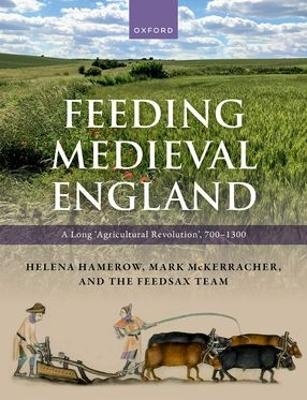
Feeding Medieval England
Oxford University Press (Verlag)
978-0-19-887852-0 (ISBN)
The population of England grew steeply in the Middle Ages, especially between the tenth and thirteenth centuries. This volume investigates how medieval farmers managed to produce the large harvests needed to sustain this growth, growth that in turn fuelled a major expansion of towns and markets. New evidence is presented for the development of the medieval farming regimes that shaped the English landscape in ways still visible today.
Medieval farming is a contentious topic, not least because of the different approaches taken by historians, archaeologists and geographers and no consensus has been reached about the cultivation regimes that underpinned medieval cereal production. This volume presents a new perspective on this question, based on the results of a project that analysed the remains of medieval crops, arable weeds, livestock and pollen from hundreds of excavations. The new evidence that this generated reveals the conditions in which medieval crops were grown and how land use changed between the late Roman period and the Black Death. The authors relate the results to archaeological and written evidence for farms and farming, bringing an ecological perspective to the debate about the so-called medieval 'agricultural revolution'. The 'cerealisation' of England emerges as a regionally varied process lasting several centuries, whose overall impact was nevertheless revolutionary.
Amy Bogaard is Professor of European Archaeology at the University of Oxford and a Fellow of Keble College. Mike Charles is Professor of Environmental Archaeology at the University of Oxford and a Fellow of St Cross College. Emily Forster is a Freelance Palynologist and Environmental Archaeologist specialising in palynology, diatom analysis and archaeobotany. Helena Hamerow is Professor of Early Medieval Archaeology at the University of Oxford and a Fellow of St Cross College. Matilda Holmes has taught zooarchaeology at Birmingham University, UCL, University of Leicester and the University of Nottingham and mentors several early career specialists. Mark McKerracher is the Product Manager and Migrations Lead for the Sustainable Digital Scholarship service within the School of Archaeology and currently works in research data management at the Bodleian Libraries, University of Oxford. Christopher Bronk Ramsey is Professor of Archaeological Science at the University of Oxford. Elizabeth Stroud is a Departmental Lecturer in Archaeological Science at the University of Oxford. Richard Thomas is Professor of Archaeology, Pro-Vice Chancellor for Research and Enterprise at the University of Leicester.
1: An 'Agricultural Revolution' in the Making
2: Materials and Methods
3: The Intensity of Cultivation: Soil Fertility and the Expansion of Arable
4: Crop Rotation and Seasonal Sowing
5: The Spread of the Mouldboard Plough: Draught Cattle and Disturbed Ground
6: Agricultural Land Use, c.AD 300-1500
7: A Long 'Agricultural Revolution'
| Erscheinungsdatum | 11.11.2025 |
|---|---|
| Verlagsort | Oxford |
| Sprache | englisch |
| Maße | 195 x 253 mm |
| Gewicht | 853 g |
| Themenwelt | Geisteswissenschaften ► Archäologie |
| Geschichte ► Allgemeine Geschichte ► Mittelalter | |
| Geisteswissenschaften ► Geschichte ► Hilfswissenschaften | |
| ISBN-10 | 0-19-887852-4 / 0198878524 |
| ISBN-13 | 978-0-19-887852-0 / 9780198878520 |
| Zustand | Neuware |
| Informationen gemäß Produktsicherheitsverordnung (GPSR) | |
| Haben Sie eine Frage zum Produkt? |
aus dem Bereich