


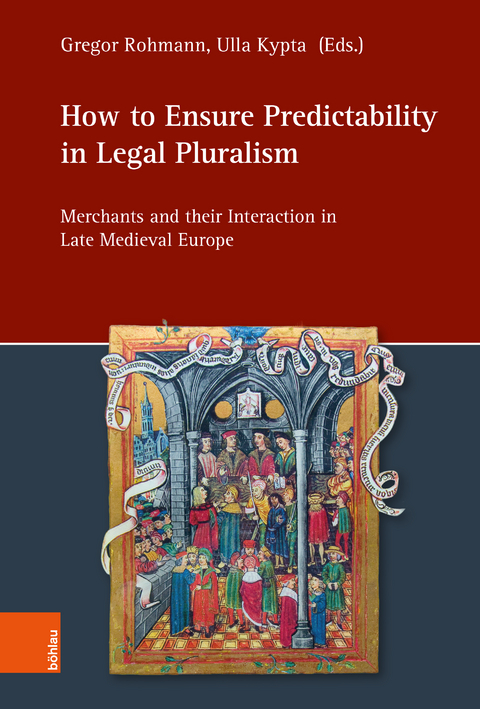
How to Ensure Predictability in Legal Pluralism
Merchants and their Interaction in Late Medieval Europe
Seiten
2025
|
1. Edition
Böhlau Köln (Verlag)
978-3-412-53376-2 (ISBN)
Böhlau Köln (Verlag)
978-3-412-53376-2 (ISBN)
How did pre-modern merchants provide for predictability in situations of legal pluralism?
How did pre-modern merchants provide for predictability in situations of legal pluralism? What kind of practices did merchants use to make other parties act according to their expectations? In spheres of legal pluralism, different normative framings always overlapped and had to be negotiated in order to manage expectations. How did the actors in premodern trade decide on the framing they would act upon? The contributors discuss various means to cope with legal pluralism in place in Northern Europe, from trust and diplomacy to violence and normative orders. Taken together, the contributions show that merchants and their communities did not strive for a unification and harmonization of laws according to modern statehood, but for an enhancement of their particular group’s position in a pluralist normative field.
How did pre-modern merchants provide for predictability in situations of legal pluralism? What kind of practices did merchants use to make other parties act according to their expectations? In spheres of legal pluralism, different normative framings always overlapped and had to be negotiated in order to manage expectations. How did the actors in premodern trade decide on the framing they would act upon? The contributors discuss various means to cope with legal pluralism in place in Northern Europe, from trust and diplomacy to violence and normative orders. Taken together, the contributions show that merchants and their communities did not strive for a unification and harmonization of laws according to modern statehood, but for an enhancement of their particular group’s position in a pluralist normative field.
Gregor Rohmann ist Professor für Regionale Kulturgeschichte Mecklenburgs an der Universität Rostock.
Ulla Kypta arbeitet als Juniorprofessorin für die Geschichte des Späten Mittelalters und der Frühen Neuzeit an der Universität Hamburg.
Matthias Berlandi is a postdoctoral research assistant at the Georg August University Göttingen.
Ulrike Ludwig ist Universitätsprofessorin für die Geschichte der Frühen Neuzeit an der WWU Münster und Ko-Direktorin des Käte Hamburger-Kollegs „Einheit und Vielfalt im Recht“.
Peter Oestmann ist Professor für Bürgerliches Recht und Deutsche Rechtsgeschichte am Institut für Rechtsgeschichte der Universität Münster.
| Erscheinungsdatum | 11.11.2025 |
|---|---|
| Reihe/Serie | Einheit und Vielfalt im Recht / Legal Unity and Pluralism ; Band 005 |
| Co-Autor | Gregor Rohmann, Ulla Kypta, Matthias Berlandi, Alexandr Osipian, Leslie Carr-Riegel, Olga Kozubska, Tobias Boestad, Gijs Dreijer, Anna Maleszka, Philipp Höhn |
| Mitarbeit |
Herausgeber (Serie): Ulrike Ludwig, Peter Oestmann |
| Verlagsort | Köln |
| Sprache | englisch |
| Maße | 160 x 235 mm |
| Gewicht | 622 g |
| Themenwelt | Geschichte ► Teilgebiete der Geschichte ► Militärgeschichte |
| Recht / Steuern ► Rechtsgeschichte | |
| Schlagworte | Anglo-Norman Law • Antwerp • armenian merchants • iura maritima • Late Medieval Anglo-Hansard Disputes • Late Medieval Trade • lex maritima • Northern Europe |
| ISBN-10 | 3-412-53376-9 / 3412533769 |
| ISBN-13 | 978-3-412-53376-2 / 9783412533762 |
| Zustand | Neuware |
| Informationen gemäß Produktsicherheitsverordnung (GPSR) | |
| Haben Sie eine Frage zum Produkt? |
Mehr entdecken
aus dem Bereich


aus dem Bereich
von der Wiederbewaffnung bis zur Zeitenwende
Buch | Softcover (2025)
C.H.Beck (Verlag)
CHF 16,80
von der Frühen Neuzeit bis zur Gegenwart
Buch | Hardcover (2025)
C.H.Beck (Verlag)
CHF 69,85


