


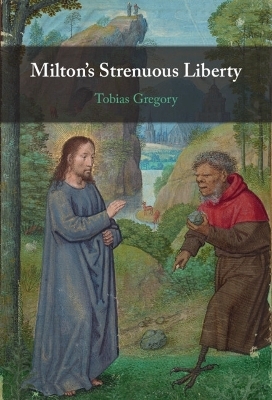
Milton's Strenuous Liberty
Seiten
2025
Cambridge University Press (Verlag)
9781009561105 (ISBN)
Cambridge University Press (Verlag)
9781009561105 (ISBN)
What motivated Milton? Tobias Gregory advances a new paradigm for Milton's shifting priorities, arguing that, at the heart of his public agenda from the early 1640s to the end of his life, there lay a concern to maximize liberty of conscience for heterodox godly lay intellectuals like himself.
What motivated John Milton? Amidst his shifting concerns, which ones moved him most deeply? These are the animating questions of Milton's Strenuous Liberty. Tobias Gregory advances a new paradigm for Milton's priorities as a heterodox, godly, lay intellectual, arguing that, at the heart of Milton's public agenda from the early 1640s to the end of his life, there lay a concern to maximize liberty of conscience. In contrast to the republican Milton prevalent in recent scholarship, Gregory presents an anticlerical Milton whose real radicalism lay in his individualistic view of the church. Milton emerges in this study as an eloquent spokesman for unpopular positions, and as a poet who, in his late masterpieces, arrived at a broader perspective on the Puritan revolution, though without ever disavowing it as a dearly-held cause.
What motivated John Milton? Amidst his shifting concerns, which ones moved him most deeply? These are the animating questions of Milton's Strenuous Liberty. Tobias Gregory advances a new paradigm for Milton's priorities as a heterodox, godly, lay intellectual, arguing that, at the heart of Milton's public agenda from the early 1640s to the end of his life, there lay a concern to maximize liberty of conscience. In contrast to the republican Milton prevalent in recent scholarship, Gregory presents an anticlerical Milton whose real radicalism lay in his individualistic view of the church. Milton emerges in this study as an eloquent spokesman for unpopular positions, and as a poet who, in his late masterpieces, arrived at a broader perspective on the Puritan revolution, though without ever disavowing it as a dearly-held cause.
Tobias Gregory is Associate Professor of English at the Catholic University of America in Washington, DC. He is the author of From Many Gods to One: Divine Action in Renaissance Epic (2006), and a contributor to the London Review of Books.
Introduction; 1. Milton's anticlericalism, part 1; 2. Milton's anticlericalism, part 2; 3. How Milton defined heresy and why; 4. Milton and the protectorate: another look at the evidence; 5. How the trouble starts in paradise lost; 6. Paradise regained and the rejection of the world; 7. The political messages of Samson Agonistes; Bibliography; Index.
| Erscheinungsdatum | 28.10.2025 |
|---|---|
| Zusatzinfo | Worked examples or Exercises |
| Verlagsort | Cambridge |
| Sprache | englisch |
| Gewicht | 501 g |
| Themenwelt | Geisteswissenschaften ► Religion / Theologie |
| Geisteswissenschaften ► Sprach- / Literaturwissenschaft ► Anglistik / Amerikanistik | |
| Geisteswissenschaften ► Sprach- / Literaturwissenschaft ► Literaturgeschichte | |
| Geisteswissenschaften ► Sprach- / Literaturwissenschaft ► Literaturwissenschaft | |
| ISBN-13 | 9781009561105 / 9781009561105 |
| Zustand | Neuware |
| Informationen gemäß Produktsicherheitsverordnung (GPSR) | |
| Haben Sie eine Frage zum Produkt? |
Mehr entdecken
aus dem Bereich



aus dem Bereich
Paul Celans Poetik der Mehrsprachigkeit
Buch | Hardcover (2025)
De Gruyter (Verlag)
CHF 153,90


