


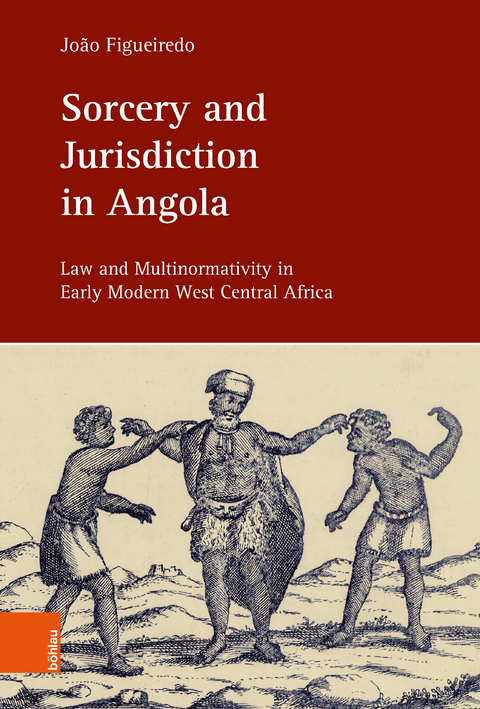
Sorcery and Jurisdiction in Angola
Law and Multinormativity in Early Modern West Central Africa
Seiten
2025
|
1. Edition
Böhlau Köln (Verlag)
978-3-412-53313-7 (ISBN)
Böhlau Köln (Verlag)
978-3-412-53313-7 (ISBN)
Jurisdiction, law, and “sorcery”
When the Portuguese arrived at the mouth of the Zaire River in 1483, two vibrant normative regimes came into contact. The European traders, missionaries, and soldiers who followed the first explorers brought a jurisdictional system of government that accepted local uses and customs as biding and a theological understanding of natural law with universalist claims. They encountered complex African societies based on various normative systems, emphasizing arbitration and mediation between corporate groups and protection against evils attributed to preternatural forms of personal agency – what the Portuguese framed as feitiçaria or sorcery. João Figueiredo focuses on the intense cross-cultural translation of normative knowledge in West Central Africa following this initial encounter. He argues it was afforded by an evolving, shared understanding of sorcery and constant renegotiation of the limits and meanings of jurisdiction, the law, and the institutions of slavery.
When the Portuguese arrived at the mouth of the Zaire River in 1483, two vibrant normative regimes came into contact. The European traders, missionaries, and soldiers who followed the first explorers brought a jurisdictional system of government that accepted local uses and customs as biding and a theological understanding of natural law with universalist claims. They encountered complex African societies based on various normative systems, emphasizing arbitration and mediation between corporate groups and protection against evils attributed to preternatural forms of personal agency – what the Portuguese framed as feitiçaria or sorcery. João Figueiredo focuses on the intense cross-cultural translation of normative knowledge in West Central Africa following this initial encounter. He argues it was afforded by an evolving, shared understanding of sorcery and constant renegotiation of the limits and meanings of jurisdiction, the law, and the institutions of slavery.
João Figueiredo ist Wissenschaftlicher Mitarbeiter am Käte Hamburger Kolleg „Einheit und Vielfalt im Recht“ der Universität Münster.
Ulrike Ludwig ist Universitätsprofessorin für die Geschichte der Frühen Neuzeit an der WWU Münster und Ko-Direktorin des Käte Hamburger-Kollegs „Einheit und Vielfalt im Recht“.
Peter Oestmann ist Professor für Bürgerliches Recht und Deutsche Rechtsgeschichte am Institut für Rechtsgeschichte der Universität Münster.
| Erscheinungsdatum | 29.07.2025 |
|---|---|
| Reihe/Serie | Einheit und Vielfalt im Recht / Legal Unity and Pluralism ; Band 003 |
| Mitarbeit |
Herausgeber (Serie): Ulrike Ludwig, Peter Oestmann |
| Zusatzinfo | incl. 10 fig. |
| Verlagsort | Köln |
| Sprache | englisch |
| Maße | 160 x 235 mm |
| Gewicht | 1031 g |
| Themenwelt | Geschichte ► Teilgebiete der Geschichte ► Militärgeschichte |
| Recht / Steuern ► Rechtsgeschichte | |
| Schlagworte | Colonialism • feitiçaria • Feitiço • Kwango • Luso-Mbangala Alliance • Mbundu Itanda • Othering • Ouvidor • Portuguese • slave trade • Zaire |
| ISBN-10 | 3-412-53313-0 / 3412533130 |
| ISBN-13 | 978-3-412-53313-7 / 9783412533137 |
| Zustand | Neuware |
| Informationen gemäß Produktsicherheitsverordnung (GPSR) | |
| Haben Sie eine Frage zum Produkt? |
Mehr entdecken
aus dem Bereich


aus dem Bereich
von der Wiederbewaffnung bis zur Zeitenwende
Buch | Softcover (2025)
C.H.Beck (Verlag)
CHF 16,80
von der Frühen Neuzeit bis zur Gegenwart
Buch | Hardcover (2025)
C.H.Beck (Verlag)
CHF 69,85


