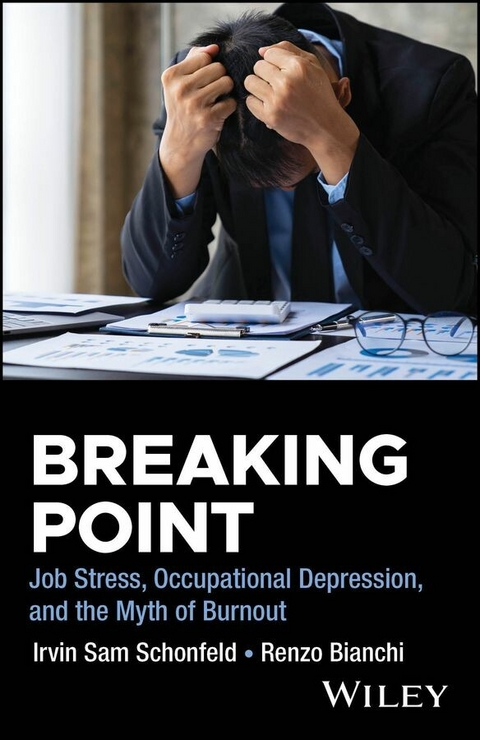
Breaking Point (eBook)
306 Seiten
Wiley (Verlag)
978-1-394-24950-3 (ISBN)
Burnout has become a popular indicator of the distress that individuals can experience at work. In Breaking Point: Job Stress, Occupational Depression, and the Myth of Burnout, the authors, in the context of more than a decade of research, show how the phenomenon hidden behind the label of burnout is, in fact, depressive in nature.
This book unravels the connections between work, depression, and burnout. The authors underline the dangers of mislabeling a depressive condition as burnout, including misdiagnosis, improper treatment, and unaddressed suicidality. Finally, they offer a path forward for individuals and society. By recognizing the depressive roots of burnout, human resources specialists and occupational health professionals can refer employees for appropriate treatment and understand how and why problematic working conditions must be changed.
- Review the history of depression and burnout and their connection to work
- Learn about research that supports occupational depression as a more valuable construct than burnout
- Understand and address the stigma that inhibits affected employees from seeking treatment
- Discover specific, research-grounded actions that occupational health specialists can take to prevent and address depression and burnout in the workplace
Irvin Sam Schonfeld is an Emeritus Professor of Psychology at The City College and Graduate Center of the City University of New York.
Renzo Bianchi is an Associate Professor of Psychology at the Norwegian University of Science and Technology, and an Extraordinary Professor of Psychology at the WorkWell Research Unit at North-West University.
Burnout has become a popular indicator of the distress that individuals can experience at work. In Breaking Point: Job Stress, Occupational Depression, and the Myth of Burnout, the authors, in the context of more than a decade of research, show how the phenomenon hidden behind the label of burnout is, in fact, depressive in nature. This book unravels the connections between work, depression, and burnout. The authors underline the dangers of mislabeling a depressive condition as burnout, including misdiagnosis, improper treatment, and unaddressed suicidality. Finally, they offer a path forward for individuals and society. By recognizing the depressive roots of burnout, human resources specialists and occupational health professionals can refer employees for appropriate treatment and understand how and why problematic working conditions must be changed. Review the history of depression and burnout and their connection to work Learn about research that supports occupational depression as a more valuable construct than burnout Understand and address the stigma that inhibits affected employees from seeking treatment Discover specific, research-grounded actions that occupational health specialists can take to prevent and address depression and burnout in the workplace
Preface
Our book has a prehistory that begins in 1991. In that year, Irvin was preparing two separate papers for national conferences, one on depression in teachers, and the other on burnout in teachers. He decided, based on his conference talks, to publish a short paper suggesting that there is more overlap between burnout and depression than many researchers suspected at that time. He published the paper in the database run by the Education Resources Information Center, better known by the acronym ERIC (Schonfeld, 1991).1 The ERIC paper did not get much play. Irvin estimated that if he were to include his wife and sister, he could safely say that three people in the world read the paper. He was soon diverted away from questions relating to burnout and depression. With one exception, other research questions called for his attention, and he did not follow up on the ERIC paper. The exception was that a University of Maryland professor whom he met at a conference colloquium asked him to write a chapter on burnout and depression for a book about stress. The Maryland professor was the book’s editor. Although Irvin wrote the chapter, unfortunately, it never got published because the publisher went out of business.
Twenty-one years after the ERIC paper was published, in December 2012, Irvin received an email from the editor of the Journal of Health Psychology. The editor asked him to review a submission. It was a time of year otherwise crowded with deadlines. Irvin was swamped with student papers to read, exams to mark, and grades to enter. And he and his wife were planning their annual New Year’s Day party. To lure reviewers, editors include an abstract of the manuscript up for review. Typically, during the reviewing process, the identities of submitters and reviewers are masked. Because he found the abstract tantalizing, awakening an interest in a subject he thought about many years earlier, he agreed to review the submission. The paper concerned three groups of French participants, a group of schoolteachers who had scores on the Maslach Burnout Inventory (MBI) that were relatively low, a group of teachers with relatively high scores on the MBI, and a group of depressed outpatients. Irvin found interesting that the depressive symptom profiles of the patients and the teachers with high burnout scores were largely similar and those two sets of symptom profiles dramatically differed from that of the teachers having low burnout scores. Irvin suggested that the authors make some small adjustments but recommended that the editor publish the paper.
After Irvin submitted his review to the editor, the month of December passed into January and January into February. He had forgotten about the paper he reviewed. Then in March 2013, he received an email from a French graduate student he did not know. The graduate student asked Irvin to collaborate on a research project. Irvin was busy and took time to think about the wording of a return-email to politely decline the graduate student’s request without hurting the student’s feelings.
Before he drafted that return email, he received a second email from the graduate student. Attached to the email was a PDF. To Irvin’s surprise, the PDF contained an updated version of the paper he reviewed back in December. The paper had been accepted for publication.2 The graduate student was Renzo. The paper demonstrated Renzo’s bona fides. To Irvin, Renzo was the Real McCoy. Irvin agreed to collaborate with Renzo. That would be the beginning of a collaboration that has endured more than a decade.
Irvin knew that he was scheduled to spend a few days in Paris in July 2013, before traveling to Ferrara, Italy, to see an old friend. Renzo was still at his university in Besançon. The two of us arranged to meet in person in Paris and work on an ambitious paper on burnout–depression overlap. Éric Laurent, a professor at Bourgogne Franche-Comté University, the institution that in 2014 would award Renzo a doctorate, also contributed to that paper. Also in 2014, the International Journal of Stress Management published the paper.3 The Journals Office of the American Psychological Association wrote to tell us that the paper received a great deal of interest on the APA’s Facebook site, and the paper was spotlighted by the APA Center for Organizational Excellence. We knew we were onto something important. We rapidly published several additional papers.
We saw each other in person again in July 2015, in Besançon. During that visit, Irvin got to see some of the sites in eastern France and the Suisse romande (e.g., la Citadelle, the homes of Victor Hugo and the Lumiere brothers, and the Collegiate Church in Neuchâtel). Renzo and Irvin, however, spent considerable time drafting a proposal to CUNY’s human subjects committee, seeking approval for a study they were planning to run in the United States. That human-subjects proposal eventually led to a study of burnout and depression that was published in the Journal of Clinical Psychology in 2016.4 We were making progress.
We have thus been research collaborators since 2013. We have dedicated countless hours of work to clarify the burnout case, trying to address the issue as comprehensively as we could. Our work has resulted in dozens of studies and papers over the years. We are grateful for the sustained interest that our research has elicited not only among the scientific and medical communities but also among organizations and the public.
In the spring of 2023, Irvin received a request from an editor at John Wiley, asking him to review another author’s book proposal about burnout. He read the proposal and wrote what he thought was a fair and thorough review. Some weeks after he sent the review to the editor, he received another email from the editor. In this email the editor asked Irvin to submit his own book proposal. Irvin asked Renzo if he would be willing to be a partner in writing the proposal and, if the proposal were accepted, to coauthor the proposed book. Upon Renzo’s agreeing, Irvin got permission from Wiley to have Renzo as an equal partner in writing the proposal and the book the proposal mapped out.
We don’t take for granted that we owe a great deal to modern communication networks. In writing the book, Irvin has mostly worked in Brooklyn, occasionally at the CUNY Graduate Center (kitty-corner from the Empire State Building), Great Neck, New York (less than a mile from the house where Scott Fitzgerald wrote the first chapters of Gatsby), and, very occasionally, in Minnesota. Renzo worked in Trondheim, Norway and, from time to time, in Geneva, Switzerland. Although sometimes we communicated via Zoom, we mostly collaborated via email with chunks of text and commentary on the text sailing back and forth day by day, often multiple times in a day. We occasionally had disagreements, which we strove to work out. We take pride in our endeavor because we believe that our work will further the efforts of governments, labor unions, and organizations to protect the health of workers. Workers don’t become depressed because there is something in the air. Sometimes elevations in workers’ depressive symptoms result from bad job conditions. Our goal is not just to show burnout’s overlap with depression and warn against the dangers of its neglect. We also want to underscore the importance of improving working conditions such that job-related depression will be rare and helping workers who have already become depressed to recover.
We organized the book into five chapters. The first provides the reader with a brief (and necessarily partial) history of the very long arc of human knowledge of the condition identified as depression. Within the context of that arc, we show how research has linked depressive conditions to life adversity, including adverse working conditions. The second chapter is devoted to the construct known as burnout, the history of which is millennia shorter than the history of our familiarity with depression. However, from the get-go, burnout has been viewed as a work-related phenomenon and a product of contemporary changes in the economy and the labor market—very much like neurasthenia one century earlier. The third chapter lays out the research on burnout–depression overlap, with an emphasis on our own research efforts. Focusing on burnout–depression overlap allows us to examine the nature of the burnout phenomenon further. The fourth chapter concerns the stigma attached to mental (ill-)health in general, and burnout and depression in particular. The aim of the fifth and final chapter is to show what we can do to help affected workers and prevent more workers from becoming distressed.
We sought to make the book appealing to both professionals (e.g., clinicians, researchers, academics, and graduate students) and educated nonspecialist readers. For the nonspecialists we created two sections, one in Chapter 2 and the other in Chapter 5, that explain in ordinary language some of the technical aspects of the research we review. We also used footnotes at specific junctures in the book to help nonspecialists if that help is needed.
The research we present has excited us. We hope that through this book our sense of excitement carries over to our readers. But ultimately, our foremost desire is that our book be an instrument that helps to make better the lives of people who work.
We thank a number of individuals who helped us with the writing and publication of this book. First, we thank Wiley’s Nathanael Mcgavin and Kelly Gomez, who were very helpful in providing...
| Erscheint lt. Verlag | 20.5.2025 |
|---|---|
| Sprache | englisch |
| Themenwelt | Geisteswissenschaften ► Psychologie ► Allgemeines / Lexika |
| Schlagworte | Burnout • Depression • occupational burnout • occupational depression • Occupational Health • Occupational Health Psychology • prevention • Working conditions |
| ISBN-10 | 1-394-24950-0 / 1394249500 |
| ISBN-13 | 978-1-394-24950-3 / 9781394249503 |
| Informationen gemäß Produktsicherheitsverordnung (GPSR) | |
| Haben Sie eine Frage zum Produkt? |
 EPUB (Adobe DRM)
Kopierschutz: Adobe-DRM
Adobe-DRM ist ein Kopierschutz, der das eBook vor Mißbrauch schützen soll. Dabei wird das eBook bereits beim Download auf Ihre persönliche Adobe-ID autorisiert. Lesen können Sie das eBook dann nur auf den Geräten, welche ebenfalls auf Ihre Adobe-ID registriert sind.
Details zum Adobe-DRM
Dateiformat: EPUB (Electronic Publication)
EPUB ist ein offener Standard für eBooks und eignet sich besonders zur Darstellung von Belletristik und Sachbüchern. Der Fließtext wird dynamisch an die Display- und Schriftgröße angepasst. Auch für mobile Lesegeräte ist EPUB daher gut geeignet.
Systemvoraussetzungen:
PC/Mac: Mit einem PC oder Mac können Sie dieses eBook lesen. Sie benötigen eine
eReader: Dieses eBook kann mit (fast) allen eBook-Readern gelesen werden. Mit dem amazon-Kindle ist es aber nicht kompatibel.
Smartphone/Tablet: Egal ob Apple oder Android, dieses eBook können Sie lesen. Sie benötigen eine
Geräteliste und zusätzliche Hinweise
Buying eBooks from abroad
For tax law reasons we can sell eBooks just within Germany and Switzerland. Regrettably we cannot fulfill eBook-orders from other countries.
aus dem Bereich