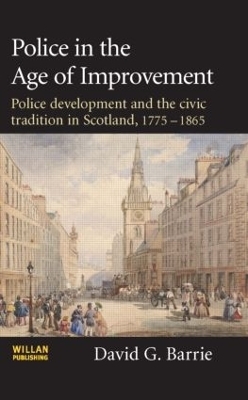
Police in the Age of Improvement
Willan Publishing (Verlag)
978-1-84392-266-7 (ISBN)
The study of police history in Scotland has largely been neglected. Little is known about the Scottish police's origins, development and character despite growing interest in the machinery of law enforcement in other parts of the United Kingdom. This book seeks to remedy this deficiency.
Based on extensive archival research, its central aim is to provide an in-depth analysis of the economic, social, intellectual and political factors that shaped police reform, development and policy in Scottish burghs during the 'Age of Improvement'. The key issues addressed include: the workings of traditional forms of law enforcement and why these were increasingly deemed to be unsuitable by the late eighteenth and early nineteenth centuries; why, and in what ways, the pattern, nature and origins of police development in urban Scotland differed from elsewhere in Britain; in what ways the Scottish police model compared and contrasted with other British models; the impact of police reform on urban governance and the struggle between social groups for control of the local state; the concerns and priorities behind police policy.
In addressing these questions, Police in the Age of Improvement moves beyond many of the 'problem-response' interpretations which have preoccupied many police historians, and locates reform within the wider contexts of urban improvement, municipal administration and Scottish Enlightenment thought. It will be essential reading for anyone interested in the history of policing, urban management and social change in the late eighteenth and nineteenth centuries.
David Barrie is a Lecturer in History at the University of Western Australia. His research interests include eighteenth and nineteenth century criminal justice history, urban history, and the history of masculinity.
1. Introduction Introduction. The Scottish experience. A curious neglect. Research focus and its historiographical context. The 'police' concept in Scotland in the eighteenth and nineteenth centuries 2. Policing before the police: law enforcement in the late eighteenth century Introduction. Constables, town officers and magistrates. Urban challenges and policing initiatives. Watching and warding. Prosecution and the local courts. Godly discipline. Conclusion 3. Politics, pressures and policing initiatives: Glasgow in the Age of Enlightenment, 1779-1800 Introduction. Early initiatives and proposals, 1779-88. The politics of reform, 1789-92. The fall and rise of policing in Glasgow, 1793-1800. The influence and legacy of Patrick Colquhoun. Ideas and Enlightenment. Conclusion 4. Urban challenges and new expectations: police origins and the pattern of adoption, 1800-32 Introduction. Urban growth and the pattern of adoption, 1800-32. Crime, disorder and professionalisation. Urban improvement. Expanding the municipal machine. Conclusion 5. Conflict and consensus: framing the model of urban management, 1800-32 Introduction. Conflict and conciliation. An uneasy consensus? Urban democracy in civil society. Conclusion 6. Pioneers in police? The police model and its historical significance, 1800-33 Introduction. Structure, organisation and significance. Links with the past Post-war tensions, reform and improvement. Conclusion 7. National legislation and the state of burgh policing at mid century, 1833-62 Introduction. National burgh statutes, 1833-62. County developments, 1839-57. Scottish burgh policing at mid century. Conclusion 8. Policing the Scottish city, 1800-48 Introduction. Vagrancy and the urban poor. Pastimes, behaviour and morality. Crowd control, industrial militancy and political policing, 1821-48. Conclusion 9. Towards incorporation: changing attitudes towards urban administration and challenges to elected police commissions, 1833-64 Introduction. Changing attitudes and pressures for reform. Hotbeds of radicalism? The social composition and political outlook of Police. Commissions. Opposition, apathy and exclusion. Conclusion 10. Conclusion. Appendix I: Social status classifications of police commissioners' occupational profiles. Appendix II: Selection of amended police constitutions, 1800-33
| Erscheint lt. Verlag | 1.5.2008 |
|---|---|
| Verlagsort | Cullompton |
| Sprache | englisch |
| Maße | 156 x 234 mm |
| Gewicht | 725 g |
| Themenwelt | Geschichte ► Teilgebiete der Geschichte ► Kulturgeschichte |
| Recht / Steuern ► Strafrecht ► Kriminologie | |
| Sozialwissenschaften ► Soziologie | |
| ISBN-10 | 1-84392-266-5 / 1843922665 |
| ISBN-13 | 978-1-84392-266-7 / 9781843922667 |
| Zustand | Neuware |
| Informationen gemäß Produktsicherheitsverordnung (GPSR) | |
| Haben Sie eine Frage zum Produkt? |
aus dem Bereich