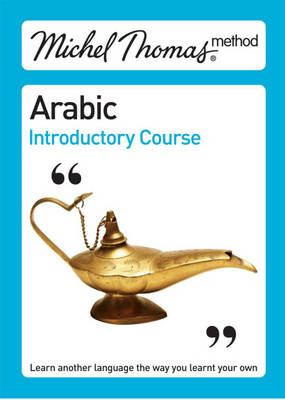
Michel Thomas Method
John Murray Learning (Verlag)
978-0-340-95728-8 (ISBN)
- Titel ist leider vergriffen;
keine Neuauflage - Artikel merken
Learn another language the way you learnt your own You learnt your own language naturally and enjoyably: now you can learn Arabic in the same way. You'll stick with it because you'll love it * Use the unique method perfected over fifty years by the celebrated psychologist and linguist Michel Thomas. * This method works with your brain, helping you to build up your Arabic in manageable, enjoyable steps by thinking out the answers for yourself. * You learn through listening and speaking -- without the pressure of writing or memorising. * You pick up the language naturally and unforgettably. The NEW Arabic Introductory Course This is the first two hours of the eight-hour Arabic Foundation Course. Join teacher Jane Wightwick and native speaker Mahmoud Gaafar and two students in a live lesson and within the first hour you will be able to construct simple phrases. You will learn the language with the students, hearing both their successes and their mistakes to keep you motivated and involved throughout the course.
Join the millions of people worldwide who have learnt a new language with the Michel Thomas Method Contents: 2 CDs plus booklet with Arabic phrases in English translation and transliterated into Roman script
Jane Wightwick is an experienced teacher of Arabic and author and publisher of Arabic-teaching materials. Mahmoud Gaafar worked for the United Nations and Radio Cairo and now authors print, radio and TV resources for the Arab world.
Introduction; how the course works History and development of the Arabic language. Standard Arabic and spoken dialects. Similarities. Position of Egyptian as most understood dialect. Instant vocabulary of English / European words adopted into Arabic English / European words slightly adapted to Arabic speech patterns Arabic words taken into English Basic requests using "mumkin - possible" No words for "a / an" in Arabic. "weh - and" Pronoun "I - ena". No word for "am / is / are" in Arabic. Arabic distinguishes masculine and feminine "you - enta / enti" Use inflexion for questions. "-a" = feminine ending. Adjective (descriptive word) endings Arabic uses "wanting - cawwiz " for "I want / you want" etc. Behaves like adjective Pronouns "he / she - huwwa / heyya" "the" = "il". "l" of "il" sometimes absorbed into following consonant Arabic "going (to) - raayiH", "coming (to) - gayy". No word needed for "to". Sentences using "alashen - because" Word order with question words (e.g. "where - fayn") Arabic possessive adjectives ("my" etc.) are tagged on to the end of the word they describe
| Erscheint lt. Verlag | 1.11.2007 |
|---|---|
| Reihe/Serie | Michel Thomas Method |
| Sprache | englisch |
| Maße | 135 x 190 mm |
| Gewicht | 142 g |
| Themenwelt | Schulbuch / Wörterbuch ► Erwachsenenbildung |
| Schulbuch / Wörterbuch ► Wörterbuch / Fremdsprachen | |
| Geisteswissenschaften ► Sprach- / Literaturwissenschaft ► Sprachwissenschaft | |
| ISBN-10 | 0-340-95728-X / 034095728X |
| ISBN-13 | 978-0-340-95728-8 / 9780340957288 |
| Zustand | Neuware |
| Informationen gemäß Produktsicherheitsverordnung (GPSR) | |
| Haben Sie eine Frage zum Produkt? |
aus dem Bereich