Censoring Sex
Rowman & Littlefield (Verlag)
978-0-7425-5132-9 (ISBN)
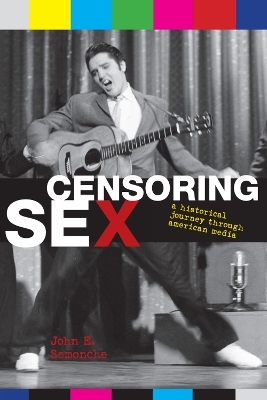
In this gracefully written, accessible and entertaining volume, John Semonche surveys censorship for reasons of sex from the nineteenth century up to the present. He covers the various forms of American media—books and periodicals, pictorial art, motion pictures, music and dance, and radio, television, and the Internet. The tale is varied and interesting, replete with a stock of colorful characters such as Anthony Comstock, Mae West, Theodore Dreiser, Marcel Duchamp, Opie and Anthony, Judy Blume, Jerry Falwell, Alfred Kinsey, Hugh Hefner, and the Guerilla Girls. Covering the history of censorship of sexual ideas and images is one way of telling the story of modern America, and Semonche tells that tale with insight and flair. Despite the varieties of censorship, running from self-censorship to government bans, a common story is told. Censorship, whether undertaken to ward off government regulation, to help preserve the social order, or to protect the weak and vulnerable, proceeds on the assumption that the censor knows best and that limiting the choices of media consumers is justified. At various times all of the following groups were perceived as needing protection from sexually explicit materials: children, women, the lower classes, and foreigners. As social and political conditions changed, however, the simple fact that someone was a woman or a day laborer did not support stereotyping that person as weak or impressionable. What would remain as the only acceptable rationale for censorship of sexual materials was the protection of children and unconsenting adults. For each mode of media, Semonche explains via abundant examples how and why censorship took place in America. Censoring Sex also traces the story of how the cultural territory contested by those advocating and opposing censorship has diminished over the course of the last two centuries. Yet, Semonche argues, the censorship of sexual materials that continues in the United States poses a challenge to the free speech that is part of the foundation upon which the nation is built. Indeed, in an era in which sexual images are pervasive and the need for reliable information about sex and sexuality is growing, he questions the remaining rationales for censorship and the justification for placing obscenity outside the protection of the U. S. Constitution.
John E. Semonche is professor of history at the University of North Carolina, Chapel Hill. An authority on American constitutional and legal history, he is the author of numerous articles and books, including Keeping the Faith: A Cultural History of the U.S. Supreme Court and Religion and Constitutional Government in the United States.
1 Introduction
Chapter 2 1. Books and Periodicals: Seduction by the Written Word and Maybe a Picture or Two
Chapter 3 2. Paintings, Sculptures, and Other Pictorial Arts: You Call Dirty Pictures Art?
Chapter 4 3. The Movies: Teaching the Wrong Lessons and in the Dark As Well
Chapter 5 4. Music and Dance: Stirring the Senses and Unleashing the Beast
Chapter 6 5. Radio, Television, and the Internet: Home Invaders
7 Epilogue
| Erscheint lt. Verlag | 20.9.2007 |
|---|---|
| Sprache | englisch |
| Maße | 157 x 230 mm |
| Gewicht | 499 g |
| Themenwelt | Geisteswissenschaften ► Geschichte ► Regional- / Ländergeschichte |
| Geschichte ► Teilgebiete der Geschichte ► Kulturgeschichte | |
| Sozialwissenschaften ► Kommunikation / Medien ► Medienwissenschaft | |
| Sozialwissenschaften ► Soziologie | |
| ISBN-10 | 0-7425-5132-6 / 0742551326 |
| ISBN-13 | 978-0-7425-5132-9 / 9780742551329 |
| Zustand | Neuware |
| Informationen gemäß Produktsicherheitsverordnung (GPSR) | |
| Haben Sie eine Frage zum Produkt? |
aus dem Bereich