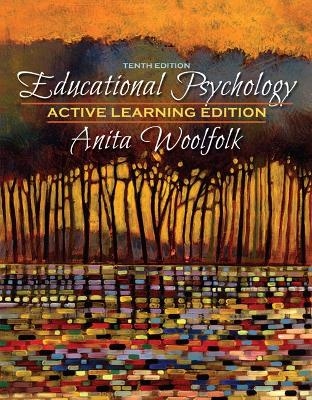
Educational Psychology, Active Learning Edition
Pearson (Verlag)
9780205542789 (ISBN)
- Titel erscheint in neuer Auflage
- Artikel merken
Anita Woolfolk Hoy received her BA Magna Cum Laude in 1969 from the University of Texas at Austin, with a major in Psychology and a minor in Chemistry. In 1972 she was awarded a Ph.D. in Educational Psychology from the same university. From 1973 to 1993 she was on the faculty of the Department of Educational Psychology (Chair 1990-1993) of the Graduate School of Education, Rutgers University. Currently she is a Professor in the College of Education, The Ohio State University, Columbus, Ohio. Her professional offices include Vice-President for Division K (Teaching & Teacher Education) of the American Educational Research Association and President of Division 15 (Educational Psychology) of the American Psychological Association. Currently, she is editor of Theory Into Practice, a journal that provides multiple perspectives and scholarly discussions of issues that concern educators. Professor Woolfolk Hoy has published research in the areas of teacher cognition, student perceptions of teachers, teachers’ beliefs, student motivation, and the application of educational psychology to teaching. Her work appears in the Journal of Educational Psychology, American Educational Research Journal, Review of Research in Education, Teaching and Teacher Education, the Elementary School Journal, Action in Teacher Education, Teachers College Record, Educational Researcher, and theEducational Psychologist. Her text, Educational Psychology (Allyn and Bacon), is in its 10th edition and is the most widely read introduction to educational psychology in the field. She is married to Wayne K. Hoy, the Novice Fawcett Chair in Educational Administration at The Ohio State University. Together have completed the 3rd edition of Instructional Leadership: A Research-Based Guide to Learning in Schools (Allyn & Bacon) and conduct research on teacher and school efficacy. They have three children: Wayne, President of Advanced Software Products; Kelly, a teacher at The Phillips Brooks School in Menlo Park, CA; and Liz, a student in Columbus, OH. Their insights about education are frequently volunteered and greatly appreciated.
<>Preface: How to Use This Book.
I. TEACHERS, TEACHING AND EDUCATIONAL PSYCHOLOGY.
1. Educational Psychology for Teachers.
II. COGNITIVE DEVELOPMENT AND LANGUAGE.
2. Development: Some General Principles.
3. Piaget's Theory of Cognitive Development.
4. Vygotsky's Sociocultural Perspective.
5. Implications of Piaget and Vygotsky for Teachers.
III. PERSONAL, SOCIAL AND MORAL DEVELOPMENT.
6. Understanding Ourselves and Others.
7. Socialization: Family, Peers, and Teachers.
8. Moral Development.
IV. LEARNER DIFFERENCES AND LEARNING NEEDS.
9. Individual Differences: Intelligence, Cognitive Processing, and Learning Styles.
10. Integration and Inclusion: Teaching Every Child.
11. Ability Differences and Teaching.
V. CULTURE AND COMMUNITY.
12. Diversity in Today's Classrooms.
13. Girls and Boys: Differences in the Classroom.
14. Creating Culturally Compatible Classrooms.
VI. BEHAVIORAL VIEWS OF LEARNING.
15. Behavioral Explanations of Learning: Contiguity, Classical Conditioning, Operant Conditioning.
16. Applied Behavior Analysis.
17. Observational Learning and Cognitive Behavior Modification.
VII. COGNITIVE VIEWS OF LEARNING.
18. Elements of the Cognitive Perspective: Information Processing.
19. Long-Term Memory: The Goal of Teaching.
20. Cognition and Metacognition.
VIII. COMPLEX COGNITIVE PROCESSES.
21. Learning and Teaching About Concepts.
22. Problem Solving and Creativity.
23. Teaching for Transfer.
IX. SOCIAL COGNITIVE AND CONSTRUCTIVIST VIEWS OF LEARNING.
24. Social Learning and Social Cognitive Theories.
25. Cognitive and Social Constructivism.
26. Applications of Constructivist and Situated Perspectives on Learning.
X. MOTIVATION IN LEARNING AND TEACHING.
27. Motivation: A Definition and Four General Approaches.
28. Needs, Goals, Interests and Emotions.
29. Beliefs and Self-Schemas.
30. Motivation to Learn in School.
XI. Engaged Learning: Cooperation and Communication.
31. Social Processes and Cooperation.
32. Creativity and Community.
XII. CREATING LEARNING ENVIRONMENTS.
33. Creating a Positive Learning Environment.
34. Maintaining a Good Environment for Learning.
35. The Need for Communication.
XIII. TEACHING FOR ACADEMIC LEARNING.
36. The First Step: Planning.
37. VTeacher-Directed Instruction.
38. Student-Centered Teaching in Content Areas and Inclusive Classrooms.
XIV. EVALUATION, MEASUREMENT AND ASSESSMENT.
39. Definitions and Concepts.
40. Standardized Tests.
41. Issues and New Directions in Standardized Testing.
42. Getting the Most from Traditional Classroom Assessment Approaches: Testing and Grading.
43. Innovations in Classroom Assessment.
Appendix I: Becoming a Professional: Passing the PRAXIS(tm), Insights About Job Interview Questions, Creating Your Teaching Portfolio, Enhancing Your Expertise With Technology.
Appendix II: Standards and Licensure: PRAXIS II(tm) and INTASC.
Appendix III: Technology Resources for Active Learning Connections
Glossary.
References.
Index.
| Erscheint lt. Verlag | 16.7.2007 |
|---|---|
| Sprache | englisch |
| Maße | 275 x 215 mm |
| Gewicht | 1606 g |
| Themenwelt | Geisteswissenschaften ► Psychologie ► Pädagogische Psychologie |
| ISBN-13 | 9780205542789 / 9780205542789 |
| Zustand | Neuware |
| Informationen gemäß Produktsicherheitsverordnung (GPSR) | |
| Haben Sie eine Frage zum Produkt? |
aus dem Bereich