


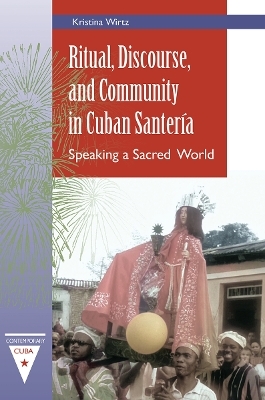
Ritual, Discourse, and Community in Cuban Santeria
Speaking a Sacred World
Seiten
2007
University Press of Florida (Verlag)
978-0-8130-3064-7 (ISBN)
University Press of Florida (Verlag)
978-0-8130-3064-7 (ISBN)
- Titel ist leider vergriffen;
keine Neuauflage - Artikel merken
How do Santeria practitioners in Cuba create and maintain religious communities amidst disagreements and competition among them? Examining the religious lives of santeros in Santiago de Cuba, this book argues that these communities hold together not because members agree on their interpretations of rituals but because they often disagree.
How do Santeria practitioners in Cuba create and maintain religious communities amidst tensions, disagreements, and competition among them, and in the absence of centralized institutional authority? What serves as the ""glue"" that holds practitioners of different backgrounds together in the creation of a moral community? Examining the religious lives of santeros in Santiago de Cuba, Wirtz argues that these communities hold together not because members agree on their interpretations of rituals but because they often disagree. Religious life is marked by a series of ""telling moments"" - not only the moments themselves but their narrated representations as they are retold and mined for religious meanings. Long after they occur, spiritually elevated experiences circulate in narratives that may express skepticism or awe and hold the promise of more such experiences. The author finds that these episodes resonate in gossip and other forms of public commentary about the experiences of their fellow Santeria practitioners. Drawing on ethnographic research about Santeria beliefs and practices, Wirtz observes that practitioners are constantly engaged in reflection about what they and other practitioners are doing, how the orichas (deities) have responded, and what the consequences of their actions were or will be. By focusing their reflective attention on particular events, santeros re-create, moment to moment, what their religion is. Wirtz also argues that Santeria cannot be considered in isolation from the complex religious landscape of contemporary Cuba, in which African-based traditions are viewed with a mix of fascination, folkloric pride, and suspicion.
How do Santeria practitioners in Cuba create and maintain religious communities amidst tensions, disagreements, and competition among them, and in the absence of centralized institutional authority? What serves as the ""glue"" that holds practitioners of different backgrounds together in the creation of a moral community? Examining the religious lives of santeros in Santiago de Cuba, Wirtz argues that these communities hold together not because members agree on their interpretations of rituals but because they often disagree. Religious life is marked by a series of ""telling moments"" - not only the moments themselves but their narrated representations as they are retold and mined for religious meanings. Long after they occur, spiritually elevated experiences circulate in narratives that may express skepticism or awe and hold the promise of more such experiences. The author finds that these episodes resonate in gossip and other forms of public commentary about the experiences of their fellow Santeria practitioners. Drawing on ethnographic research about Santeria beliefs and practices, Wirtz observes that practitioners are constantly engaged in reflection about what they and other practitioners are doing, how the orichas (deities) have responded, and what the consequences of their actions were or will be. By focusing their reflective attention on particular events, santeros re-create, moment to moment, what their religion is. Wirtz also argues that Santeria cannot be considered in isolation from the complex religious landscape of contemporary Cuba, in which African-based traditions are viewed with a mix of fascination, folkloric pride, and suspicion.
Kristina Wirtz is assistant professor of anthropology at Western Michigan University.
| Erscheint lt. Verlag | 30.7.2007 |
|---|---|
| Reihe/Serie | Contemporary Cuba |
| Zusatzinfo | 26 b&w figures, notes, bibliography, index |
| Verlagsort | Florida |
| Sprache | englisch |
| Maße | 165 x 235 mm |
| Gewicht | 583 g |
| Themenwelt | Geisteswissenschaften ► Religion / Theologie ► Weitere Religionen |
| Sozialwissenschaften ► Ethnologie | |
| Sozialwissenschaften ► Soziologie ► Spezielle Soziologien | |
| ISBN-10 | 0-8130-3064-1 / 0813030641 |
| ISBN-13 | 978-0-8130-3064-7 / 9780813030647 |
| Zustand | Neuware |
| Informationen gemäß Produktsicherheitsverordnung (GPSR) | |
| Haben Sie eine Frage zum Produkt? |
Mehr entdecken
aus dem Bereich

aus dem Bereich


