


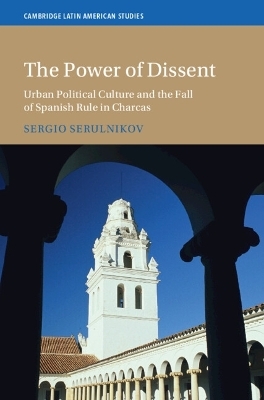
The Power of Dissent
Urban Political Culture and the Fall of Spanish Rule in Charcas
Seiten
2025
Cambridge University Press (Verlag)
978-1-009-61007-0 (ISBN)
Cambridge University Press (Verlag)
978-1-009-61007-0 (ISBN)
This book explores the crisis of Spanish rule through the advent of a culture of popular contestation and dissent in Chuquisaca, the most important city in the southern Andes, in the decades preceding the wars of independence. It will interest students and scholars of Latin American history and the age of Atlantic revolutions.
The Power of Dissent examines the crisis of Spanish rule through the changing political culture of Chuquisaca (Bolivia), the most important city in the southern Andes. Sergio Serulnikov argues that in the four decades preceding the nineteenth-century wars of independence, a vibrant political public sphere emerged, both patrician and plebeian. It manifested itself in a variety of social domains: protracted legal battles, collective petitions, popular revolts, the culture of manly honor, disputes over the rights of city council members and university faculty to hold free annual elections to choose their authorities, clashes between urban militias and Spanish soldiers, and contested public ceremonies and rituals of state power. In the process, a discernible aspiration took shape: the full participation of the local population in public affairs. The culture of dissent undermined the very premises of Bourbon absolutism and, more broadly, imperial control.
The Power of Dissent examines the crisis of Spanish rule through the changing political culture of Chuquisaca (Bolivia), the most important city in the southern Andes. Sergio Serulnikov argues that in the four decades preceding the nineteenth-century wars of independence, a vibrant political public sphere emerged, both patrician and plebeian. It manifested itself in a variety of social domains: protracted legal battles, collective petitions, popular revolts, the culture of manly honor, disputes over the rights of city council members and university faculty to hold free annual elections to choose their authorities, clashes between urban militias and Spanish soldiers, and contested public ceremonies and rituals of state power. In the process, a discernible aspiration took shape: the full participation of the local population in public affairs. The culture of dissent undermined the very premises of Bourbon absolutism and, more broadly, imperial control.
Sergio Serulnikov is Professor at the Universidad de San Andrés and researcher at the National Scientific Council of Argentina. He is author of Subverting Colonial Authority: Challenges to Spanish Rule in Eighteenth-Century Southern Andes (2003).
Introductory essay: politics and society in the late colonial world, historiographical dialogues; 1. Citizens and magistrates; 2. Public dissension; 3. The paradoxes of loyalty; 4. The revolt against the company of savoy; 5. The revolt against the company of Extremadura; 6. The election of a rector; 7. Suppressing politics; 8. Contentious autonomies; 9. The crisis before the crisis; 10. The uses of carlotism; 11. The uprising; which revolution? final considerations; Bibliography.
| Erscheinungsdatum | 26.07.2025 |
|---|---|
| Reihe/Serie | Cambridge Latin American Studies |
| Zusatzinfo | Worked examples or Exercises |
| Verlagsort | Cambridge |
| Sprache | englisch |
| Themenwelt | Geschichte ► Allgemeine Geschichte ► Neuzeit (bis 1918) |
| Geisteswissenschaften ► Geschichte ► Regional- / Ländergeschichte | |
| ISBN-10 | 1-009-61007-4 / 1009610074 |
| ISBN-13 | 978-1-009-61007-0 / 9781009610070 |
| Zustand | Neuware |
| Informationen gemäß Produktsicherheitsverordnung (GPSR) | |
| Haben Sie eine Frage zum Produkt? |
Mehr entdecken
aus dem Bereich

aus dem Bereich
Geschichte einer wilden Handlung
Buch | Hardcover (2024)
C.H.Beck (Verlag)
CHF 47,60


